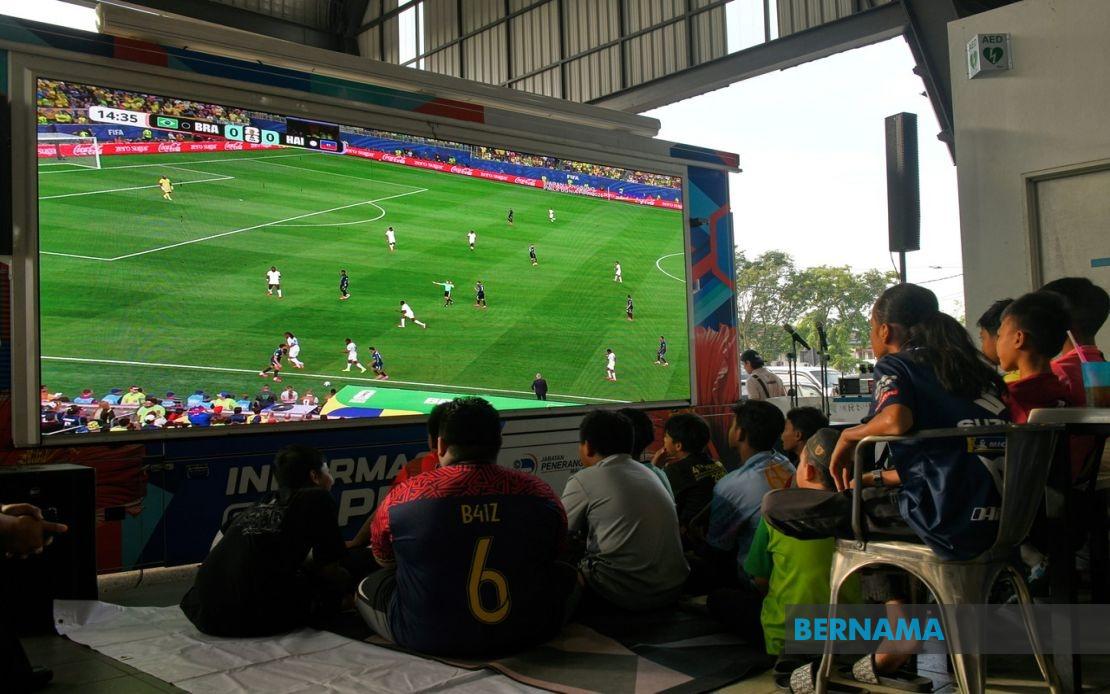
Communications Minister Datuk Fahmi Fadzil has highlighted the tangible benefits of the government's decision to provide free 2026 FIFA World Cup broadcasts through Radio Televisyen Malaysia and Unifi TV, citing positive feedback from business owners and the general public who have welcomed the initiative as a means to manage rising operational expenses. The announcement underscores a broader strategy by the Malaysian government to make premium sporting content accessible without burdening households and commercial establishments during economically challenging times.
During a visit to the Seberang Jaya Public Market food court in Butterworth, Fahmi engaged directly with traders and diners, gathering real-time insights into how the free broadcast arrangement is reshaping consumer spending patterns and business profitability. The Malaysian Muslim Restaurant Owners Association has been particularly vocal in endorsing the initiative, communicating to Fahmi that the provision of free matches represents substantial operational savings that would otherwise cut into already-thin profit margins in the competitive food and beverage sector.
One trader shared a particularly striking observation with the minister, noting that this marks the first occasion in over two decades that he has been able to present World Cup matches to customers without incurring prohibitive broadcast licensing fees. This detail encapsulates the cumulative financial burden that sports broadcasting rights have historically imposed on small and medium-sized enterprises across Malaysia, particularly in the hospitality and food service industries that depend on live sports content to attract and retain customers during major tournaments.
The availability of matches across multiple platforms—RTM's traditional television service, the digital RTMKlik streaming service, and Unifi TV—has ensured widespread accessibility across different demographic and socioeconomic segments. This multi-platform approach addresses both rural and urban audiences, as well as households with varying levels of digital infrastructure, thereby maximizing the public benefit of the government's investment in securing broadcasting rights. For restaurant operators, the free-to-air model eliminates the need to negotiate expensive commercial broadcast subscriptions or navigate complex licensing arrangements that previously constrained their ability to showcase matches.
Fahmi articulated an economic rationale extending beyond immediate cost reduction, framing the initiative as a catalyst for increased customer traffic and revenue generation within food establishments. By removing the financial barrier to broadcasting matches, restaurants and food courts can leverage the cultural significance and broad appeal of World Cup football to draw larger crowds, potentially offsetting initial revenue anxieties and creating a multiplier effect throughout the hospitality sector. This approach recognizes that major sporting events function as anchor attractions capable of driving footfall and incremental spending across food, beverages, and ancillary services.
Beyond the immediate sports broadcasting context, Fahmi's Butterworth visit served a broader purpose of gathering ground-level intelligence on trader challenges and business sentiment in Penang. By personally visiting market stalls, observing trading conditions, and conducting informal consultations with vendors, the minister sought to understand firsthand the operational pressures facing small businesses navigating an increasingly constrained economic environment. This direct engagement methodology contrasts with remote policy-making and underscores the government's stated commitment to evidence-based decision-making grounded in authentic stakeholder experiences.
The minister subsequently committed to channeling the feedback collected during this market visit to Prime Minister Datuk Seri Anwar Ibrahim and Penang Chief Minister Chow Kon Yeow, suggesting that trader concerns will receive high-level policy attention. This escalation pathway indicates that the issues identified—ranging from broadcasting costs to broader operational challenges—are being treated as matters warranting ministerial and executive consideration rather than being confined to sectoral discussions.
Fahmi further emphasized the cascading economic impact of geopolitical instability in West Asia, which has manifested in Malaysia through elevated costs for certain imported goods and commodities. The conflict's inflationary effects are creating compounding pressure on traders already managing thin margins, suggesting that cost-reduction initiatives like free World Cup broadcasts serve as partial countermeasures to broader macroeconomic headwinds beyond government control. This contextualizes the free broadcast initiative within a wider framework of government support for businesses facing imported inflation and supply-chain disruptions.
The minister's call for increased ministerial and parliamentary visibility at grassroots level represents an implicit critique of governance patterns wherein senior officials maintain distance from traders and communities. By advocating that cabinet ministers, Members of Parliament, and state assemblymen regularly conduct market visits and engage traders directly, Fahmi is promoting a governance model emphasizing accountability, situational awareness, and responsiveness to constituent needs. This emphasis on ground-level engagement aligns with contemporary expectations of accessible, people-centered governance and acknowledges that policy effectiveness depends on understanding real-world implementation challenges.
For Malaysian households and food service businesses, the free World Cup broadcasting initiative represents tangible relief during a period characterized by cost-of-living pressures stemming from both domestic inflation and imported price increases. While the initiative's fiscal impact may appear modest in isolation, its cumulative effect across thousands of restaurants, hawker stalls, and domestic viewing environments demonstrates government recognition that major sporting events remain culturally significant and economically consequential for many Malaysians. The initiative also reflects a pragmatic understanding that accessibility to premium content can strengthen social cohesion and provide shared cultural experiences that transcend socioeconomic divides.
The success of this free broadcast model may influence future government decisions regarding sporting rights acquisition and distribution, potentially establishing a precedent for public-value broadcasting arrangements. If the 2026 World Cup broadcasts deliver measurable benefits to the food and beverage sector—reflected in increased customer traffic, improved business sentiment, and higher overall spending—the initiative could justify similar investments in broadcasting rights for other major sporting events. This would represent a shift toward treating premium sports content as a public good rather than exclusively as a commercial commodity.
Moving forward, the challenge will be ensuring that the technical infrastructure—encompassing RTM broadcast quality, RTMKlik streaming reliability, and Unifi TV distribution—functions seamlessly throughout the tournament, preventing technical failures that could undermine public confidence and business expectations. Additionally, awareness campaigns may be necessary to ensure that traders and consumers across all regions are fully informed about the free broadcast options available, particularly in areas with lower digital literacy or media penetration. The initiative's long-term success depends not only on policy intent but on flawless execution and comprehensive public communication.

%22%2F%3E%3C%2Fpattern%3E%3C%2Fdefs%3E%3Crect%20width%3D%22100%25%22%20height%3D%22100%25%22%20fill%3D%22url(%23ph2hy9vg)%22%2F%3E%3Crect%20width%3D%22100%25%22%20height%3D%22100%25%22%20fill%3D%22url(%23ph2hy9vp)%22%2F%3E%3Ctext%20x%3D%2250%25%22%20y%3D%2250%25%22%20text-anchor%3D%22middle%22%20dominant-baseline%3D%22central%22%20fill%3D%22rgba(255%2C255%2C255%2C0.95)%22%20font-family%3D%22Georgia%2C%20'Times%20New%20Roman'%2C%20serif%22%20font-weight%3D%22700%22%20font-size%3D%22272%22%20letter-spacing%3D%22-0.02em%22%3EAnwar%3C%2Ftext%3E%3C%2Fsvg%3E)