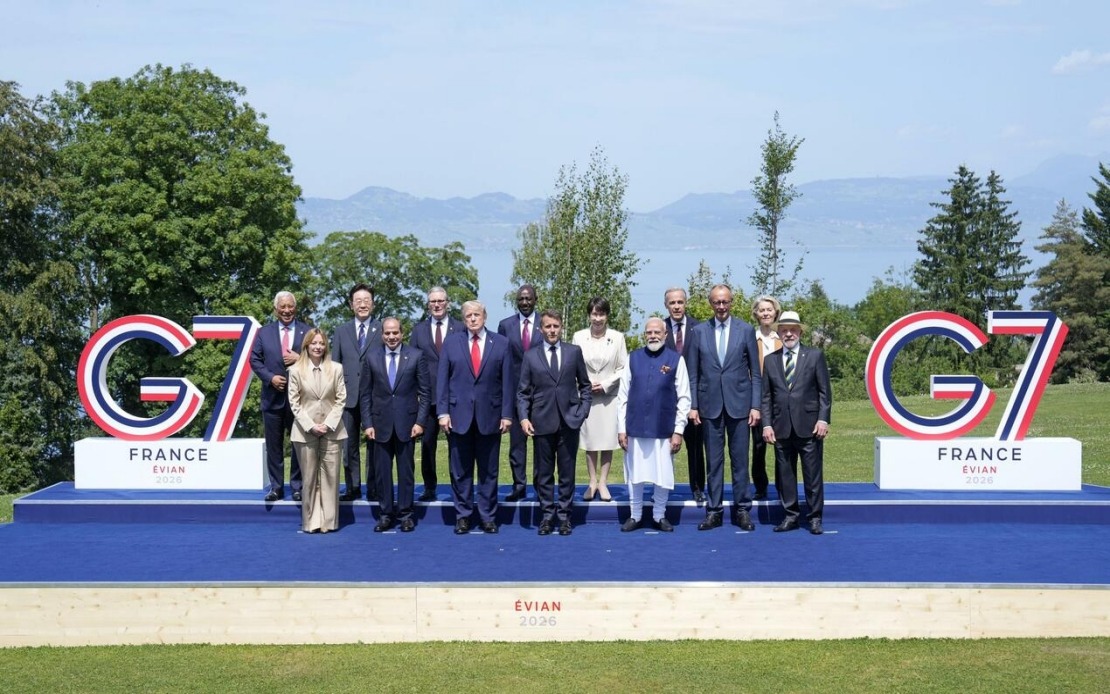
The Group of Seven concluded their annual summit in the French alpine town of Evian-les-Bains with a unified commitment to strengthen assistance for Ukraine, marking a rare moment of consensus among the world's leading industrialised democracies despite mounting tensions between the United States and its European allies. Gathered on the shores of Lake Geneva near the Swiss border, the leaders heard directly from Ukrainian President Volodymyr Zelenskyy about his nation's circumstances and reaffirmed their determination to pursue what they described as a "just and lasting peace" by sustaining diplomatic and military pressure on Moscow.
The agreement on Ukraine stands as a significant diplomatic achievement given the complex web of disagreements that have fractured G7unity in recent months. Tensions have simmered over trade policies, North Atlantic Treaty Organization spending commitments, and most recently over statements by US President Donald Trump regarding the acquisition of Greenland and American involvement in Middle Eastern conflicts. That the group managed to present a unified front on this critical geopolitical issue underscores the perceived gravity of the situation in Eastern Europe and the shared conviction that maintaining collective resolve remains essential to influencing Russian decision-making.
Trump's direct message to Russia demonstrated a shift in his diplomatic focus following what he characterised as successful negotiations with Iran. Speaking to journalists after the session, the American president contended that Moscow faces mounting costs from its military campaign and stands to benefit from diplomatic resolution. He suggested that the temporary lifting of certain sanctions on Russia—implemented to suppress global oil prices in the aftermath of recent Middle Eastern hostilities—could be reversed once market conditions stabilise. The implicit leverage embedded in this statement reflects Trump's transactional approach to foreign policy, where economic incentives and penalties serve as primary negotiating instruments.
The reference to Iranian negotiations provides important context for understanding Trump's current Ukraine strategy. By invoking his administration's preliminary agreement with Tehran to reopen the Strait of Hormuz and cease military operations, Trump positioned himself as an effective dealmaker capable of resolving protracted conflicts. He explicitly linked these two regional crises, suggesting that having concluded the Iranian matter, his administration could now devote full attention to achieving a ceasefire between Russia and Ukraine. This sequential framing suggests Trump views major geopolitical disputes as interconnected challenges requiring sequential resolution rather than simultaneous management.
Ukrainian President Zelenskyy's public statements following the meeting revealed a carefully calibrated emphasis on two specific priorities: the reinforcement of air defence capabilities and advancement of diplomatic channels designed to compel Russian withdrawal. His social media posts indicated awareness that military resilience and political negotiation must proceed in parallel, with neither precluding the other. The timing of Zelenskyy's participation in the G7 gathering reflected Ukraine's strategic imperative to maintain Western support while simultaneously strengthening partnerships with European nations, particularly as Kyiv has reportedly intensified direct military and political coordination with Paris and Berlin at the expense of relying solely on Washington.
Japanese Prime Minister Sanae Takaichi emerged as a vocal advocate for maintaining G7 cohesion in pressuring Russia toward what she termed "positive and concrete action." Her statements emphasised the principle that unilateral alteration of territorial status through military force represented an unacceptable breach of international norms—a position reflecting Tokyo's own security concerns regarding Chinese military assertiveness in East Asia. Takaichi additionally highlighted Japan's apprehension concerning deepening military collaboration between Russia and North Korea and expanding defence partnerships between Moscow and Beijing, demonstrating how the Ukraine conflict interconnects with broader Asian security dynamics and threatens to create problematic military alignments.
The multilateral dimension of this summit extended beyond the traditional G7 membership to include representatives from Brazil, Egypt, India, Qatar, South Korea, and the United Arab Emirates, reflecting France's presidency initiative to build broader international consensus on development finance reform and stability in the Middle East. During a working lunch focused on the region, leaders from the G7, Egypt, Qatar, and the United Arab Emirates engaged in substantive discussion of the four-month-old conflict between the United States and Iran, with particular attention to the preliminary accord aimed at reopening critical shipping channels. The convergence of discussion on Ukraine, Middle Eastern stability, and development financing demonstrates how contemporary geopolitical challenges demand integrated diplomatic responses addressing security, economic, and humanitarian dimensions simultaneously.
For Malaysian policymakers and regional observers, the G7's emphasis on ensuring free navigation through the Strait of Hormuz carries immediate implications. As a major trading nation dependent on stable supply chains and reliable energy markets, Malaysia's economic interests depend substantially on maintaining open maritime corridors and preventing regional conflicts from disrupting commerce. The preliminary US-Iran agreement to reopen this chokepoint holds consequences for regional energy prices, shipping insurance costs, and supply chain predictability affecting Malaysian importers and exporters. Japanese Prime Minister Takaichi's insistence on finalising comprehensive agreements between Washington and Tehran reflected these shared economic concerns transcending G7 membership.
The development financing reform agenda discussed at the summit addresses structural challenges particularly relevant to Southeast Asian economies navigating the transition from traditional development assistance to more innovative financing mechanisms. The G7's recognition that conventional official development assistance has become insufficient to meet the needs of developing nations prompted France to champion the creation of mutually beneficial partnerships that balance donor strategic interests with recipient economic requirements. This philosophical reorientation toward private capital mobilisation for long-term infrastructure and developmental projects offers potential pathways for Malaysian participation in global development networks while protecting national interests.
The joint declaration issued by summit participants affirmed commitment to reforming the development cooperation system while explicitly acknowledging the need to balance strategic interests of both developed and developing nations. This language represents a meaningful evolution from earlier development frameworks that sometimes imposed conditions viewed as infringing on national sovereignty. For Malaysian readers, this shift suggests expanding opportunities for structuring development partnerships that accommodate genuine reciprocity rather than imposing donor-centric conditionality, potentially enabling greater flexibility in engaging with both Western and non-Western development finance sources.
The consensus achieved at Evian-les-Bains regarding Ukraine, despite underlying G7 tensions, reflects recognition that strategic competition between major powers must not entirely displace cooperation on shared threats. Trump's engagement in the Ukrainian discussion, notwithstanding his stated preference for rapid negotiated settlements and reduced American military commitment, demonstrated that even transactionally-minded leadership acknowledges the necessity of maintaining multilateral frameworks for addressing regional security crises. For Southeast Asia, this pattern suggests that despite US-European tensions and shifting international alignments, the institutional architecture of global cooperation remains sufficiently resilient to address critical challenges affecting all stakeholders.
Looking forward, the implications of the G7's position will substantially influence the trajectory of the Ukraine conflict and broader European security architecture. Trump's emphasis on negotiation coupled with the G7's commitment to sustained pressure on Russia creates an ambiguous framework potentially satisfying neither rapid Ukrainian battlefield victories nor comprehensive Russian objectives. This tension between negotiation and pressure, mediation and deterrence, reflects the fundamental difficulty of resolving conflicts where parties maintain incompatible strategic objectives. For the region, monitoring how these dynamics evolve will prove essential to understanding whether the liberal international order can effectively manage great power competition while maintaining commitment to multilateral institutions and the rule of law.

%22%2F%3E%3C%2Fpattern%3E%3C%2Fdefs%3E%3Crect%20width%3D%22100%25%22%20height%3D%22100%25%22%20fill%3D%22url(%23ph2hy9vg)%22%2F%3E%3Crect%20width%3D%22100%25%22%20height%3D%22100%25%22%20fill%3D%22url(%23ph2hy9vp)%22%2F%3E%3Ctext%20x%3D%2250%25%22%20y%3D%2250%25%22%20text-anchor%3D%22middle%22%20dominant-baseline%3D%22central%22%20fill%3D%22rgba(255%2C255%2C255%2C0.95)%22%20font-family%3D%22Georgia%2C%20'Times%20New%20Roman'%2C%20serif%22%20font-weight%3D%22700%22%20font-size%3D%22272%22%20letter-spacing%3D%22-0.02em%22%3EAnwar%3C%2Ftext%3E%3C%2Fsvg%3E)