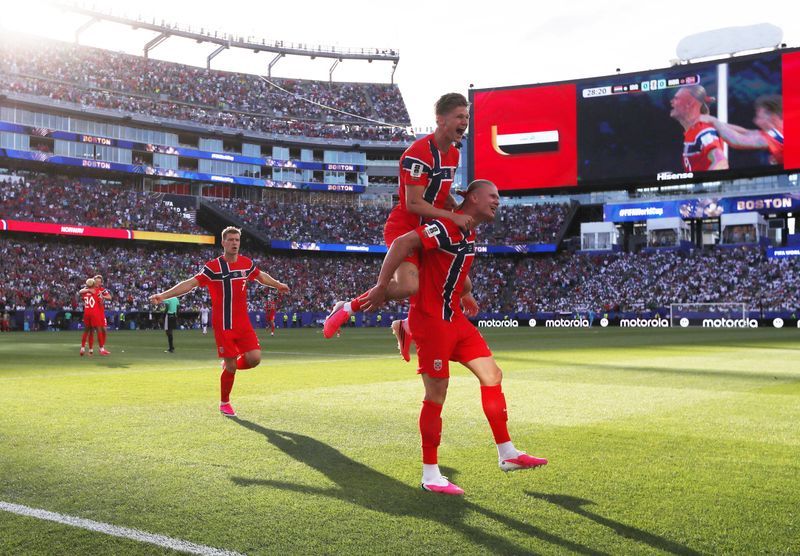
Erling Haaland made an unmistakable statement of intent in his World Cup debut, striking twice in the opening period as Norway overwhelmed Iraq 4-1 in their group fixture on Tuesday. The high-profile striker has now added the world's premier international tournament to an already impressive roll call of competitions in which he has found the net on his debut, having previously announced himself in similar fashion across the German Bundesliga, English Premier League, and the UEFA Champions League. Few observers questioned whether the Norwegian would rise to the occasion when it mattered most, and his clinical finishing vindicated those expectations.
The manner of Haaland's performance underscored his mounting reputation as one of football's most feared finishers. His opening goal exemplified the predatory instincts that have made him such a coveted talent, arriving at the far post to convert a precise delivery from David Moller Wolfe with the composure of a player well accustomed to such opportunities. The second followed swiftly, arriving after Haaland's aggressive pressing forced an Iraqi defender into a loose back-pass, allowing him to intercept and guide the ball past the goalkeeper as the custodian attempted to clear the danger. These were not spectacular or elaborate strikes, but rather the product of positioning, hunger, and an almost mechanical capacity to capitalise when chances materialised.
Norway's overall performance, however, painted a more complicated picture than the scoreline suggested. Despite securing such a comprehensive victory in their first men's World Cup finals appearance since 1998, the Scandinavian side struggled to impose consistent control throughout the contest. Erratic passing, unforced errors, and momentary lapses in concentration punctuated their display, indicating that manager Stale Solbakken will have significant refinements to implement before their next outing. Iraq, despite their eventual heavy defeat, periodically threatened and even found the net through Aymen Hussein, whose opportunistic finish briefly levelled the contest and suggested the match contained far more unpredictability than the final scoreline conveyed.
The tactical blueprint underlying Norway's approach became evident in how their system functioned. In an environment where most of the camp typically maintains a reserved relationship with the media, Haaland stands out as particularly taciturn, allowing his on-pitch actions to carry his message. Yet the team's primary strategic objective appeared transparent: create sight lines for their exceptional striker and permit him to operate freely within dangerous areas. Prime Minister Jonas Gahr Stoere had articulated this philosophy during pre-match commentary, emphasising that although individuals may score, successful tournament runs depend on collective effort and coordination. The reality of Tuesday's contest bore out this observation—Norway collectively worked to serve their most lethal weapon, even if the execution fell short of polished at times.
Captain and midfield conductor Martin Odegaard, typically the orchestrator of his team's attacking moves, proved surprisingly muted in his contributions. The playmaker's subdued involvement limited Norway's capacity to construct flowing offensive sequences and generate consistent pressure through organised build-up play. Simultaneously, the Norwegian defensive line exhibited occasional vulnerabilities to counter-attacking threats, most notably when ball-watching permitted Hussein to exploit space and finish clinically. These defensive deficiencies, while not ultimately costly in Tuesday's context, represent areas requiring urgent attention as the tournament intensifies and opponents apply greater attacking precision.
The result's implications for the group stage proved immediately significant. Norway moved atop their pool with three points, edging ahead of France on goal difference following the French side's 3-1 triumph against Senegal earlier that day. However, Haaland demonstrated appropriate caution when evaluating his team's performance, acknowledging forthrightly that substantially improved standards would be necessary in forthcoming matches. The narrow margin separating tournament progression from disappointment meant that such honest self-assessment proved invaluable, particularly for a nation returning to this competition after three decades of absence.
For Norwegian supporters, the occasion carried profound significance beyond the three available points. Two and a half decades had elapsed since their nation last competed at a men's World Cup, making this return a moment of genuine celebration throughout the country. Haaland's contribution ensured that this comeback began on an optimistic note rather than with the uncertainty that might have accompanied a more laboured victory. When asked about the mood back home, the striker's response captured the nation's sentiment perfectly: while acknowledging that the emphatic nature of the win exceeded expectations, he expressed genuine hope that supporters across Norway were celebrating this return to football's grandest stage.
The broader significance of Haaland's tournament debut extends beyond Norway's immediate group ambitions. His continued success at the World Cup level consolidates his position among contemporary football's most prominent talents while simultaneously placing expectation upon his shoulders to deliver in knockout fixtures where the margin for error vanishes entirely. Opponents will undoubtedly study his movements and positioning with greater intensity as the tournament develops, forcing him to evolve his game beyond relying solely on predatory positioning. Yet Tuesday's demonstration suggested he possesses the intelligence and adaptability to overcome such increased scrutiny.
As the group stage progresses, Norway faces the considerable challenge of maintaining their present position while ensuring Haaland receives consistent service in attacking areas. The upcoming fixtures will determine whether Tuesday's comprehensive victory represented the beginning of an improbable tournament run or merely a fortunate opening that more organised opponents might exploit. For Malaysian and Southeast Asian observers watching from afar, Haaland's performance exemplified the gulf that exists between elite European programmes and developing footballing nations—a reminder of the exceptional talent concentration residing in Europe's top competitions and the physical and technical superiority they command at the international level.


%22%2F%3E%3C%2Fpattern%3E%3C%2Fdefs%3E%3Crect%20width%3D%22100%25%22%20height%3D%22100%25%22%20fill%3D%22url(%23ph2hy9vg)%22%2F%3E%3Crect%20width%3D%22100%25%22%20height%3D%22100%25%22%20fill%3D%22url(%23ph2hy9vp)%22%2F%3E%3Ctext%20x%3D%2250%25%22%20y%3D%2250%25%22%20text-anchor%3D%22middle%22%20dominant-baseline%3D%22central%22%20fill%3D%22rgba(255%2C255%2C255%2C0.95)%22%20font-family%3D%22Georgia%2C%20'Times%20New%20Roman'%2C%20serif%22%20font-weight%3D%22700%22%20font-size%3D%22272%22%20letter-spacing%3D%22-0.02em%22%3EAnwar%3C%2Ftext%3E%3C%2Fsvg%3E)