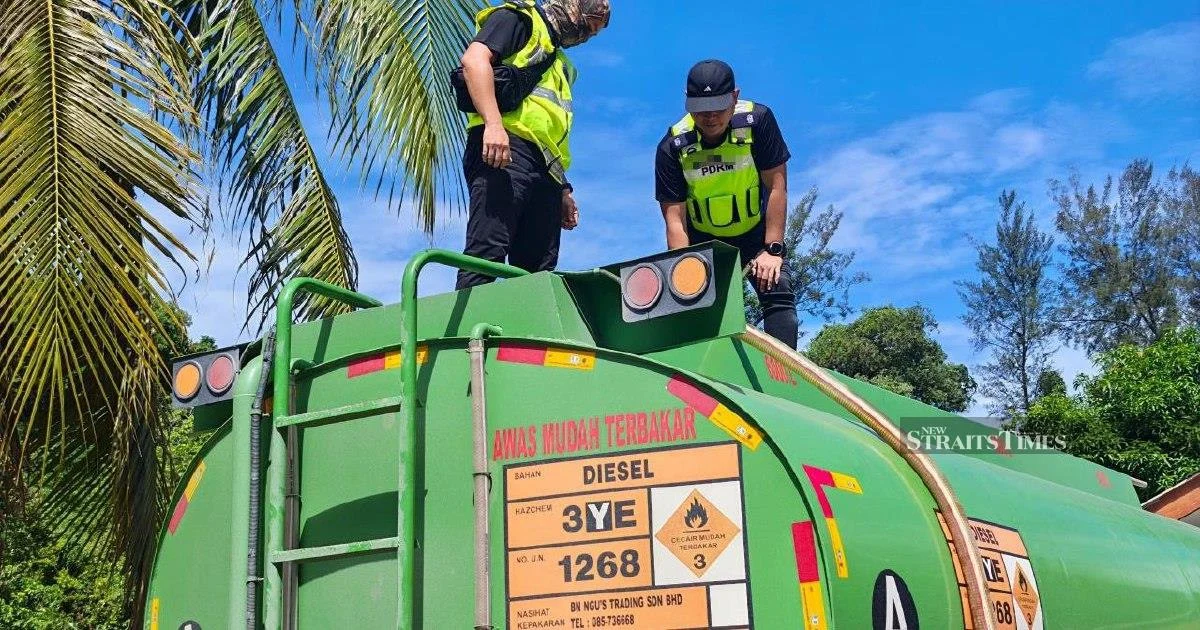
Enforcement authorities have successfully shut down an underground diesel operation hidden within a private residence in Tanjung Lobang, Miri, culminating in the seizure of 15,000 litres of subsidised fuel and the detention of four suspects. The discovery underscores the persistent challenge Malaysia faces in combating fuel subsidy diversion schemes that bleed billions from national coffers while fuelling organised crime networks.
The covert depot, operating from what appeared to be an ordinary residential bungalow, represents a sophisticated attempt to circumvent government fuel regulation systems. By establishing the facility in a populated residential area rather than an industrial zone, operators sought to evade detection whilst maintaining convenient distribution access. This operating model has become increasingly common across Peninsular Malaysia and East Malaysia as enforcement efforts target more obvious wholesale operations.
Fuel subsidy fraud represents one of the most persistent economic crimes facing Malaysia's security establishment. Diverted diesel, purchased at government-controlled prices for legitimate industrial and agricultural use, commands considerably higher prices on black markets where unscrupulous distributors sell to consumers and businesses unwilling to queue at official pumps or lacking proper documentation. The 15,000-litre seizure in this single operation illustrates how individual syndicates can accumulate substantial quantities before detection.
The four arrested individuals will face investigation under relevant anti-smuggling and fuel subsidy diversion statutes. Depending on the evidence uncovered during interrogation, charges may encompass fuel theft, operating unlicensed fuel distribution infrastructure, and conspiracy. Authorities are likely exploring connections to larger supply networks, as small independent operators rarely exist in isolation within Malaysia's organised fuel-diversion ecosystem.
Sarawak, Malaysia's largest state by area with dispersed population centres and lengthy borders, has emerged as a vulnerable transit point for diverted fuel bound for Brunei and Indonesian markets where prices significantly exceed Malaysian subsidised rates. The Miri division, positioned strategically near international maritime boundaries, has previously featured in major fuel smuggling cases. Tanjung Lobang's location near the coast increases its utility for both maritime fuel distribution and rapid evacuation routes.
The discovery reflects intensified enforcement coordination between Sarawak's authorities and federal agencies tasked with protecting Malaysia's fuel subsidy system. Recent operations have demonstrated improved intelligence gathering capabilities, moving enforcement focus from traditional wholesale distribution points toward smaller, dispersed retail networks that were previously harder to detect. The hidden bungalow operation likely came to official attention through community tip-offs, routine surveillance, or intelligence gathered from monitoring downstream fuel market disruptions.
From an economic perspective, fuel subsidy diversion imposes dual harm on Malaysia's public finances. Government loses revenue through artificially depressed pump prices, whilst simultaneously forfeits tax income when diverted fuel escapes the formal economy entirely. Estimating the total annual cost of fuel diversion remains challenging, though industry specialists suggest leakage may exceed hundreds of millions of ringgit annually when accounting for both direct theft and foregone tax revenue.
The syndicate's operation methodology demonstrates evolution in diversion tactics over recent years. Rather than attempting large-scale interstate trucking operations with accompanying detection risks, contemporary schemes emphasise distributed networks of modest facilities serving localised demand. Multiple small depots, each holding manageable quantities, present enforcement agencies with resource allocation challenges, as exhaustively monitoring all possibilities exceeds practical capacity.
This enforcement success should prompt businesses and residential communities in Sarawak's larger towns to report suspicious fuel handling operations, particularly where unusual tanker movements or storage configurations become apparent. The ordinary appearance of the Tanjung Lobang bungalow reinforces that fuel diversion operations employ sophisticated concealment techniques beyond obvious industrial warning signs.
Government policymakers continue debating structural solutions to Malaysia's persistent fuel subsidy problem. Longer-term strategies include progressively widening the price gap between subsidised and market rates to reduce smuggling incentives, though political considerations complicate rapid implementation. Enhanced enforcement, supported by improved intelligence infrastructure and inter-agency coordination, represents the immediate enforcement tool against expanding diversion networks.
For Malaysian consumers and businesses legitimate concerns surrounding fuel availability and pricing will persist whilst diversion syndicates siphon supplies into parallel markets. The Tanjung Lobang operation's dismantling removes one distribution point but underscores that comprehensive solutions require addressing underlying economic incentives driving diversion, alongside continuing robust law enforcement action against individual operations.
Authorities have urged the public to provide actionable intelligence regarding suspected fuel diversion activities. Reporting mechanisms through police and customs channels enable communities to contribute to reducing fuel subsidy leakage affecting national development priorities.

%22%2F%3E%3C%2Fpattern%3E%3C%2Fdefs%3E%3Crect%20width%3D%22100%25%22%20height%3D%22100%25%22%20fill%3D%22url(%23ph2hy9vg)%22%2F%3E%3Crect%20width%3D%22100%25%22%20height%3D%22100%25%22%20fill%3D%22url(%23ph2hy9vp)%22%2F%3E%3Ctext%20x%3D%2250%25%22%20y%3D%2250%25%22%20text-anchor%3D%22middle%22%20dominant-baseline%3D%22central%22%20fill%3D%22rgba(255%2C255%2C255%2C0.95)%22%20font-family%3D%22Georgia%2C%20'Times%20New%20Roman'%2C%20serif%22%20font-weight%3D%22700%22%20font-size%3D%22272%22%20letter-spacing%3D%22-0.02em%22%3EAnwar%3C%2Ftext%3E%3C%2Fsvg%3E)