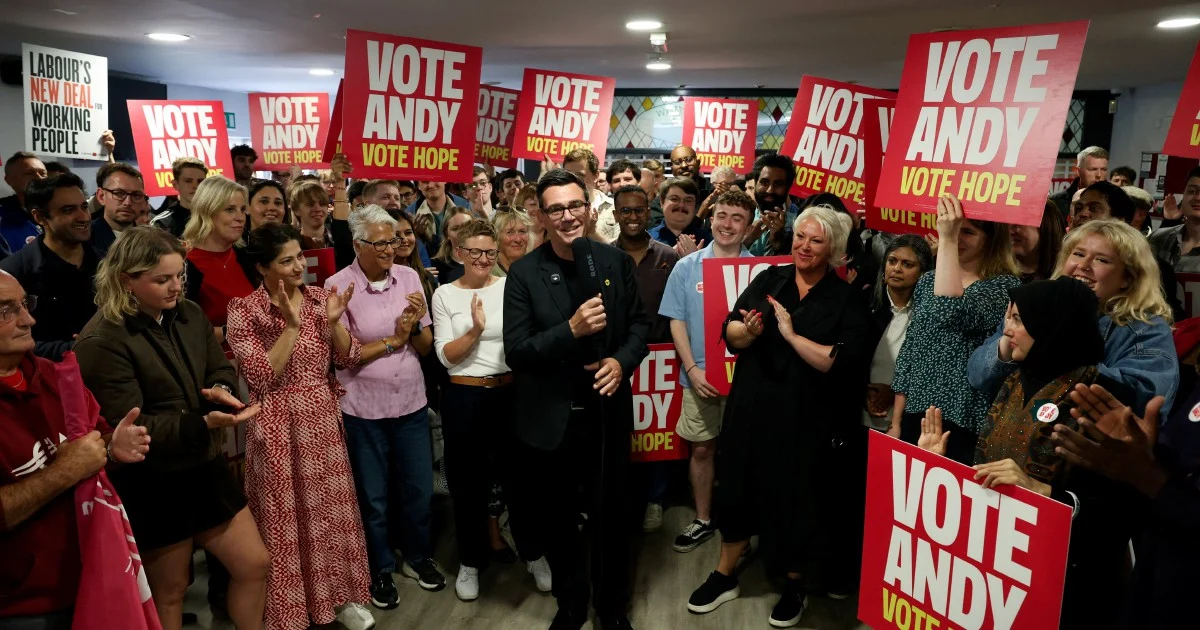
Andy Burnham's prospects of mounting a credible leadership challenge against sitting Prime Minister Keir Starmer have been unexpectedly strengthened by the strategic miscalculations and internal divisions plaguing Britain's right-wing opposition. The Labour figure is positioned to retain the Makerfield constituency in Thursday's election—a crucial first step in assembling the parliamentary influence and profile necessary to emerge as a serious contender for the country's top job. Yet his advantage appears less a reflection of widespread personal popularity than the consequence of poisonous feuding between two populist movements competing for the same electoral base.
The Conservative Party and Reform UK, which have spent months battling for dominance among right-leaning voters, have effectively fragmented the anti-Labour vote in seats like Makerfield where traditional Tory strength once provided a formidable barrier to Labour ambitions. This division mirrors broader upheaval in British politics, where the post-2016 Brexit realignment has never fully settled into stable party structures. Reform UK's emergence as a genuine electoral force—fuelled by disaffected Conservatives and working-class voters alienated from the traditional party establishment—has created a zero-sum dynamic where gains for one right-wing faction necessarily weaken the other's position.
For Malaysian observers of Westminster politics, this phenomenon offers instructive parallels to how fragmentation among opposition groupings can inadvertently benefit incumbent power structures, particularly when rival camps refuse to cooperate or coordinate their campaigns. The British situation demonstrates how personality-driven populist movements can prioritise factional dominance over electoral strategy, ultimately diluting their collective strength against a unified competitor. The mutual animosity between Conservative leaders and Reform UK figures has prevented any meaningful electoral pacts or vote-sharing arrangements that might consolidate the non-Labour electorate.
Burnham's trajectory illustrates a deeper shift in how British politicians construct national leadership credentials. As Mayor of Greater Manchester since 2017, he has built a regional power base independent of Westminster's traditional hierarchies, positioning himself as a voice for neglected provincial interests. His consistent advocacy for devolved powers and regional investment has resonated with voters frustrated by London-centric governance, a pitch that gains force when opponents fragment and appear incapable of presenting coherent alternatives. Thursday's election victory would represent the foundational step—securing parliamentary representation—upon which any future leadership campaign would rest.
The timing of right-wing infighting could hardly be more consequential for Labour's internal politics. Starmer currently faces pressure from his own party's left wing over economic policy and his cautious approach to various social issues. A strengthened Burnham, buoyed by electoral success and regional prominence, might emerge as a focal point for those seeking to push the party toward more ambitious redistributive policies. Conversely, a fractured Conservative opposition struggling to articulate unified alternatives on taxation, public services, or immigration gives Starmer's government considerable breathing room to consolidate power without facing coordinated legislative challenges.
The mechanics of Britain's first-past-the-post electoral system amplify these fragmentation effects dramatically. Because constituencies elect single representatives, every vote that goes to Reform UK in a seat like Makerfield is effectively a vote subtracted from Conservative resistance. In closely contested seats across the country, this dynamic has proven decisive. Conservative campaign strategists have attempted to frame Reform UK as a spoiler party whose presence guarantees Labour victories, but this messaging has struggled to overcome the genuine appeal Reform UK holds for voters convinced that the Conservative Party has abandoned its traditional base on issues ranging from immigration enforcement to cultural conservatism.
From a Southeast Asian perspective, the British predicament reflects challenges familiar across democracies wrestling with electoral fragmentation and ideological realignment. Malaysia's own multi-ethnic coalition politics, while structured around different cleavages, demonstrates how opposition unity—or its absence—dramatically affects electoral outcomes. Just as Burnham benefits from his opponents' disunity, incumbent power structures everywhere gain significant advantages when challengers cannot overcome factional pride to present unified alternatives.
Burnham's potential ascent also underscores how British Labour, once written off after 2019's historic defeat, has rebuilt through a combination of organizational competence under Starmer and genuine mistakes by an exhausted Conservative administration. Right-wing feuding represents merely one element of Labour's recovery, but it is a consequential one. The Conservatives' inability to resolve their internal schisms—between One Nation moderates and the populist insurgency represented by Reform UK—suggests their travails will persist regardless of immediate electoral outcomes.
Looking ahead, the structural factors driving Conservative-Reform UK conflict appear durable rather than cyclical. Reform UK has built genuine grassroots support and media platforms independent of the Conservative establishment. Conservative attempts to accommodate populist positions on immigration or red tape reduction have failed to stanch Reform UK's growth, suggesting the split reflects genuine ideological differences rather than mere personality clashes. This means Burnham's path toward higher office, whether as a future challenger to Starmer or as a powerful figure within Labour's coalition, will likely remain smoother than his right-wing opponents can manage.


%22%2F%3E%3C%2Fpattern%3E%3C%2Fdefs%3E%3Crect%20width%3D%22100%25%22%20height%3D%22100%25%22%20fill%3D%22url(%23ph2hy9vg)%22%2F%3E%3Crect%20width%3D%22100%25%22%20height%3D%22100%25%22%20fill%3D%22url(%23ph2hy9vp)%22%2F%3E%3Ctext%20x%3D%2250%25%22%20y%3D%2250%25%22%20text-anchor%3D%22middle%22%20dominant-baseline%3D%22central%22%20fill%3D%22rgba(255%2C255%2C255%2C0.95)%22%20font-family%3D%22Georgia%2C%20'Times%20New%20Roman'%2C%20serif%22%20font-weight%3D%22700%22%20font-size%3D%22272%22%20letter-spacing%3D%22-0.02em%22%3EAnwar%3C%2Ftext%3E%3C%2Fsvg%3E)