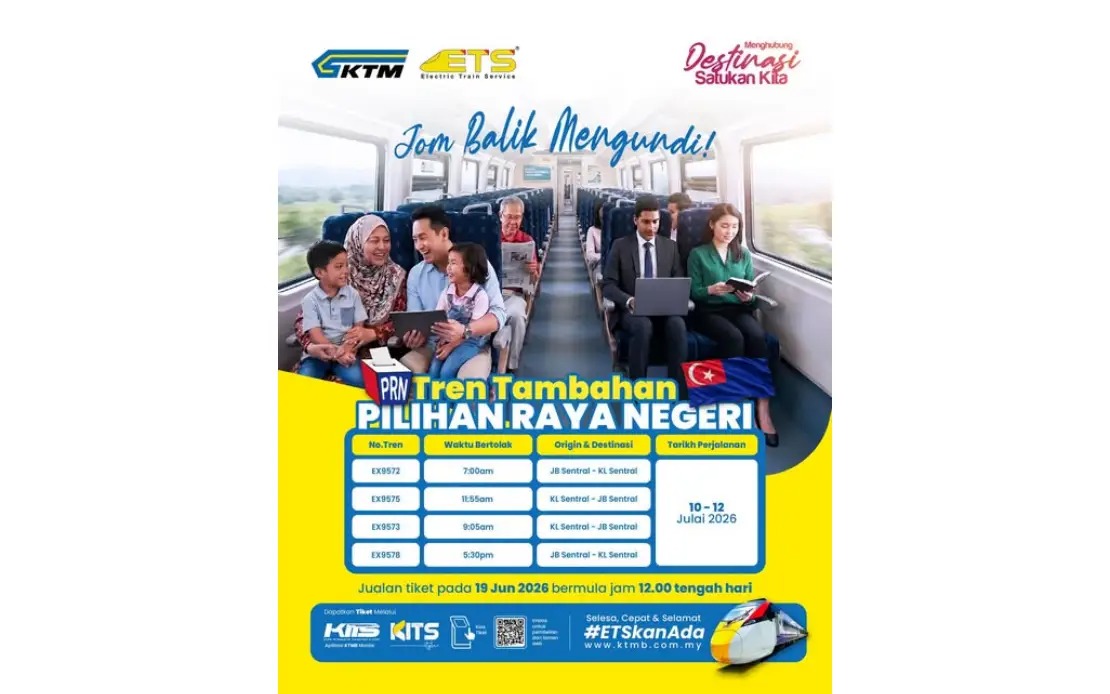
Keretapi Tanah Melayu Berhad, the country's primary rail operator, has moved to ease travel logistics for the upcoming Johor state election by introducing additional Electric Train Service capacity on the southern corridor. The decision reflects anticipation of heightened passenger demand as voters across the nation prepare to return to the state to cast ballots on July 11.
Ticket sales for the supplementary services commenced at noon on June 19, with KTMB providing several avenues for purchase. Commuters can acquire tickets via the KTMB Mobile application, through the KITS Style platform, from the official online portal at online.ktmb.com.my, or by visiting any KTMB ticket counter in person. This multi-channel approach aims to prevent bottlenecks and accommodate the expected surge in booking activity.
The extra trains will operate between July 10 and 12, bookending the polling day itself to ensure voters have adequate opportunity to reach their constituencies. By extending service both before and after the election, KTMB essentially creates a three-day window during which supporters of various political factions can arrange their homecoming. This mirrors similar transportation preparations undertaken during previous electoral exercises across Malaysia, where state and federal authorities collaborate to minimise logistical friction.
Johor's state election was triggered by the dissolution of the State Legislative Assembly on June 1, a procedural step that set in motion the electoral calendar culminating in the July 11 polling day. The Election Commission formalised this date following standard constitutional protocols, signalling to the public and transport operators the precise window within which campaign activities would conclude and voting would proceed.
For many Johor residents employed or studying in other states, the election represents a specific commitment requiring travel planning and time away from regular routines. Rail transport remains a popular option for such journeys given its reliability, cost-effectiveness compared to private vehicles, and convenience for passengers originating from or destined for major urban centres. The availability of additional capacity removes a potential constraint that might otherwise force some voters to explore alternative transport modes.
The southern ETS corridor serves as a critical artery connecting Kuala Lumpur and the central region to Johor Bahru and intermediate stations including Seremban, Kuala Lumpur Sentral, and Bandar Tasik Selatan. Heightened traffic on this route during election periods is a predictable phenomenon, as populations in federal territories and Selangor mobilise to return to their home states for voting obligations. By pre-announcing expanded services and opening ticket sales well in advance, KTMB allows potential passengers to secure seats and plan their schedules with certainty.
The announcement also reflects broader policy objectives within Malaysia's transport sector, which increasingly prioritises facilitating civic participation and democratic engagement. When state institutions—including transport operators, communication authorities, and electoral bodies—synchronise their efforts around election periods, the cumulative effect supports higher voter turnout rates. Reduced friction in returning home, whether through improved road conditions or expanded rail capacity, removes practical barriers that might otherwise discourage participation.
From a commercial perspective, the introduction of supplementary services during predictably high-demand periods represents rational capacity management. Rather than allowing standard service levels to be overwhelmed with frustrated passengers and operational strain, KTMB's approach distributes demand across additional train sets. This maintains service quality for both election-related travellers and regular commuters utilising the corridor during the same window, preventing degradation that might otherwise result from overcrowding.
The multi-platform ticket sales system underscores Malaysia's advancing digital infrastructure for public services. While traditional counter-based purchasing remains available for those preferring in-person transactions, the integration of mobile applications and online portals reflects modernisation efforts that enhance accessibility. For tech-savvy voters, particularly younger demographics accustomed to smartphone-based transactions, this approach reduces friction in ticket acquisition and allows real-time monitoring of availability and booking status.
Beyond the immediate election context, the exercise itself represents a template for future large-scale civic events requiring population mobility. By documenting demand patterns, observing which sales channels prove most popular, and monitoring passenger flow during the election period, KTMB accumulates operational intelligence useful for optimising services during subsequent elections or comparable mass-participation events. The success or challenges encountered will inform adjustments to scheduling, pricing, or marketing approaches in future instances.
The decision to announce expanded capacity specifically and prominently signals institutional readiness to support democratic processes. When citizens perceive that public institutions are actively facilitating their electoral participation, confidence in both the transport system and the broader electoral machinery strengthens. Conversely, transport constraints that prevent willing voters from reaching polling stations represent genuine obstacles to democratic representation and inclusive governance.
For Southeast Asian observers tracking Malaysia's electoral management practices, the coordination between KTMB and the electoral timeline demonstrates how democratic states can leverage existing infrastructure to enable participation. Unlike contexts where institutional capacity or political will constrains voter access, Malaysia's proactive approach to transport logistics reflects established institutional competence and acceptance of high-turnout democratic processes as desirable governance outcomes.

%22%2F%3E%3C%2Fpattern%3E%3C%2Fdefs%3E%3Crect%20width%3D%22100%25%22%20height%3D%22100%25%22%20fill%3D%22url(%23ph2hy9vg)%22%2F%3E%3Crect%20width%3D%22100%25%22%20height%3D%22100%25%22%20fill%3D%22url(%23ph2hy9vp)%22%2F%3E%3Ctext%20x%3D%2250%25%22%20y%3D%2250%25%22%20text-anchor%3D%22middle%22%20dominant-baseline%3D%22central%22%20fill%3D%22rgba(255%2C255%2C255%2C0.95)%22%20font-family%3D%22Georgia%2C%20'Times%20New%20Roman'%2C%20serif%22%20font-weight%3D%22700%22%20font-size%3D%22272%22%20letter-spacing%3D%22-0.02em%22%3EAnwar%3C%2Ftext%3E%3C%2Fsvg%3E)