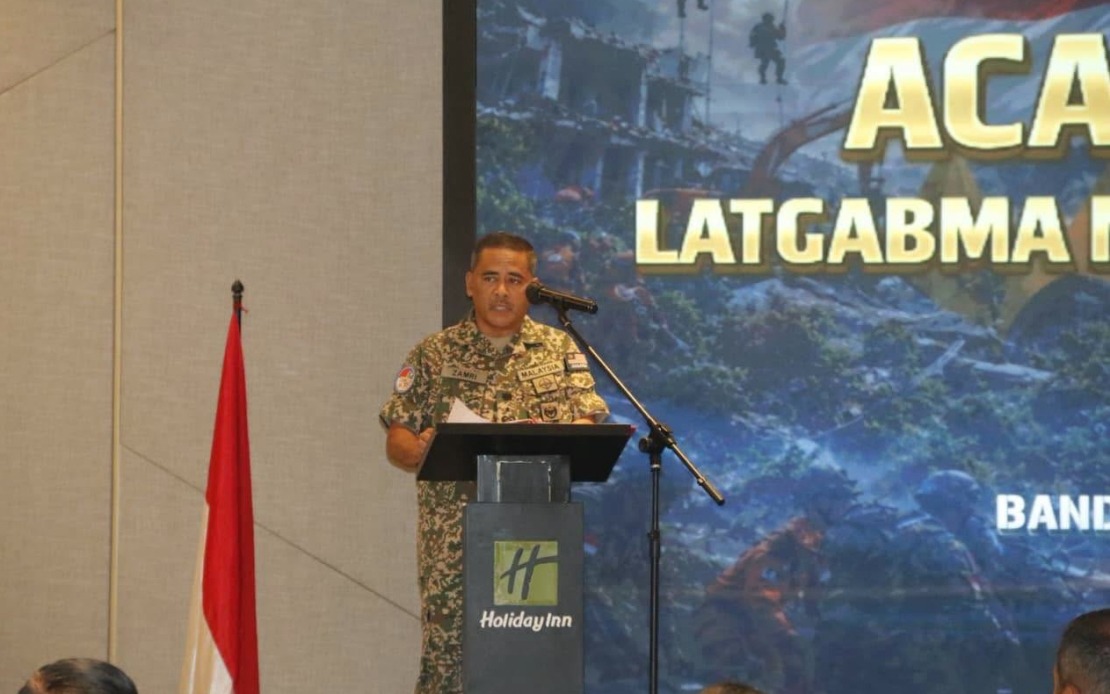
Malaysia and Indonesia have embarked on an ambitious 13-day military exercise designed to reinforce their strategic partnership while preparing both nations for emerging security challenges. The LATGABMA MALINDO DARSASA 12AB/2026 exercise, currently underway in Lampung, Sumatra, represents a significant commitment by the Malaysian Armed Forces (MAF) and Indonesia's National Armed Forces (TNI) to coordinate effectively across land, maritime and air operations. With 719 personnel from various government agencies participating, the exercise transcends routine training to demonstrate the depth of mutual trust between two of Southeast Asia's largest military powers.
The scale and complexity of the operation underscore how regional defence cooperation has evolved beyond traditional border security concerns. According to Brig Gen Datuk Zamri Othman, Commander of the 1st Infantry Brigade and chief of the MAF Exercise Planning Group, this initiative reflects far more than standard military procedures. The exercise serves as a tangible expression of the fraternal relationship between Malaysia and Indonesia, rooted in shared geographic proximity and overlapping strategic interests. By bringing together personnel from diverse operational backgrounds, the training creates an environment where soldiers, sailors and airmen can develop mutual understanding and refine coordinated responses to complex scenarios.
The security landscape facing both nations has shifted dramatically in recent decades, moving away from state-to-state conflict towards asymmetric and non-traditional threats. Maritime crime, transnational smuggling networks, organised terrorism, sophisticated cyber attacks and devastating natural disasters pose interconnected challenges that no single nation can address effectively in isolation. Indonesia's geographic position along major shipping lanes makes it particularly vulnerable to piracy and smuggling operations, while Malaysia's extensive maritime zones require constant vigilance. The exercise framework acknowledges these realities by incorporating multiple threat dimensions, ensuring that personnel develop competencies across conventional and emerging domains.
The choice of Lampung as the primary training venue reflects careful strategic planning rather than arbitrary selection. Located at the convergence of three active tectonic plate belts, the province faces genuine and recurring natural disaster risks that shape the regional security environment. Indonesia has experienced catastrophic earthquakes and tsunamis, particularly across southern Sumatra, creating real-world imperatives for robust humanitarian assistance and disaster relief capabilities. By conducting exercises in geographically relevant locations, both armed forces ensure that training scenarios remain grounded in actual threat profiles, enhancing the practical value of lessons learned and building institutional knowledge that transfers directly to operational readiness.
The academic component of the exercise, structured through comprehensive Staff Exercises, focuses on ten interconnected disaster-response scenarios that mirror conditions personnel would encounter during genuine emergencies. These include initial emergency response protocols, management of mass casualties, stabilisation of compromised infrastructure, medical emergencies, mechanisms for requesting and coordinating international assistance, and the transition from emergency response to normalcy. Additionally, the exercise incorporates cyber attack and information warfare scenarios, reflecting how modern disasters increasingly involve digital infrastructure failures alongside physical destruction. This scenario-based approach enables participants to develop deeper conceptual understanding before applying knowledge during field training, creating a pedagogically sound progression from theory to practical application.
The Field Training Exercise phase brings the academic learning into concrete operational settings, featuring integrated force training that includes MAF personnel working directly alongside TNI counterparts and Indonesian civilian agencies. This integration is deliberately designed to mirror real-world emergency responses, which invariably involve military and civilian institutions functioning under unified command. Participating agencies include the National Search and Rescue Agency (BASARNAS), Disaster Preparedness Cadets (TAGANA), the Indonesian Red Cross (PMI) and Regional Disaster Management Agencies (BPBD). Personnel conduct practical skills training in rope work, rappelling techniques and emergency response protocols while establishing functional field hospitals capable of managing wounded personnel. This hands-on component builds confidence in executing complex operations while identifying procedural gaps that require refinement.
Beyond traditional military training, the exercise incorporates humanitarian projects that generate tangible benefits for affected communities while reinforcing cooperation principles. The Engineering Civil Action Programme includes repair work on two uninhabitable houses in Kampung Sukamaju and construction of a concrete road in Kampung Keteguhan, providing infrastructure improvements to villages that host the exercise. The Medical Civic Action Programme, conducted at the Community Health Centre (PUSKESMAS), offers comprehensive health screenings, free spectacles distribution and blood donation opportunities. These initiatives demonstrate how military cooperation can serve civilian populations, building goodwill and demonstrating the armed forces' role beyond security provision. For Malaysian readers, such programmes illustrate approaches that could enhance MAF engagement with communities across Malaysia.
Cyber security training represents perhaps the most forward-looking component of the exercise, acknowledging how modern conflicts increasingly unfold in digital space. The Cyber Exercise segment covers technical skills spanning reconnaissance activities, system enumeration, credential-based attacks, man-in-the-middle interception techniques, spoofing methods and data manipulation. These capabilities reflect how contemporary threats to national infrastructure extend far beyond physical attack. Both Malaysia and Indonesia face increasing targeting by state-sponsored and criminal cyber actors, making coordinated cyber defence capabilities essential. By training personnel together, both nations develop shared understanding of attack methodologies and defensive responses, facilitating information sharing during actual cyber incidents.
The LATGABMA MALINDO DARSASA exercise has been conducted triennially since 1984 through formal institutional mechanisms including the General Border Committee and the Malaysia-Indonesia Joint Training Committee. This consistency demonstrates sustained institutional commitment to military cooperation, creating continuity in relationships and procedures despite changes in political leadership. The 2023 edition held in Pekan, Pahang emphasised anti-terrorism concepts, while the current exercise pivots toward disaster response and cyber security, reflecting evolving threat assessments. This adaptive approach ensures that training remains relevant to contemporary challenges while maintaining the institutional framework that has proven effective across four decades.
The participation figures reveal the comprehensive nature of the engagement, with 463 TNI personnel, 150 MAF personnel, representatives from Malaysia's National Disaster Management Agency (NADMA), 25 Indonesian National Police (POLRI) members and 79 participants from various Indonesian civilian agencies. This composition demonstrates how modern security challenges require coordination across military and civilian institutions. For Malaysia, this exercise offers valuable insights into coordinating with multiple stakeholders during complex emergencies, a capability that becomes increasingly important as disasters grow more sophisticated and interconnected with infrastructure failures.
For Malaysia's strategic position in Southeast Asia, this exercise reinforces bilateral relationships with Indonesia while demonstrating commitment to regional stability mechanisms. A cohesive, well-coordinated Malaysia-Indonesia defence partnership strengthens broader regional security architecture and provides a foundation for addressing transnational challenges including maritime security, terrorism financing and cross-border criminal networks. Investment in joint training creates personal relationships among military personnel that facilitate information sharing and cooperation beyond formal channels, building trust that proves invaluable during genuine crises.
The exercise also carries implications for Malaysia's defence capabilities development. Exposure to Indonesian approaches to disaster management and cyber security provides MAF with comparative insights into different institutional solutions to common problems. This cross-pollination of ideas, when properly institutionalised through follow-up dialogue and information sharing mechanisms, enhances both nations' overall effectiveness. As Malaysia continues modernising its defence capabilities, understanding how regional partners approach emerging challenges provides valuable context for procurement decisions and doctrine development.
Moving forward, the sustainability of such exercises depends on maintaining political will and budgetary commitment despite competing domestic priorities. Both Malaysia and Indonesia face resource constraints that occasionally challenge military modernisation programmes. However, joint exercises represent cost-effective investments in capability building, as participating nations share training expenses and derive multiple benefits simultaneously—building interoperability, enhancing operational readiness, and demonstrating commitment to alliance relationships. The consistent tri-annual schedule established through formal committees ensures these exercises continue despite political transitions or temporary diplomatic tensions, providing valuable stability in an increasingly uncertain strategic environment.


%22%2F%3E%3C%2Fpattern%3E%3C%2Fdefs%3E%3Crect%20width%3D%22100%25%22%20height%3D%22100%25%22%20fill%3D%22url(%23ph2hy9vg)%22%2F%3E%3Crect%20width%3D%22100%25%22%20height%3D%22100%25%22%20fill%3D%22url(%23ph2hy9vp)%22%2F%3E%3Ctext%20x%3D%2250%25%22%20y%3D%2250%25%22%20text-anchor%3D%22middle%22%20dominant-baseline%3D%22central%22%20fill%3D%22rgba(255%2C255%2C255%2C0.95)%22%20font-family%3D%22Georgia%2C%20'Times%20New%20Roman'%2C%20serif%22%20font-weight%3D%22700%22%20font-size%3D%22272%22%20letter-spacing%3D%22-0.02em%22%3EAnwar%3C%2Ftext%3E%3C%2Fsvg%3E)