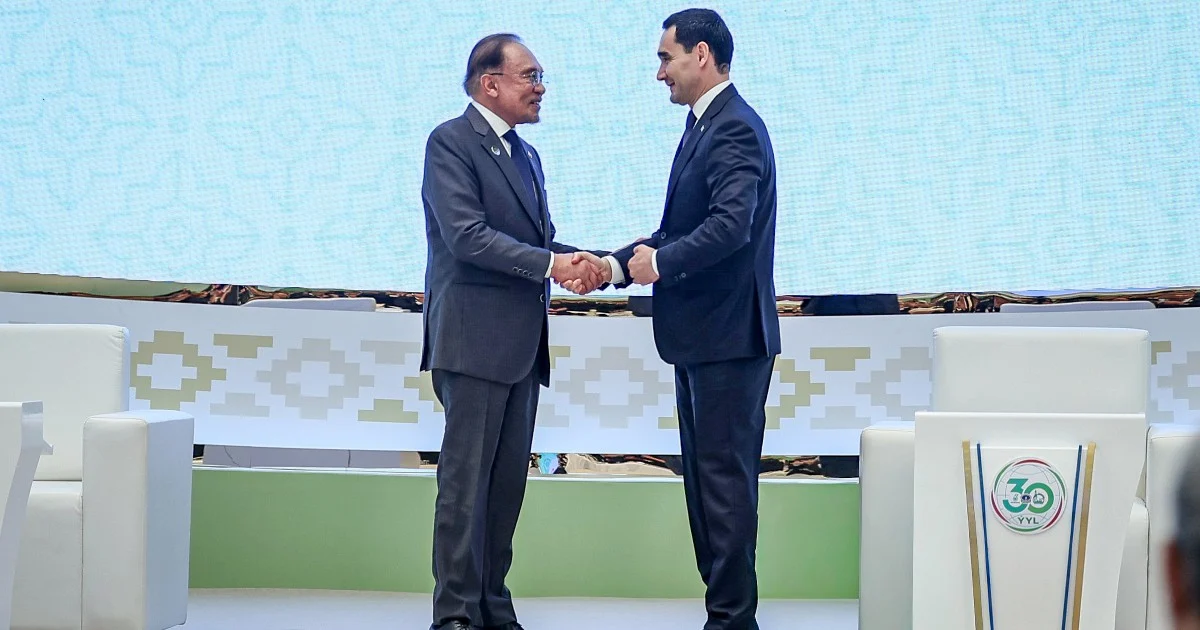
Malaysia and Turkmenistan have formalised a framework for deepened cooperation spanning the energy sector and broader economic dimensions, emerging from Prime Minister Datuk Seri Anwar Ibrahim's recent state visit to the Central Asian nation. The agreement represents a deliberate expansion of ties between the two countries and underscores Malaysia's strategic intent to broaden its regional partnerships beyond traditional Southeast Asian markets.
The energy sector stands as the cornerstone of this renewed bilateral relationship. Turkmenistan, one of the world's largest natural gas reserves holders, possesses significant potential to supply energy resources to Asian markets, including Malaysia. For Malaysia, which has faced questions about long-term domestic energy security and the sustainability of its own reserves, engagement with energy-rich nations in Central Asia offers a pathway to diversify supply sources and secure stable partnerships for future resource needs. This alignment is particularly relevant as regional economies navigate the transition toward cleaner energy systems whilst maintaining reliable baseload power generation.
The broader economic collaboration framework extends far beyond hydrocarbon exchanges. Malaysia and Turkmenistan have identified trade and investment as priority areas for mutual growth. Malaysian businesses possess expertise in financial services, manufacturing, telecommunications, and downstream energy processing—sectors where Turkmenistan is actively seeking external partnerships to modernise its economy and integrate more deeply with global value chains. Conversely, Turkmenistan's raw material endowments and geographical position as a bridge between Asia and Europe create opportunities for Malaysian investors seeking exposure to Central Asian markets.
Transportation infrastructure emerges as a critical enabler for bilateral commerce. The logistical challenge of connecting Southeast Asia to Central Asia has historically limited trade volumes, but improved transportation corridors could unlock new commercial possibilities. Malaysia's established expertise in port operations, logistics management, and maritime services positions it advantageously to contribute to infrastructure development initiatives. Enhanced connectivity would benefit not merely bilateral trade but could position Malaysia as a crucial transit hub for goods flowing between Central Asia and Southeast Asia.
Educational collaboration represents another dimension of this partnership with long-term strategic implications. Malaysian universities and vocational training institutions have developed strong reputations across Asia, attracting students from neighbouring countries. Expanding educational ties with Turkmenistan would facilitate knowledge transfer, particularly in technical disciplines aligned with energy sector requirements, whilst simultaneously building people-to-people connections that underpin sustained diplomatic relations. Such exchanges also create pathways for future business partnerships as young professionals from Turkmenistan gain exposure to Malaysian professional networks and business culture.
Technology transfer and innovation collaboration feature prominently in the agreement's scope. Malaysia, whilst not a technology leader in global terms, has developed competencies in specific sectors including digital transformation, telecommunications infrastructure, and environmental technologies. For a nation like Turkmenistan seeking to modernise its industrial base and improve operational efficiencies in resource extraction and processing, such technological inputs carry tangible value. Joint ventures and research collaborations could position both countries as contributors to regional technological advancement.
Prime Minister Anwar Ibrahim's personal visit to Turkmenistan signals Malaysia's commitment to maintaining high-level diplomatic engagement with Central Asian stakeholders. Such visits are not merely ceremonial; they facilitate direct negotiation of strategic priorities and demonstrate national commitment to partnership development at the highest political levels. This level of engagement reflects Malaysia's recognition that Central Asia matters to regional stability, energy security, and economic diversification—issues increasingly prominent in Malaysian strategic thinking.
The timing of this agreement aligns with broader regional geopolitical dynamics. Central Asian nations, historically within Russia's sphere of influence, are increasingly diversifying their international partnerships. Turkmenistan, in particular, has sought to strengthen ties with Asian economies whilst balancing its relationships with traditional partners. Malaysia's engagement contributes to this diversification and potentially positions Southeast Asia more prominently within Turkmenistan's strategic calculations. Such developments have implications extending beyond bilateral relations, potentially reshaping regional power dynamics and creating new coalitions around shared interests in energy security and economic development.
For Malaysian policymakers, deepened engagement with Central Asia represents a natural extension of the country's regional role and economic ambitions. As a nation with substantial Islamic heritage, established business networks across the Muslim world, and proven capacity to navigate complex regional relationships, Malaysia possesses genuine competitive advantages in Central Asian engagement. Unlike larger regional powers, Malaysia approaches such partnerships without historical baggage or hegemonic intentions, potentially making it an attractive partner for nations seeking balanced international relationships.
The practical implementation of these agreements will now occupy both governments' attention. Sectoral delegations from Malaysian companies in energy, finance, and technology will likely undertake exploratory missions to Ashgabat to identify specific partnership opportunities. Similarly, Turkmen business representatives may visit Malaysia to understand available investment vehicles and partnership structures. These technical-level engagements, though less visible than high-level diplomatic visits, ultimately determine whether agreements translate into sustained commercial relationships or remain primarily symbolic diplomatic exercises.
Looking forward, the success of Malaysia-Turkmenistan cooperation depends substantially on both nations' commitment to removing administrative barriers and creating conducive frameworks for business interaction. Currency convertibility, visa facilitation for business travellers, and clear regulatory pathways for joint ventures will prove crucial. Additionally, both nations must identify quick-win projects capable of generating early commercial returns, thereby building momentum and political commitment for more ambitious long-term initiatives.
This partnership also carries implications for Malaysia's broader strategic positioning in an era of intensifying great power competition. By expanding ties with Central Asian nations, Malaysia diversifies its international relationships and reduces dependency on any single regional alliance structure. Such strategic autonomy has consistently characterised Malaysian foreign policy, and the Turkmenistan engagement represents a contemporary manifestation of this principle. As the region continues evolving, Malaysia's ability to maintain productive relationships across diverse partners will remain a crucial asset.

%22%2F%3E%3C%2Fpattern%3E%3C%2Fdefs%3E%3Crect%20width%3D%22100%25%22%20height%3D%22100%25%22%20fill%3D%22url(%23ph2hy9vg)%22%2F%3E%3Crect%20width%3D%22100%25%22%20height%3D%22100%25%22%20fill%3D%22url(%23ph2hy9vp)%22%2F%3E%3Ctext%20x%3D%2250%25%22%20y%3D%2250%25%22%20text-anchor%3D%22middle%22%20dominant-baseline%3D%22central%22%20fill%3D%22rgba(255%2C255%2C255%2C0.95)%22%20font-family%3D%22Georgia%2C%20'Times%20New%20Roman'%2C%20serif%22%20font-weight%3D%22700%22%20font-size%3D%22272%22%20letter-spacing%3D%22-0.02em%22%3EAnwar%3C%2Ftext%3E%3C%2Fsvg%3E)