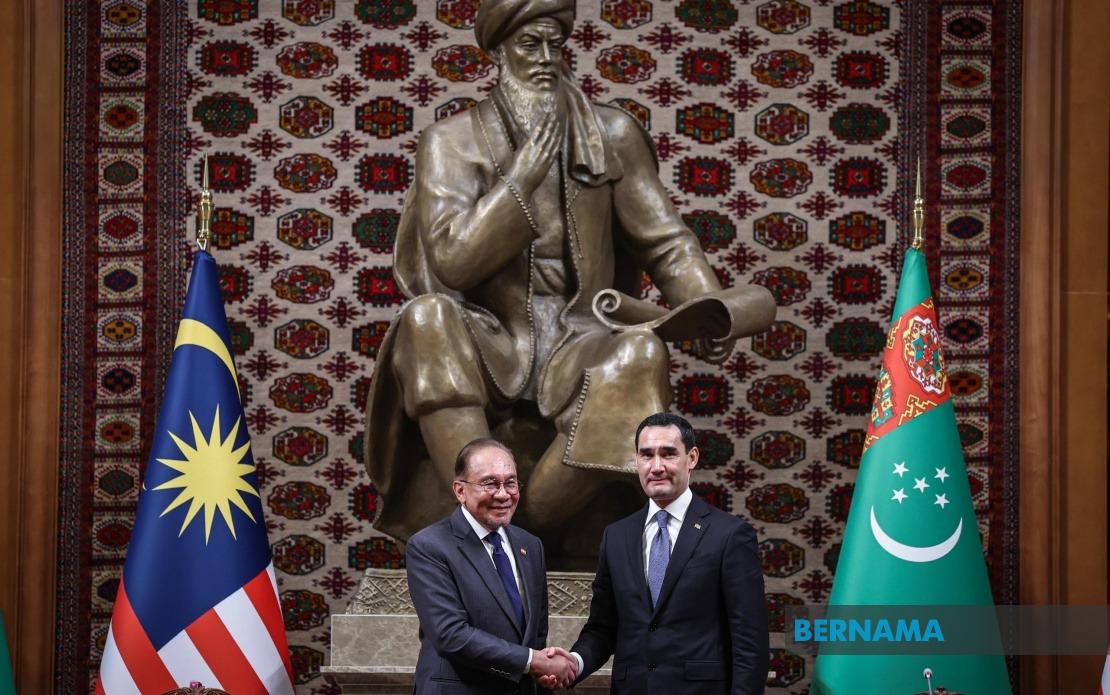
Prime Minister Datuk Seri Anwar Ibrahim has announced a significant deepening of Malaysia's relationship with Turkmenistan, establishing what both nations characterise as a more structured and progressive bilateral partnership grounded in mutual strategic interests and shared benefits. The commitment emerged from substantive discussions between Anwar and Turkmenistan President Serdar Berdimuhamedov at the Presidential Palace in Ashgabat on Friday, where the two leaders formalised their vision through the exchange of multiple agreements and memoranda of understanding.
The bilateral engagement marks an important diplomatic milestone for Malaysia in Central Asia, representing Anwar's inaugural official visit to Turkmenistan since assuming office as the nation's 10th Prime Minister in November 2022. Coming at Berdimuhamedov's invitation, the two-day visit signals both countries' determination to move beyond ceremonial diplomacy towards concrete, implementable cooperation frameworks that benefit their respective populations and advance regional stability.
At the joint press conference held in Ashgabat, Anwar underscored the comprehensive nature of the partnership under discussion, emphasising that Malaysia and Turkmenistan would pursue their collaboration through channels characterised by disciplined implementation, transparency, and operational effectiveness. This approach reflects a broader diplomatic philosophy increasingly adopted by Malaysia in its regional engagements—moving away from aspirational rhetoric towards measurable, time-bound commitments that deliver tangible outcomes for citizens and businesses.
The four key documents exchanged during the visit demonstrate the breadth of intended cooperation. An Air Services Agreement between the two governments creates a foundation for expanded aviation connectivity, potentially facilitating increased business travel and tourism between Malaysia and Turkmenistan. Two additional memoranda involving Malaysia's Ministry of Transport and Turkmenistan's State Service, as well as corresponding diplomatic institutions under each nation's foreign ministry, establish bureaucratic mechanisms to sustain engagement and resolve implementation challenges as they arise. The fourth agreement, signed between Malaysia's and Turkmenistan's academies of sciences, opens pathways for research collaboration in fields ranging from energy technology to natural resource management.
The substantive agenda encompassing these agreements reveals Malaysia's strategic interests in Central Asia. Energy cooperation tops the list, reflecting Turkmenistan's significant natural gas reserves and Malaysia's position as a major energy consumer and exporter within Asia-Pacific. Trade and investment discussions indicate Malaysian businesses' interest in Turkmenistan's market and regional position along the historic Silk Road corridors. The explicit inclusion of halal industry and Islamic banking cooperation positions Malaysia as a partner in developing Turkmenistan's Muslim-majority economy through knowledge transfer in sectors where Malaysia has built considerable expertise and international certification authority.
Education, research, and science and technology cooperation address longer-term human capital development. Malaysian universities and research institutions increasingly seek partnerships beyond traditional Western institutions, and collaboration with Turkmenistan's academy of sciences reflects a strategic pivot towards deepening ties with Central Asian knowledge systems. Tourism engagement suggests both nations see reciprocal potential in cultural and heritage tourism, particularly as Malaysian tourism operators seek new markets and Turkmenistan develops its tourism infrastructure.
The inclusion of air connectivity within the partnership framework holds particular significance for Malaysia's broader Southeast Asian strategic positioning. Direct flights between Malaysia and Turkmenistan could transform the efficiency of bilateral business dealings and regional trade flows, positioning Malaysia as a natural hub for Southeast Asian engagement with Central Asia. This geographical and economic bridge-building aligns with Malaysia's historical role as a maritime trading crossroads and its contemporary aspiration to serve as a connector between major global regions.
Anwar's delegation composition reflects the government's integrated approach to this partnership. The presence of Minister of Investment, Trade and Industry Datuk Seri Johari Abdul Ghani alongside Minister of Economy Akmal Nasrullah Mohd Nasir demonstrates that engagement with Turkmenistan is framed not as foreign policy theatre but as an economic opportunity requiring direct involvement of Malaysia's investment and trade machinery. This signals to Malaysian private sector stakeholders that opportunities may emerge from these formalised channels.
The bilateral discussions, as characterised by Anwar, transcended superficial protocol exchanges and engaged substantively with how both nations can cooperate across multiple sectors simultaneously. This multi-sectoral approach contrasts with narrower bilateral relationships that focus on single industries or strategic assets. The simultaneous pursuit of energy cooperation, trade frameworks, halal industry development, educational partnerships, and connectivity improvements creates multiple reinforcing incentives for both governments to maintain momentum and ensure follow-through on commitments.
The emphasis on friendship grounded in deep trust and mutual respect, as articulated in Anwar's closing remarks, carries particular weight given Malaysia's historical engagement patterns in Asia. Rather than transactional relationships based solely on immediate commercial advantage, the framing suggests both nations view this partnership as foundational to a longer-term strategic alignment. For Malaysia, this represents a measured approach to Central Asian engagement—neither overstating the relationship nor undervaluing Turkmenistan's potential as a partner in Malaysia's broader economic and strategic diversification away from traditional regional and Western allies.
The success of these agreements ultimately depends on implementation rigour, a concern both leaders explicitly acknowledged. Establishing transparent, disciplined mechanisms for follow-through distinguishes this partnership from numerous other bilateral frameworks that remain dormant after initial ceremonies. Malaysian policymakers have learned from past experiences that documented commitments require dedicated institutional attention, resource allocation, and regular performance review to translate into measurable outcomes.
From a regional perspective, Malaysia's expanding engagement with Central Asia diversifies its geopolitical and economic partnerships during a period of significant power realignment in Asia. As regional attention focuses heavily on US-China competition, India's rise, and intra-Southeast Asian dynamics, Malaysia's deliberate cultivation of partnerships with Central Asian nations demonstrates strategic awareness that economic opportunity and political stability extend beyond these more frequently discussed axes of regional competition and cooperation.


%22%2F%3E%3C%2Fpattern%3E%3C%2Fdefs%3E%3Crect%20width%3D%22100%25%22%20height%3D%22100%25%22%20fill%3D%22url(%23ph2hy9vg)%22%2F%3E%3Crect%20width%3D%22100%25%22%20height%3D%22100%25%22%20fill%3D%22url(%23ph2hy9vp)%22%2F%3E%3Ctext%20x%3D%2250%25%22%20y%3D%2250%25%22%20text-anchor%3D%22middle%22%20dominant-baseline%3D%22central%22%20fill%3D%22rgba(255%2C255%2C255%2C0.95)%22%20font-family%3D%22Georgia%2C%20'Times%20New%20Roman'%2C%20serif%22%20font-weight%3D%22700%22%20font-size%3D%22272%22%20letter-spacing%3D%22-0.02em%22%3EAnwar%3C%2Ftext%3E%3C%2Fsvg%3E)