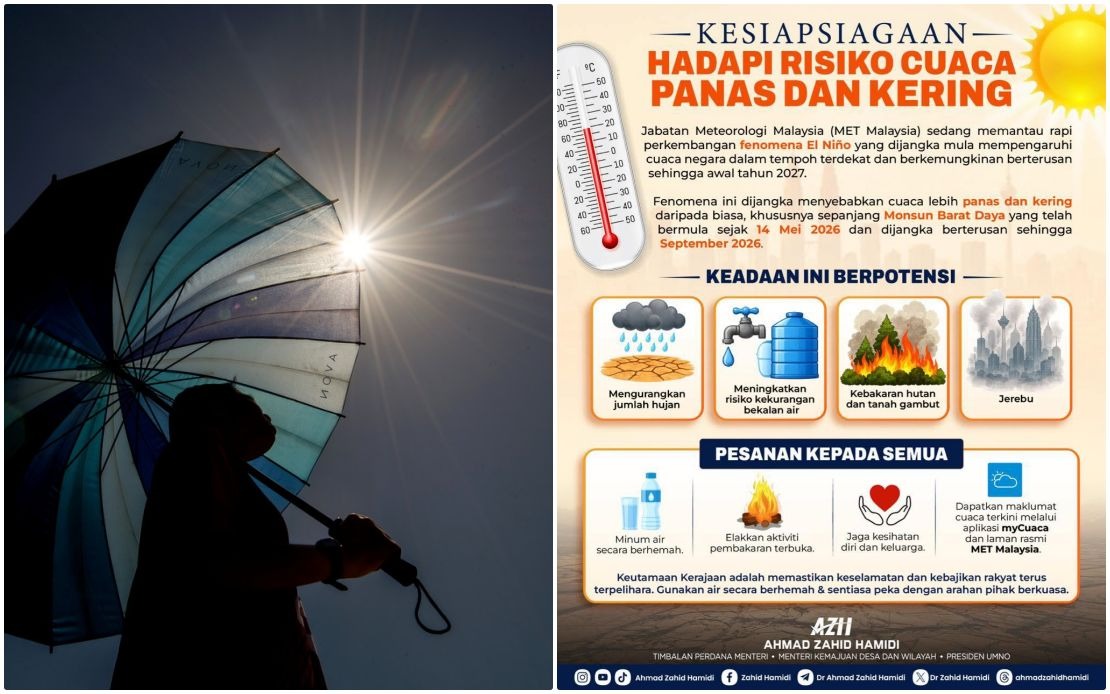
Malaysia faces an extended period of heightened heat and drought conditions as the El Niño phenomenon approaches and looks set to grip the nation through the early months of 2027. Deputy Prime Minister Datuk Seri Dr Ahmad Zahid Hamidi, who chairs the Central Disaster Management Committee, has issued a public advisory urging Malaysians to prepare now for the climatic pressures ahead, signalling that government agencies are already mobilizing contingency measures across multiple sectors.
The El Niño event carries significant ramifications for Southeast Asia's most developed economy. The phenomenon is projected to intensify hotter and drier conditions particularly during the Southwest Monsoon, a seasonal pattern that began on May 14 and typically runs through September. This timing compounds concerns, as the monsoon period normally sees variable rainfall across the peninsula. When El Niño overlaps with this season, the suppression of rainfall becomes more pronounced, creating cascading risks for water security, agricultural productivity, and environmental stability across the region.
Among the most pressing concerns is the prospect of acute water shortages in affected areas. Malaysia's water infrastructure, though relatively advanced, remains vulnerable to prolonged dry spells, particularly in states that depend on monsoon precipitation for reservoir replenishment. The risk extends beyond urban water supply; rural communities and agricultural zones face serious challenges to irrigation and livestock operations. Ahmad Zahid specifically highlighted the correlation between reduced rainfall and heightened vulnerability to both controlled and uncontrolled fire incidents, a pattern well documented in Southeast Asia during previous El Niño cycles.
The threat of forest and peatland fires represents perhaps the most visible transnational concern. Previous El Niño events, notably in 2015, triggered catastrophic wildfires across Indonesia and Malaysia that blanketed the region in choking haze, disrupting daily life, affecting respiratory health across multiple countries, and causing billions in economic losses. The potential for history to repeat itself has prompted authorities to emphasize prevention, placing responsibility on both government agencies and individual citizens to avoid open burning and maintain heightened vigilance around fire sources.
Ahmad Zahid's statement reflects a deliberate shift toward public engagement and shared responsibility in climate adaptation. Rather than framing the El Niño challenge as purely a government management issue, the Deputy Prime Minister has positioned it as requiring sustained collective action. His call for prudent water use, avoidance of open burning, and heightened attention to vulnerable populations—particularly elderly citizens and those with pre-existing health conditions—acknowledges that extreme heat poses direct human health risks alongside environmental and economic threats.
The Malaysian Meteorological Department (MetMalaysia) has been identified as the primary source of real-time weather intelligence. Ahmad Zahid specifically directed the public to utilize the myCuaca mobile application and official MetMalaysia channels for continuous monitoring and updated forecasts. This emphasis on accessible, technology-enabled information reflects recognition that public preparedness depends on timely, accurate data reaching households and businesses throughout the country. The myCuaca platform has evolved substantially in recent years, now offering hyperlocal forecasting capabilities that enable residents and businesses to anticipate conditions specific to their districts.
For Malaysia's business community, particularly sectors reliant on rainfall patterns, the El Niño outlook necessitates strategic planning adjustments. Water-intensive industries including palm oil production, semiconductor manufacturing, and hydroelectric power generation face operational pressures. Agricultural enterprises must reconsider planting schedules, irrigation infrastructure investments, and crop selection to build resilience against extended dry periods. The energy sector faces particular complexity, as reduced precipitation affects hydroelectric output at a time when cooling demands for data centers and air conditioning typically spike during heat waves.
The duration of this particular El Niño cycle—stretching into early 2027—distinguishes it as a medium-to-long-term planning challenge rather than a temporary seasonal adjustment. Regional meteorological agencies have already begun analyzing ocean temperature anomalies and atmospheric circulation patterns that inform these extended projections. For Malaysian households and enterprises, this extended timeline underscores the necessity of moving beyond temporary conservation measures toward systemic adaptations: rainwater harvesting infrastructure improvements, updated fire safety protocols, and healthcare capacity expansion to manage heat-related illnesses.
Government coordination across multiple agencies will be essential. Ahmad Zahid's role as chairman of the Central Disaster Management Committee positions him as a coordinating authority across disaster mitigation, water resource management, forestry services, and health systems. The implicit message in his statement is that this challenge requires synchronized responses: water authorities must optimize distribution systems, forestry agencies must enhance fire surveillance and suppression readiness, health services must prepare for surge demands, and local authorities must implement land-use controls to minimize fire ignition risks.
Regional context adds another layer of complexity and necessity. El Niño impacts are not confined within Malaysia's borders. When Indonesian peatlands dry and burn, transboundary haze affects Malaysian air quality regardless of domestic fire prevention efforts. Coordinated responses across ASEAN become imperative, as regional water systems, atmospheric circulation, and ecological zones are fundamentally interconnected. The long timeline until early 2027 provides opportunity for Malaysian authorities to engage with regional counterparts on harmonized climate adaptation strategies.
Citizens are being encouraged to adopt precautionary habits now rather than react to shortages or emergencies later. Water conservation during normal conditions—fixing leaks, reducing garden irrigation, modifying consumption habits—builds the behavioral and infrastructural foundation for managing genuine scarcity. Similarly, compliance with open burning prohibitions and careful waste management reduce fire risks substantially. These individual actions, multiplied across millions of households and thousands of businesses, create the resilience margin that determines whether Malaysia navigates this El Niño cycle with manageable adjustment or significant disruption.
The advisory represents a calculated attempt at proactive public health and environmental management. By communicating the challenge transparently and soliciting public participation, Malaysian authorities are attempting to distribute responsibility and build social acceptance for the conservation measures that will likely become necessary. Whether this early warning catalyzes sustained behavioral change or fades from public attention once the initial headlines pass remains uncertain—a critical variable in determining Malaysia's actual vulnerability to the coming climatic pressures.

%22%2F%3E%3C%2Fpattern%3E%3C%2Fdefs%3E%3Crect%20width%3D%22100%25%22%20height%3D%22100%25%22%20fill%3D%22url(%23ph2hy9vg)%22%2F%3E%3Crect%20width%3D%22100%25%22%20height%3D%22100%25%22%20fill%3D%22url(%23ph2hy9vp)%22%2F%3E%3Ctext%20x%3D%2250%25%22%20y%3D%2250%25%22%20text-anchor%3D%22middle%22%20dominant-baseline%3D%22central%22%20fill%3D%22rgba(255%2C255%2C255%2C0.95)%22%20font-family%3D%22Georgia%2C%20'Times%20New%20Roman'%2C%20serif%22%20font-weight%3D%22700%22%20font-size%3D%22272%22%20letter-spacing%3D%22-0.02em%22%3EAnwar%3C%2Ftext%3E%3C%2Fsvg%3E)