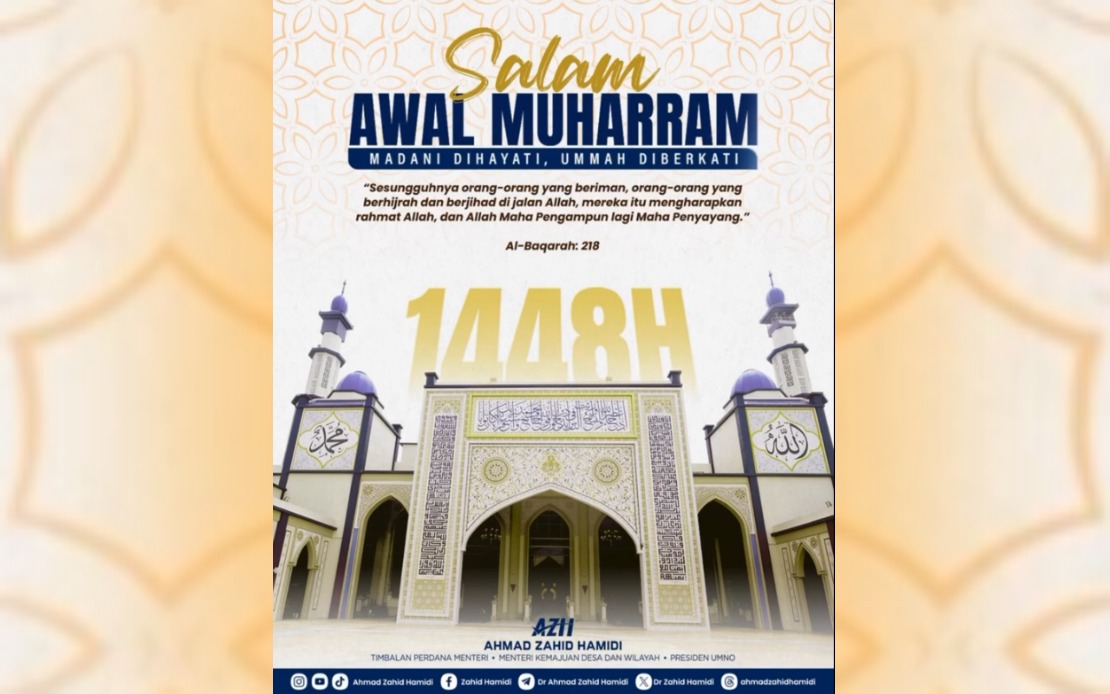
Malaysia's senior leadership has issued a coordinated call for the nation to internalize the transformative principles of Hijrah as the Islamic calendar marks the arrival of 1448H, positioning the Islamic New Year not merely as a date change but as a moment for genuine personal and collective renewal. Deputy Prime Minister Datuk Seri Dr Ahmad Zahid Hamidi framed the occasion as an opportunity for Malaysians to reflect on the deeper spiritual significance embedded in the Prophet Muhammad's migration, translating ancient wisdom into contemporary action for national advancement.
At the heart of the government's message lies a central conviction about how meaningful change actually occurs within societies and institutions. Datuk Seri Dr Ahmad Zahid emphasized that transformation requires far more than rhetoric or declarations of intent, instead demanding sustained commitment through disciplined effort and unwavering determination to surpass one's previous accomplishments. This framing carries particular resonance for Malaysia, a nation navigating complex economic pressures, governance challenges and the need for institutional modernization across multiple sectors simultaneously.
The Deputy Prime Minister's invocation of sacrifice and perseverance as guiding principles suggests the government recognizes significant challenges ahead that cannot be overcome through comfort or complacency. By linking these virtues explicitly to the work of leading communities, executing professional responsibilities and serving the public interest, the message appears designed to inspire both government personnel and ordinary citizens toward greater accountability and commitment. For a country contending with concerns about corruption, efficiency and public service delivery, such an emphasis on personal integrity and sustained effort takes on particular weight.
Deputy Prime Minister Datuk Seri Fadillah Yusof extended the framework by connecting Hijrah's principles directly to Malaysia's current economic circumstances and the practical pressures facing households and communities. He highlighted how global supply chain disruptions, economic uncertainties and the lingering effects of international crises have created material hardship for many Malaysians, positioning the Islamic New Year as an invitation toward greater prudence, adaptability and resilience in response. This grounding of spiritual reflection in concrete economic reality demonstrates how traditional religious observances can address contemporary anxieties about living costs, resource availability and financial security.
Fadillah's emphasis on moderation and the rejection of wastefulness extends Islamic teaching into household management and personal consumption patterns, areas where many Malaysian families are actively struggling with rising expenses for food, utilities and transportation. By encouraging wisdom in spending, energy conservation, food preservation and the prioritization of genuine needs above desires, the government provides practical guidance aligned with religious principles while simultaneously addressing national concerns about inflation and consumer spending. The framing of individual prudence as contributing to family stability, community welfare and national prosperity creates a clear logical chain connecting personal behavior to macro-level outcomes.
A significant portion of the government's message addresses what might be termed the national cohesion dimension of Hijrah, with multiple officials emphasizing that Malaysia's historical strength derives from its culturally and religiously diverse population living in relative harmony. Fadillah specifically warned against allowing differences to fracture society, instead urging the continuation and deepening of mutual respect, cooperation and togetherness. For Malaysia, where religious and ethnic sensitivities have periodically generated tensions, this explicit reminder that unity requires active cultivation and constant reinforcement during challenging times carries particular importance.
Communications Minister Datuk Fahmi Fadzil articulated a somewhat more introspective angle on Hijrah, presenting the occasion as primarily an opportunity for individual reflection, renewed conviction and strengthened faith as citizens navigate life's complexities. His invocation of courage to transform oneself, patience through adversity and sincerity in endeavor suggests a complementary emphasis on personal spiritual development alongside the collective themes stressed by other officials. This dual-track messaging acknowledges that meaningful national progress emerges from both individual character development and coordinated social action.
Minister Zulkifli Hasan, responsible for religious affairs within the Prime Minister's Department, provided specific spiritual guidance for how Muslim Malaysians should observe and internalize the occasion. His distinction between Maal Hijrah as merely a public holiday versus its deeper significance as a moment for self-examination and internal improvement reflects official concern that religious observances can become routinized without generating genuine behavioral or attitudinal change. By encouraging family-centered prayer practices and emphasizing the dual transitions of both concluding the previous Islamic year and initiating the new one, Hasan offers a structured pathway for Malaysians to engage meaningfully with the occasion.
The breadth of the government response, with some seventeen ministers and deputy ministers explicitly issuing Maal Hijrah messages across diverse portfolio areas, suggests a coordinated effort to embed the Hijrah narrative throughout the machinery of state. Education, agriculture, defense-adjacent portfolios like digital infrastructure, human resources, health and youth development all received explicit connection to Hijrah's themes, indicating a systematic attempt to infuse the new Islamic year's message throughout government operations and public messaging. This comprehensive approach suggests leadership believes that consistent reinforcement of these principles across multiple institutional voices will more effectively penetrate public consciousness than isolated statements.
For Malaysian observers and the broader Southeast Asian region, these coordinated messages reveal how a Muslim-majority nation's political leadership attempts to mobilize religious and cultural resources toward addressing contemporary governance and economic challenges. Rather than treating Islam as primarily a source of ceremonial observance or legal frameworks, the government here deploys Islamic historical narrative and spiritual principle as motivational resources intended to reshape public behavior toward greater discipline, sacrifice and collective responsibility. The success or failure of such efforts in actually moving public attitudes and behaviors remains distinct from the intent, but the articulation itself reflects official recognition that material challenges alone cannot fully explain national difficulties without also addressing questions of collective will, ethical standards and social cohesion.


%22%2F%3E%3C%2Fpattern%3E%3C%2Fdefs%3E%3Crect%20width%3D%22100%25%22%20height%3D%22100%25%22%20fill%3D%22url(%23ph2hy9vg)%22%2F%3E%3Crect%20width%3D%22100%25%22%20height%3D%22100%25%22%20fill%3D%22url(%23ph2hy9vp)%22%2F%3E%3Ctext%20x%3D%2250%25%22%20y%3D%2250%25%22%20text-anchor%3D%22middle%22%20dominant-baseline%3D%22central%22%20fill%3D%22rgba(255%2C255%2C255%2C0.95)%22%20font-family%3D%22Georgia%2C%20'Times%20New%20Roman'%2C%20serif%22%20font-weight%3D%22700%22%20font-size%3D%22272%22%20letter-spacing%3D%22-0.02em%22%3EAnwar%3C%2Ftext%3E%3C%2Fsvg%3E)