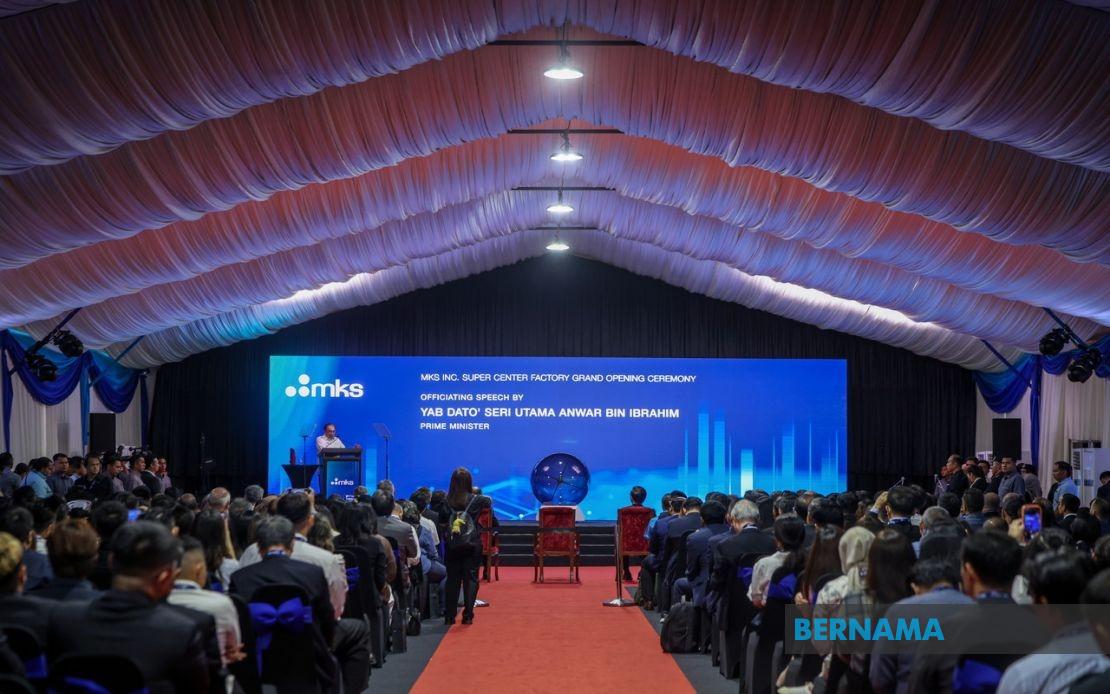
Prime Minister Datuk Seri Anwar Ibrahim has underscored Malaysia's strategic advantage in pursuing a non-aligned foreign policy that balances engagement with major powers while preserving the nation's autonomy and impartiality. Speaking during the inauguration of the MKS Super Centre facility in Bandar Cassia Technology Park at Batu Kawan, Anwar emphasized that this diplomatic approach has translated into tangible economic returns and elevated Malaysia's standing as a trusted partner across the global arena.
The Premier's remarks come at a moment when Malaysia seeks to leverage its geopolitical positioning to attract investment and deepen commercial partnerships. Rather than tilting exclusively toward any single bloc, Malaysia has cultivated relationships spanning multiple continents, from the United States to China, India, and Russia. This deliberate strategy of non-alignment, a cornerstone of Malaysian foreign policy since independence, continues to yield dividends in the contemporary multipolar landscape where nations worldwide compete for influence and economic cooperation.
Anwar pointed to Petroliam Nasional Bhd's recent agreement in Turkmenistan as evidence of Malaysia's expanding economic footprint through balanced engagement. Such ventures underscore how Malaysia's reputation for neutrality and independent decision-making creates confidence among partners that the country will not subordinate economic interests to ideological allegiances or pressure from powerful capitals. This predictability and autonomy have become valuable commodities in an era of intensifying great-power competition, making Malaysia an attractive destination for multinational firms and strategic partnerships.
The Prime Minister specifically referenced high-profile diplomatic visits, including a significant engagement with United States President Donald Trump last year, alongside parallel overtures to Beijing and New Delhi. These interactions illustrate Malaysia's conscious effort to maintain equidistance and symmetry in bilateral relations, avoiding the appearance of favoring one superpower over another. For Malaysian policymakers, this equilibrium is essential to safeguarding the nation's sovereignty while maximizing economic opportunities across competing spheres of influence.
Crucially, Anwar stressed that Malaysia's non-aligned positioning does not entail silence on global issues. Rather, the nation reserves the right to articulate positions on contentious matters affecting the international community while remaining fundamentally committed to cooperative engagement with all nations. This nuanced stance reflects Malaysia's experience navigating complex regional dynamics in Southeast Asia, where smaller nations must assert principles without unnecessarily antagonizing powerful neighbors or global stakeholders whose support remains economically vital.
The factory opening ceremony attended by Penang Chief Minister Chow Kon Yeow, Deputy Minister of Investment, Trade and Industry Sim Tze Tzin, and MKS president and chief executive officer John T.C. Lee served as a platform to articulate this broader vision. The presence of state leadership underscored the alignment between federal economic strategy and Penang's ambitions as a manufacturing and technology hub, demonstrating how Malaysia's international positioning translates into tangible infrastructure investment and job creation at the regional level.
For Malaysian businesses and investors, the implications are substantial. A foreign policy predicated on independence and inclusive engagement reduces the risk of sudden shifts in trade access, sanctions, or diplomatic isolation that might accompany more overtly aligned stances. Malaysian firms operating across different geopolitical zones benefit from the perception that their home government maintains stable, pragmatic relations with major trading partners regardless of international tensions.
Southeast Asia broadly stands to benefit from Malaysia's commitment to this principle. As a regional anchor and founding member of ASEAN, Malaysia's emphasis on non-alignment reinforces the Association's own doctrine of non-interference and centrality in regional affairs. By demonstrating that neutrality need not mean irrelevance, Malaysia provides a model that other Southeast Asian nations can reference in their own efforts to balance Chinese economic and strategic weight against American security interests and Indian economic ambitions.
The economic imperatives driving this diplomatic posture remain compelling. In an era when supply chains are increasingly regionalized and investment flows are highly sensitive to political risk, nations that project stability and impartiality gain competitive advantage. Malaysia's deliberate cultivation of this reputation—through consistent messaging about respect for sovereignty, emphasis on mutual benefit in partnerships, and principled but pragmatic engagement—has positioned it favorably in attracting foreign direct investment and facilitating technology transfer.
Looking forward, sustaining this balanced approach will require careful management as geopolitical tensions potentially intensify. The challenge for Malaysian leadership will be maintaining credibility across multiple constituencies while resisting pressure to choose sides in disputes where neutrality becomes increasingly costly. Anwar's articulation of Malaysia's position suggests the government intends to persist in this middle path, betting that the economic and diplomatic dividends of independence continue to outweigh the costs of refusing alignment.

%22%2F%3E%3C%2Fpattern%3E%3C%2Fdefs%3E%3Crect%20width%3D%22100%25%22%20height%3D%22100%25%22%20fill%3D%22url(%23ph2hy9vg)%22%2F%3E%3Crect%20width%3D%22100%25%22%20height%3D%22100%25%22%20fill%3D%22url(%23ph2hy9vp)%22%2F%3E%3Ctext%20x%3D%2250%25%22%20y%3D%2250%25%22%20text-anchor%3D%22middle%22%20dominant-baseline%3D%22central%22%20fill%3D%22rgba(255%2C255%2C255%2C0.95)%22%20font-family%3D%22Georgia%2C%20'Times%20New%20Roman'%2C%20serif%22%20font-weight%3D%22700%22%20font-size%3D%22272%22%20letter-spacing%3D%22-0.02em%22%3EAnwar%3C%2Ftext%3E%3C%2Fsvg%3E)