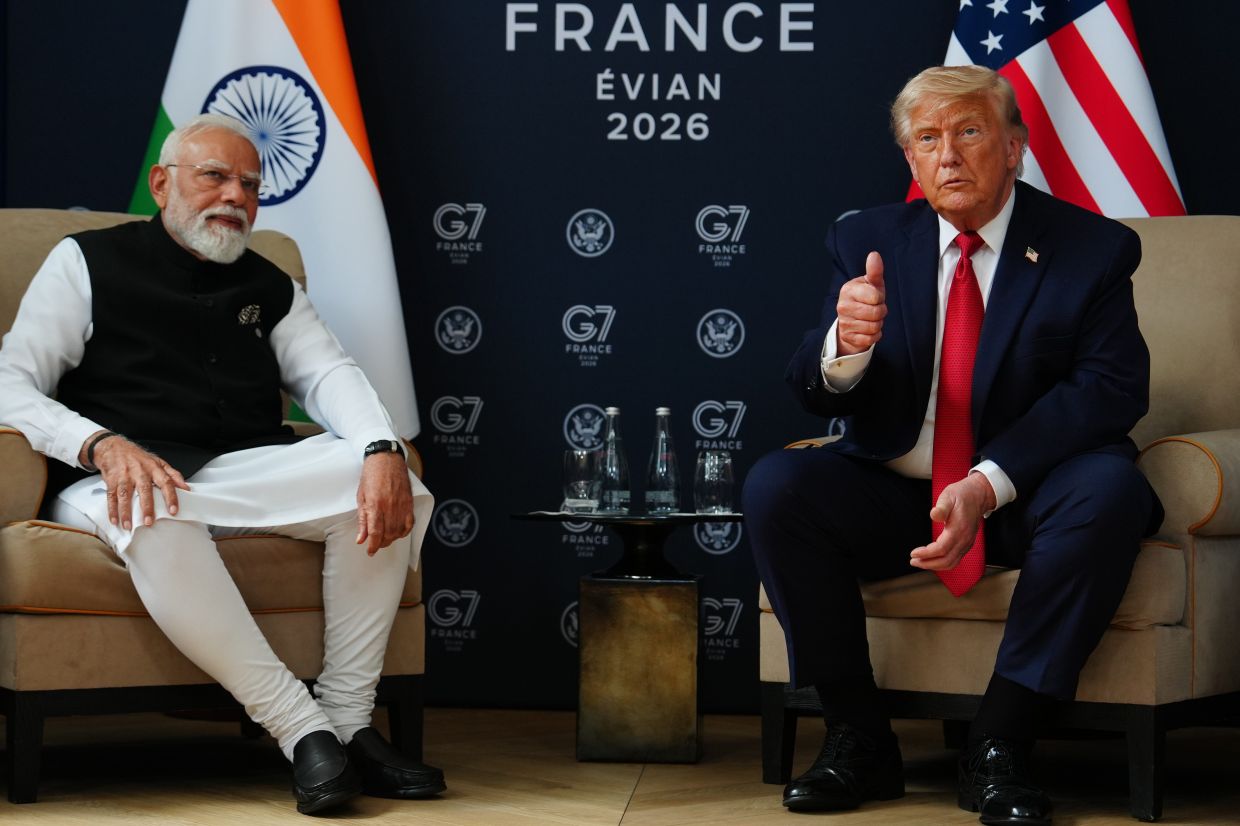
Indian Prime Minister Narendra Modi has signalled substantial headway in long-stalled trade negotiations with the United States, announcing after a face-to-face meeting with President Donald Trump that talks towards a bilateral trade agreement have reached a critical juncture. The two leaders met on the margins of the G7 summit in Evian, France on Wednesday, marking their first in-person encounter since February 2025 when they met in Washington. An official readout from India's foreign ministry underscored the momentum, noting that both leaders took "particular satisfaction" in the "significant progress made in negotiations towards an interim Bilateral Trade Agreement," signalling that this phase of talks is nearing completion.
Trump's own assessment to reporters in Evian underscored the proximity to an agreement, with the US president telling journalists that Washington and New Delhi were "very close" to sealing a deal. Trump characterised Modi as an exceptionally skilled negotiator, using colourful language to describe the Indian leader's approach to trade discussions. The framing of Modi as a formidable negotiator reflects the challenging nature of these talks, which have stretched across multiple administrations and involved complex discussions around market access, tariff structures, and sectoral priorities for both nations.
Official statements from New Delhi indicate that Modi and Trump have tasked their respective trade teams to accelerate work towards what they are describing as a "commercially meaningful agreement at the earliest." This language suggests both sides have moved beyond preliminary frameworks and are now focused on substantive outcomes that will have tangible economic impacts for businesses and consumers in both countries. The directive carries implicit pressure on negotiators to resolve outstanding contentious issues that have repeatedly delayed finalisation in recent months.
US Trade Representative Jamieson Greer is scheduled to travel to India next week to lead the latest round of formal negotiations, indicating the two governments intend to maintain momentum and translate the high-level political support into concrete progress at the technical level. This pattern of regular diplomatic visits and negotiating missions demonstrates the priority both administrations have attached to concluding an arrangement that aligns with their broader strategic partnership in the Indo-Pacific region. For Malaysian and Southeast Asian observers, the success or failure of US-India trade negotiations carries implications for regional trade dynamics and how major powers structure engagement with Asian economies.
The bilateral trade ambition reflects the scale of economic integration both nations envision. Washington and New Delhi have formally committed to expanding bilateral trade to US$500 billion by 2030, a target that requires sustained growth in commerce across multiple sectors ranging from agriculture and pharmaceuticals to technology and defence-related manufacturing. Achieving this figure would represent a significant expansion from current levels and would necessitate resolving long-standing disputes over tariff schedules and product categories that have prevented agreement on a comprehensive framework.
India's Commerce Minister Piyush Goyal indicated in early June that negotiators had completed approximately 99 per cent of the first major component of the agreement, suggesting that what remains are technical details and final political sign-offs rather than fundamental disagreements on core principles. This assessment provides a more granular picture than the headline announcements, revealing that substantial groundwork has been completed and the remaining challenges are increasingly about finalising language and ensuring both sides can present the outcome as satisfactory to their domestic stakeholders.
Progress towards a trade deal has not followed a linear path. The two countries achieved an initial understanding in February, but negotiations subsequently stalled following a significant blow to Trump's trade agenda when the US Supreme Court struck down his sweeping tariff measures. Following that court decision, the Trump administration launched investigations into alleged unfair trade practices by multiple countries, including India, while simultaneously implementing a blanket 10 per cent tariff on imports. These developments created uncertainty about Washington's broader trade strategy and complicated efforts to conclude bilateral negotiations at a time when the regulatory and tariff environment was in flux.
Modi used his meeting with Trump to raise security concerns affecting Indian nationals, particularly regarding seafarers operating in volatile regions. The Indian Prime Minister urged Trump to ensure the safety of Indian seafarers in the context of the Iran-US deal aimed at resolving Middle East hostilities. This concern stems from a recent incident on June 10 when three Indian sailors were killed in a US military strike targeting a commercial vessel operating off Oman. The intersection of maritime safety, Middle East geopolitics, and bilateral trade negotiations underscores how security and economic interests become intertwined in great power relationships.
The Middle East conflict has imposed substantial economic costs on India and other Global South nations. Modi emphasised during his discussions with Trump that disruptions to fuel, fertiliser, and food supply chains resulting from regional instability will continue reverberating through developing economies for an extended period. Iran's closure of the Strait of Hormuz, a critical maritime chokepoint through which substantial quantities of global oil and gas transit, has constrained energy supplies and elevated costs for energy-dependent economies. India's particular vulnerability reflects both its substantial energy import requirements and its reliance on Middle Eastern petroleum sources, making regional stability directly relevant to India's economic growth trajectory.
For Southeast Asian nations, Modi's concerns about Middle East spillovers carry direct relevance, as the region similarly depends on stable energy supplies and unimpeded maritime commerce through critical waterways. The intersection of the Modi-Trump trade negotiations with discussions about Middle East security and energy supply chains illustrates how regional issues in one part of Asia influence bilateral economic arrangements with the United States. Malaysia and other ASEAN members monitor US engagement with major regional powers carefully, recognising that how Washington structures trade relationships and security partnerships with countries like India shapes the broader competitive and cooperative environment in which Southeast Asian economies operate.
The timing of these negotiations also reflects broader strategic considerations. The expansion of US-India economic ties serves American interests in developing alternative trading partners and deepening engagement with a major Asian democracy, while for India, a substantial trade agreement with Washington provides economic diversification and reinforces its position as a crucial strategic partner for the United States in managing geopolitical competition with China. For the region, a successful US-India trade agreement could influence how other Asian economies structure their own economic relationships with the United States and whether Washington prioritises bilateral deals over regional frameworks in its Asian trade strategy.

%22%2F%3E%3C%2Fpattern%3E%3C%2Fdefs%3E%3Crect%20width%3D%22100%25%22%20height%3D%22100%25%22%20fill%3D%22url(%23ph2hy9vg)%22%2F%3E%3Crect%20width%3D%22100%25%22%20height%3D%22100%25%22%20fill%3D%22url(%23ph2hy9vp)%22%2F%3E%3Ctext%20x%3D%2250%25%22%20y%3D%2250%25%22%20text-anchor%3D%22middle%22%20dominant-baseline%3D%22central%22%20fill%3D%22rgba(255%2C255%2C255%2C0.95)%22%20font-family%3D%22Georgia%2C%20'Times%20New%20Roman'%2C%20serif%22%20font-weight%3D%22700%22%20font-size%3D%22272%22%20letter-spacing%3D%22-0.02em%22%3EAnwar%3C%2Ftext%3E%3C%2Fsvg%3E)