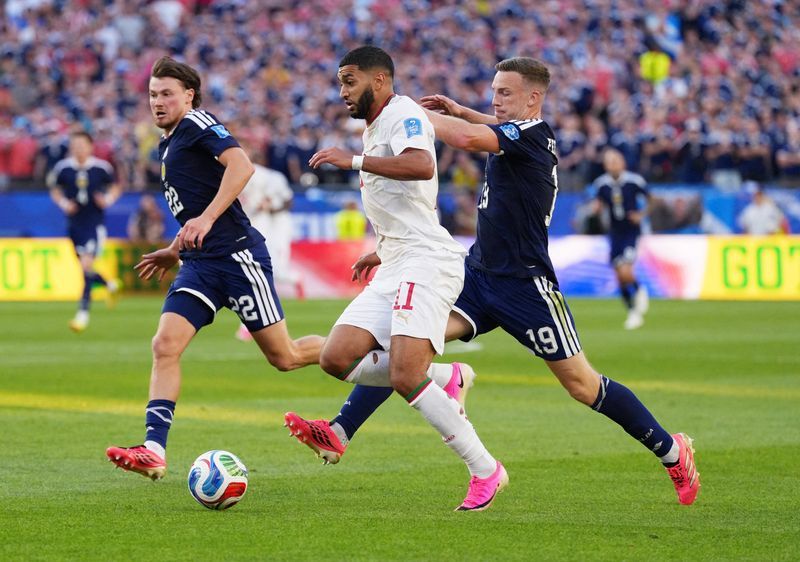
Morocco produced a masterclass in controlled aggression at Foxborough on Friday, defeating Scotland 1-0 through an electrifying early strike that showcased their credentials as one of this tournament's most formidable sides. Ismael Saibari's goal after just 71 seconds proved the fastest in this World Cup edition, capturing the essence of a performance in which the North Africans imposed their physical dominance and tactical precision from the opening whistle. The victory propels Morocco to the summit of Group C with four points from two matches, leaving them in pole position to advance as group winners heading into their final fixture against Haiti on Wednesday.
The Scots arrived in Massachusetts riding a wave of euphoria following their 1-0 triumph over Haiti in their tournament opener—their first World Cup victory since 1990—but any lingering confidence was swiftly dismantled by Morocco's suffocating approach. What made the scoreline deceptive was the sheer extent of the hosts' superiority throughout the contest. The Scottish defence was breached almost immediately when Brahim Diaz's penetrating cross found Saibari lurking behind a high line, with central defender Grant Hanley's aggressive positioning playing directly into the Moroccan's hands. The finish itself was emphatic, a powerful drive that left goalkeeper Angus Gunn with no chance and set the tone for an afternoon of relentless Moroccan pressure.
Saibari's moment of individual brilliance carries particular significance in the broader context of African football history at world football's premier tournament. By scoring in his first two World Cup appearances, the 25-year-old has matched an exclusive club of African performers, joining Egypt's Mohamed Salah as only the second player from the continent to achieve this feat. This milestone becomes even more remarkable considering Saibari's established himself following his side's 1-1 draw against Brazil the previous week—a result that demonstrated Morocco's ability to compete against established powerhouses. Reports of the midfielder's impending transfer to German champions Bayern Munich add another layer of intrigue to his emergence as one of the tournament's unexpected stars.
Morocco's dominance extended far beyond the opening moments, establishing a pattern of possession and territorial control that left Scotland perpetually on the back foot. The visitors could not muster a single attempt on or off target until deep into the first-half stoppage time, an alarming statistic that underscores how thoroughly the North Africans manipulated the game's tempo and rhythm. Bilal El Khannouss nearly doubled Morocco's advantage in the 36th minute following another flowing attacking sequence, his effort sailing over the crossbar after he had time and space to execute. The midfield battle proved decidedly one-sided, with Morocco's pressing and ball-winning intensity strangling Scotland's ability to construct meaningful attacking moves.
The second half followed an identical script. Scotland's inability to generate offensive threat continued to frustrate their hopes of salvaging something from what increasingly appeared a lost cause. Saibari tested Gunn's concentration with a deflected effort that struck the post, while El Khannouss forced the Scottish goalkeeper into a smart save with a well-placed glancing header shortly after the interval. These were not desperate scrambles but composed finishes emerging from controlled buildup play, evidence of Morocco's structural superiority. Scotland's tactical blueprint—predicated on defensive solidity and opportunistic counterattacking—crumbled against an opponent unwilling to afford them time or space to implement their gameplan.
The Scottish response came only in the closing stages when desperation forced them to commit greater numbers forward. They created genuine openings as Morocco eased off their relentless pressure, but none of their late rallies produced the equaliser that the contest's pattern had rendered increasingly unlikely. There was a clear sense that Scotland had been outthought, outrun, and outfought by a side operating on a different tactical plane entirely. The absence of clinical finishing denied Morocco a more emphatic victory margin, yet even the single goal felt sufficient given the comprehensiveness of their dominance.
The timing of this encounter carries geopolitical undertones that extend beyond sporting competition. Morocco's captain Achraf Hakimi faced vocal hostility from Scottish supporters during the match, with the full-back currently entangled in rape trial proceedings that have cast a shadow over the North African campaign. Despite this external distraction, the team's performance suggested an ability to compartmentalise and maintain focus on their tournament objectives. The incident underscores the sometimes uncomfortable intersection between professional football and broader societal issues that cannot be neatly separated from competitive narratives.
Morocco's display carries particular resonance for Southeast Asian readers observing the tournament's evolution. The North Africans demonstrated that smaller footballing nations can compete effectively against more traditionally established powers through tactical discipline, physical conditioning, and collective commitment. Their passage to Qatar's semi-finals four years ago announced their arrival as genuine contenders, and this performance against Scotland suggests that ascension reflects structural progress rather than a mere anomaly. For regional audiences tracking emerging football powers, Morocco's trajectory offers instructive lessons about the pathways through which countries can elevate their standing on the world stage.
Scotland's predicament differs markedly from Morocco's trajectory. The Scots now carry three points into their crucial final fixture against Brazil, the tournament's five-time champions, knowing that qualification depends on results elsewhere. They require either victory against the South Americans—an outcome that would appear remote given Brazil's stature—or favourable outcomes in parallel Group C matches. Haiti's encounter with Brazil later Friday would provide additional clarity, but mathematically Scotland remains in contention despite Friday's sobering reality. The gap between their Haiti victory and this Scotland collapse illustrates the tournament's unforgiving nature, where psychological momentum operates as a potent but fragile commodity.
Morocco's positioning as potential group winners reflects a subtle but significant shift in contemporary World Cup dynamics. The North African nation belongs to neither the continental establishment of European football nor the traditional powerhouses of South America, yet they have positioned themselves to lead their group into the final round. Their captain's commitment to reaching the final, voiced by midfielder Azzedine Ounahi in prematch commentary, no longer sounds like the bravado of upstart outsiders but rather the measured confidence of a side that has demonstrated genuine World Cup credentials. With Haiti representing a manageable final obstacle, Morocco stands on the threshold of fulfilling those ambitions and potentially reshaping continental footballing hierarchies for tournaments ahead.


%22%2F%3E%3C%2Fpattern%3E%3C%2Fdefs%3E%3Crect%20width%3D%22100%25%22%20height%3D%22100%25%22%20fill%3D%22url(%23ph2hy9vg)%22%2F%3E%3Crect%20width%3D%22100%25%22%20height%3D%22100%25%22%20fill%3D%22url(%23ph2hy9vp)%22%2F%3E%3Ctext%20x%3D%2250%25%22%20y%3D%2250%25%22%20text-anchor%3D%22middle%22%20dominant-baseline%3D%22central%22%20fill%3D%22rgba(255%2C255%2C255%2C0.95)%22%20font-family%3D%22Georgia%2C%20'Times%20New%20Roman'%2C%20serif%22%20font-weight%3D%22700%22%20font-size%3D%22272%22%20letter-spacing%3D%22-0.02em%22%3EAnwar%3C%2Ftext%3E%3C%2Fsvg%3E)