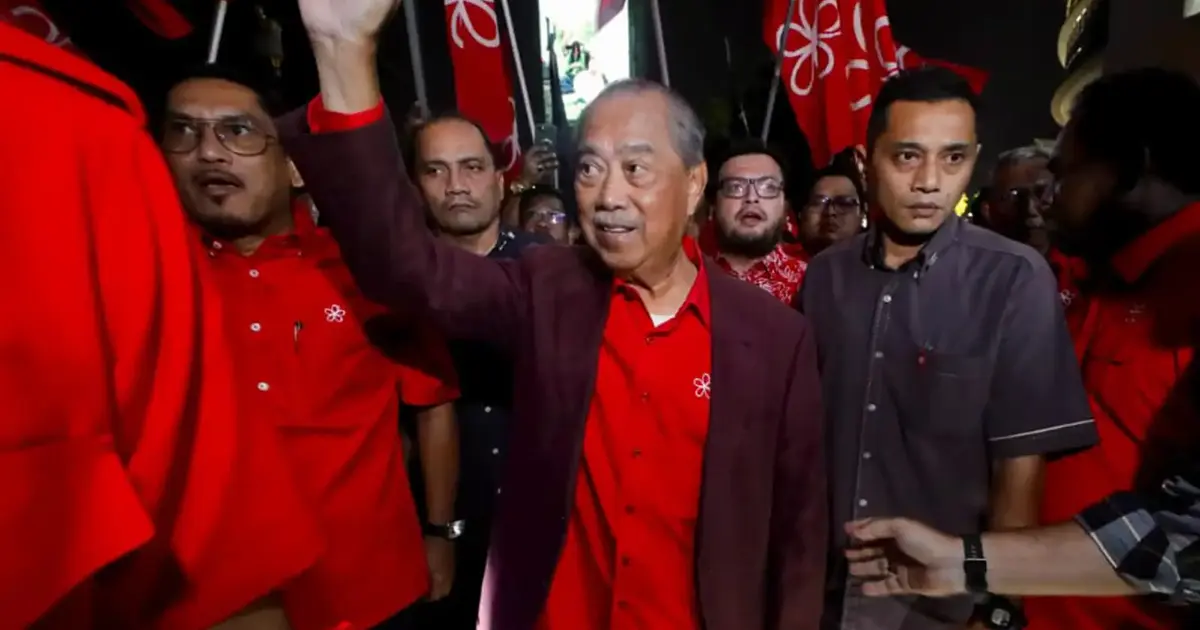
Bersatu chairman Muhyiddin Yassin commanded the backing of over 200 party members who gathered for a show of support, signalling internal consolidation within the Islamic-Malay nationalist party as it navigates a critical juncture in its political trajectory. The rally reflected the scale of enthusiasm among grassroots cadres despite recent setbacks and internal organisational challenges that have tested party cohesion.
The assembly preceded a significant party gathering at which leadership is expected to chart the direction for Bersatu's involvement in upcoming state-level contests. The meeting agenda zeroes in on logistical and strategic groundwork required for the Johor and Negeri Sembilan state elections, contests that carry considerable weight for the party's regional influence and its credibility as a major political force in the peninsula's southern and central regions.
For Malaysian political watchers, these state elections hold outsized significance beyond their immediate electoral outcomes. Johor remains one of the nation's most economically robust and strategically important states, serving as a bellwether for broader political sentiment. Negeri Sembilan, meanwhile, occupies a unique position in the Selangor-Kuala Lumpur-Putrajaya corridor that forms the economic heartland. Strong performances or relative underperformance in these contests will offer telling insights into Bersatu's capacity to retain influence and voter confidence amid the fractious national political landscape.
Equally important on the meeting's agenda is clarification of Bersatu's relationship with PAS, the Pan-Malaysian Islamic Party, a question that has generated considerable speculation and backroom negotiation. The two parties have moved in and out of formal alliance structures in recent years, each pursuing its own strategic interests while navigating the broader Malay-Muslim political space. The nature and depth of their coordination—whether formal, loose, or opportunistic—will significantly shape electoral mathematics and campaign dynamics across both states.
Bersatu's positioning carries particular relevance for Southeast Asian observers tracking Islamist party trajectories in the region. Unlike some Islamic parties that have gradually moderated toward the political centre, Bersatu and PAS represent different ideological and organisational approaches to Islamic governance. Bersatu emerged from a schism within UMNO under Muhyiddin's breakaway, while PAS operates as a more doctrinally committed Islamist formation. How these two entities calibrate their working relationship—and whether they can subordinate tactical disagreements to broader electoral objectives—remains unresolved and consequential.
The rally itself reflected typical patterns of party mobilisation in Malaysian politics, where demonstrating unified support around leadership serves both morale-boosting and internal signalling functions. The assembly of over 200 members underscores that despite external pressures and the complex coalition dynamics at federal level, Muhyiddin retains sufficient grassroots backing to project organisational strength and forward momentum. This becomes particularly relevant given the volatile nature of Malaysian politics, where parliamentary majorities can shift with relatively small defections, making such displays of membership loyalty valuable barometers of internal stability.
Bersatu's electoral strategy for these contests will likely emphasise local grievances, infrastructure delivery, and the party's claim to represent Malay-Muslim interests more authentically than UMNO, its former parent organisation. The party must also contend with the reality that PAS has expanded its own electoral reach in recent years, gaining ground in constituencies where Bersatu might have expected to compete or cooperate. Clarifying this boundary—both in terms of which party contests which seats and how resources and campaigns coordinate—forms a crucial part of strategic preparation.
For PAS, engagement with Bersatu presents a different calculus. The party must balance its pursuit of broader pan-Islamic governance with practical electoral considerations. Whether PAS views Bersatu as a vehicle for amplifying Islamic governance objectives, a temporary electoral partner, or an rival competing for the same voter base remains ambiguous. The Bersatu meeting's discussion of this relationship will likely reveal how each party's leadership assesses the viability and utility of continued close cooperation.
The timing of this rally and subsequent strategic planning also intersects with broader peninsular political currents. Both Johor and Negeri Sembilan represent territory where multiple political traditions intersect—traditional UMNO strongholds, emerging PAS influence, and Bersatu's aspirations as the party of Muhyiddin and his followers. State elections in these regions will provide valuable data about whether the political realignment triggered by federal power transitions in 2020-2022 has stabilised or continues churning.
For Malaysian stakeholders and regional political analysts, the outcomes of Bersatu's strategic deliberations will merit close monitoring. The party's ability to execute a coherent electoral strategy in Johor and Negeri Sembilan, combined with its success in stabilising its PAS relationship, will substantially influence not just state-level outcomes but also the broader equilibrium of national politics as Malaysia approaches the next general election cycle.

%22%2F%3E%3C%2Fpattern%3E%3C%2Fdefs%3E%3Crect%20width%3D%22100%25%22%20height%3D%22100%25%22%20fill%3D%22url(%23ph2hy9vg)%22%2F%3E%3Crect%20width%3D%22100%25%22%20height%3D%22100%25%22%20fill%3D%22url(%23ph2hy9vp)%22%2F%3E%3Ctext%20x%3D%2250%25%22%20y%3D%2250%25%22%20text-anchor%3D%22middle%22%20dominant-baseline%3D%22central%22%20fill%3D%22rgba(255%2C255%2C255%2C0.95)%22%20font-family%3D%22Georgia%2C%20'Times%20New%20Roman'%2C%20serif%22%20font-weight%3D%22700%22%20font-size%3D%22272%22%20letter-spacing%3D%22-0.02em%22%3EAnwar%3C%2Ftext%3E%3C%2Fsvg%3E)