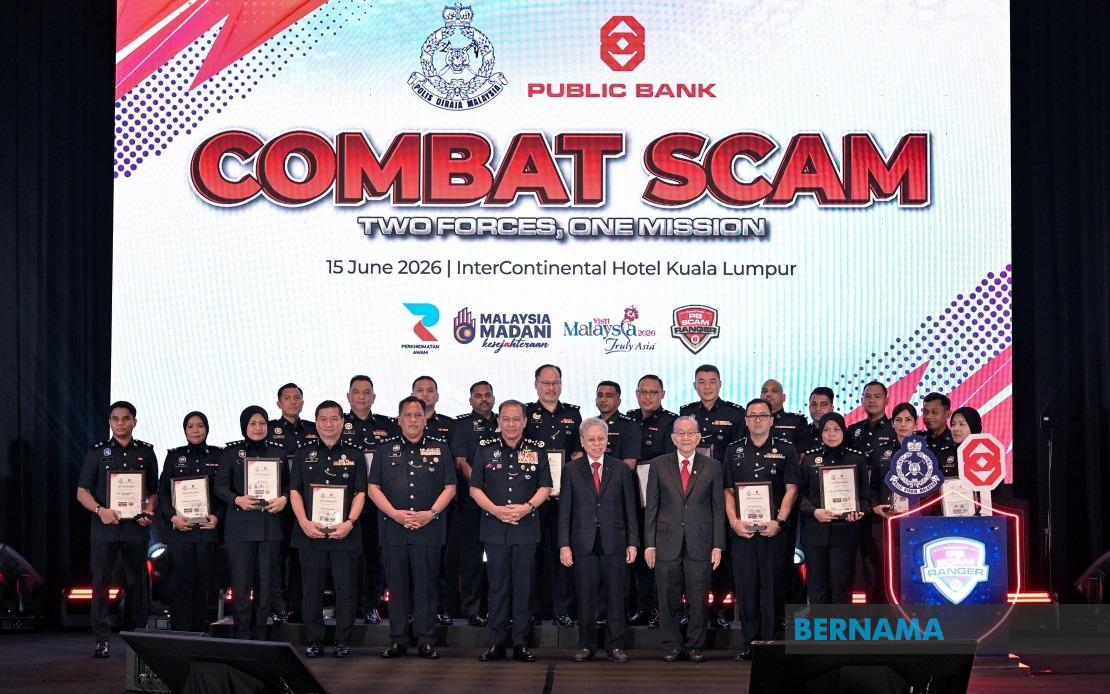
Malaysia's cybercrime crisis has reached alarming proportions, with online scams extracting RM2.97 billion from victims in 2025, representing a staggering increase of nearly 89 percent compared to RM1.57 billion the year prior. Inspector-General of Police Tan Sri Mohd Khalid Ismail released these sobering figures during the launch of the 'Combat Scam: Two Teams, One Goal' campaign in Kuala Lumpur today, underscoring what he described as an increasingly troubling trajectory in digital fraud across the nation.
The sheer volume of incidents compounds the severity of the financial toll. During 2025, police recorded 66,204 online fraud cases nationwide, representing an 87 percent surge from 35,368 cases in 2024. This explosive growth demonstrates that scammers are not only becoming more effective at extracting larger sums from individual victims, but are simultaneously expanding their reach across the Malaysian population at an unprecedented rate. The dual acceleration—both in total losses and case numbers—suggests that traditional enforcement and awareness approaches have failed to keep pace with the sophistication and scale of coordinated fraud operations.
Investment-related scams emerged as the most destructive category, responsible for RM1.47 billion of the total losses. These schemes typically lure victims with promises of unrealistic returns on cryptocurrency, forex trading, or other financial instruments, exploiting both digital literacy gaps and the natural human desire for rapid wealth accumulation. Given Malaysia's growing middle class and increasing retail investor participation in capital markets, this category remains particularly predatory, targeting individuals with accumulated savings and retirement funds. The psychological manipulation involved—building false relationships, demonstrating fake trading accounts with impressive gains—makes these schemes exceptionally difficult for victims to identify until substantial sums have been transferred.
Phonephone-based scams maintained their position as the most prevalent attack vector, with 28,388 cases reported in 2025. These range from caller spoofing impersonating government agencies to elaborate multi-step schemes where fraudsters pose as bank staff, police, or tax officials. The accessibility and relative anonymity of telephonic communication, combined with the psychological advantage of voice interaction, makes this medium particularly effective for social engineering. Many victims, particularly elderly Malaysians or those less accustomed to digital verification methods, struggle to authenticate the identity of callers claiming authority, making them susceptible to urgent requests for personal information or fund transfers.
Tan Sri Khalid emphasized that these statistics extend far beyond numerical abstraction, representing genuine human suffering across Malaysian households. Thousands of individuals have experienced devastation beyond mere financial loss—the erosion of retirement security, the inability to fund children's education, and the psychological trauma of betrayal inflicted by systematic deception. Some victims face compounded hardship when they have borrowed money to invest in scam schemes, saddling themselves with debt obligations even after losing the principal amount. The ripple effects often extend to family dynamics, with relationship breakdowns and mental health crises following major fraud incidents.
The rapid evolution of fraudster methodologies reflects their adaptation to existing safeguards and their exploitation of emerging technology platforms. Criminals leverage artificial intelligence-generated deepfakes for impersonation, utilize cryptocurrency for untraceable fund transfers, and deploy sophisticated phishing campaigns tailored to individual targets through data harvested from previous breaches. They establish elaborate front organizations with professional websites, social media presence, and fabricated testimonials, creating the appearance of legitimacy. Their operational agility means that by the time law enforcement identifies and shuts down one network, successor organizations have already shifted tactics or relocated servers to different jurisdictions.
The Inspector-General stressed that prevention, consumer education, and systematic cultivation of digital security awareness must become national priorities requiring continuous reinforcement and resource allocation. This represents a fundamental shift in approach—moving beyond reactive investigation of completed crimes toward proactive inoculation of the population against manipulation techniques. He noted that in an increasingly digital economy where transactions occur instantaneously across borders and through platforms designed for frictionless interactions, the traditional safeguard of verification delays has largely evaporated.
Public Bank Berhad's managing director and chief executive officer Tan Sri Dr Tay Ah Lek attended the campaign launch, signaling private sector commitment to addressing the crisis. The bank has introduced the PB Scam Rangers Programme in strategic partnership with the Bukit Aman Commercial Crime Investigation Department (CCID), representing one of the first substantial collaborations between banking institutions and law enforcement to combat fraud through coordinated public education. This initiative emphasizes financial literacy alongside cybersecurity awareness, recognizing that victims often lack foundational understanding of legitimate investment practices and realistic return expectations.
The programme reflects a recognition that individual vulnerability to scams correlates strongly with gaps in financial knowledge. Many Malaysians, particularly younger adults and those from lower-income backgrounds, have limited exposure to formal financial education and rely on informal sources of investment guidance. This knowledge gap creates an opening for fraudsters who present themselves as specialists offering personalized strategies or access to exclusive opportunities unavailable through conventional channels. By establishing baseline understanding of how legitimate financial institutions operate and what returns are realistic across different asset classes, the public becomes more capable of identifying fraudulent claims.
The collaborative approach advocated by the IGP acknowledges that police resources alone cannot address fraud at this scale. Banks can implement transaction monitoring systems to identify suspicious patterns and halt transfers to known fraud accounts in real time. Telecommunications providers can enhance caller authentication protocols. Technology platforms can restrict the establishment of accounts designed specifically for fraud. Government agencies can streamline the reporting process and accelerate victim fund recovery. None of these entities working independently can solve the problem, but coordinated action creates multiple friction points that degrade criminal effectiveness.
For Malaysian consumers and businesses, these figures should catalyze immediate personal security audits. This includes enabling multi-factor authentication across all financial and sensitive accounts, maintaining healthy skepticism toward unsolicited investment opportunities regardless of how persuasively presented, and verifying caller identities through independent channels before discussing sensitive matters. Organizations should establish clear protocols for employees regarding social engineering, and families should establish communication channels allowing members to validate suspicious requests before complying with financial instructions. The prevalence of scams at this magnitude means they have become a routine criminal modality affecting ordinary Malaysians, not merely a threat targeting uniquely gullible individuals.
The convergence of rising losses and expanding case numbers indicates that Malaysia faces a critical juncture in cybersecurity governance. Without substantial intensification of prevention efforts, awareness campaigns, and coordinated enforcement action, projections for 2026 and beyond appear decidedly bleak. The sophistication and scale of fraud operations suggest they have evolved from opportunistic schemes into organized criminal enterprises operating with the efficiency of commercial enterprises, generating enormous revenue streams that fund further operational expansion and recruitment of new perpetrators. The national response must match this professionalization, requiring sustained investment, legislative evolution, and cultural transformation in how Malaysians approach digital transactions and information security.


%22%2F%3E%3C%2Fpattern%3E%3C%2Fdefs%3E%3Crect%20width%3D%22100%25%22%20height%3D%22100%25%22%20fill%3D%22url(%23ph2hy9vg)%22%2F%3E%3Crect%20width%3D%22100%25%22%20height%3D%22100%25%22%20fill%3D%22url(%23ph2hy9vp)%22%2F%3E%3Ctext%20x%3D%2250%25%22%20y%3D%2250%25%22%20text-anchor%3D%22middle%22%20dominant-baseline%3D%22central%22%20fill%3D%22rgba(255%2C255%2C255%2C0.95)%22%20font-family%3D%22Georgia%2C%20'Times%20New%20Roman'%2C%20serif%22%20font-weight%3D%22700%22%20font-size%3D%22272%22%20letter-spacing%3D%22-0.02em%22%3EAnwar%3C%2Ftext%3E%3C%2Fsvg%3E)