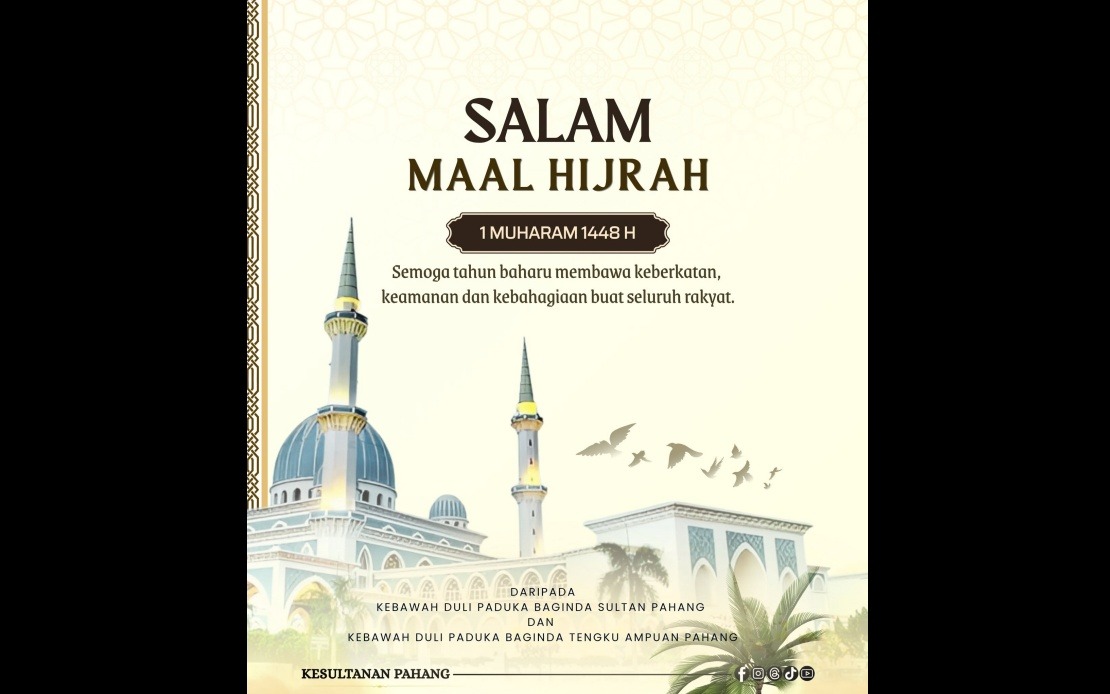
Kuantan's royal household has marked the Islamic new year with a call for spiritual renewal and communal strengthening. Al-Sultan Abdullah Ri'ayatuddin Al-Mustafa Billah Shah and Tunku Azizah Aminah Maimunah Iskandariah, the Sultan and Tengku Ampuan of Pahang respectively, released their Maal Hijrah 1448H message through the Kesultanan Pahang's official channels, addressing the faithful across the eastern state with wishes for prosperity and divine favour.
The royal couple's statement represents a significant moment in the Islamic calendar, as Maal Hijrah commemorates Prophet Muhammad's migration to Medina—an event marking both a turning point in Islamic history and a spiritual milestone for believers worldwide. For Malaysian Muslims, this occasion has become deeply embedded in the annual rhythm of religious observance, serving as a moment for personal reflection and communal rededication to Islamic principles. The Pahang palace's decision to broadcast their message underscores how state leadership continues to play an integral role in reinforcing religious values among their subjects, particularly during moments of collective spiritual significance.
Through their public address, the royal couple articulated a hope that the new Islamic year would deliver blessings, peace, and contentment to all inhabitants of Pahang, transcending religious boundaries with a message of inclusive well-being. This framing reflects a broader pattern within Malaysian Islam of presenting faith-based observances as vehicles for social harmony and individual spiritual growth. The emphasis on blessings and peace resonates particularly in a region that has witnessed economic pressures and social challenges in recent years, with religious occasions offering symbolic anchors for hope and renewal.
Pahang Menteri Besar Datuk Seri Wan Rosdy Wan Ismail expanded upon this theme in his own public statement, positioning Maal Hijrah as a distinct opportunity for Muslims to consciously reassess their spiritual commitments and reorient their personal conduct. His message highlighted the significance of treating the new Islamic year as a deliberate reset moment—a time when believers might strengthen their relationship with faith, deepen their practice, and channel greater energy toward acts of charity and compassion. This framework transforms what might otherwise be a ceremonial religious marker into an actionable call for spiritual and moral improvement.
The Menteri Besar's invocation of Prophet Muhammad's Hijrah carried particular weight, drawing parallels between the historical migration and contemporary aspirations for positive transformation. By evoking the spirit of that ancient journey, he implicitly encouraged Pahang's Muslims to embrace a similar sense of purposeful change in their own lives and communities. The Prophet's migration represented not merely a physical relocation but a commitment to establishing justice, building community bonds, and advancing divine principles—themes that carry resonance across centuries and remain pertinent to modern Malaysian society.
Central to Wan Rosdy's message was the articulation of values that extend beyond personal piety into the realm of collective responsibility. He emphasized unity, integrity, and commitment to state development, effectively positioning Islamic observance not as a private affair but as foundational to public good and communal progress. This perspective aligns with how Malaysian Islamic institutions have evolved to articulate faith as inseparable from national development goals, social cohesion, and institutional governance—a framework that has become characteristic of Islam's expression within Malaysia's plural democratic context.
The emphasis on charitable deeds and strengthened faith within Wan Rosdy's statement reflects broader patterns of Islamic teaching throughout Southeast Asia, where Maal Hijrah observances frequently stress the importance of zakat (charitable giving), community care, and moral renewal. In the Pahang context, where economic disparities and rural-urban divides persist, such messaging carries particular relevance. By framing charitable action as part of renewed Islamic commitment, state leadership creates space for faith-motivated responses to social inequality and community need.
The dual messaging from palace and executive authority—with both Sultan Abdullah and Menteri Besar Wan Rosdy issuing separate statements—demonstrates how multiple tiers of governance in Malaysia leverage religious occasions for public communication. This approach allows for both ceremonial acknowledgment of religious significance and more substantive policy messaging around values and priorities. For residents of Pahang, these coordinated messages establish a shared narrative framework within which the Islamic new year becomes not merely a calendar event but a moment of deliberate civic and spiritual reckoning.
The invocation of Allah's mercy, protection, and strength in Wan Rosdy's closing remarks also carries implicit theological messaging about human dependence on divine support during times of effort and sacrifice. This language resonates particularly in post-pandemic Malaysia, where many communities have experienced genuine hardship and where renewed calls for resilience and faith-grounded perseverance hold psychological and spiritual weight. By framing Allah's blessing as essential to sustained effort, the Menteri Besar positions religious faith as a resource for meeting contemporary challenges rather than as refuge from them.
For Malaysian observers beyond Pahang, these statements also illuminate how state governments continue to position themselves as custodians of Islamic values and spiritual leadership within their territories. While Malaysia's federal system distributes power across multiple levels, state rulers and executives retain significant moral authority in religious matters, and their public pronouncements on occasions like Maal Hijrah shape the broader tone of national Islamic observance. Pahang's message thus contributes to a wider tapestry of leadership rhetoric during the Islamic new year.
The timing of this messaging during a period of ongoing economic adjustment and social recovery within Pahang gives additional dimensions to the appeal for strengthened faith and renewed commitment. Tourism, agriculture, and manufacturing remain crucial to the state's economy, sectors that have all faced disruption and uncertainty. The royal and executive call for transformation and improved well-being, grounded in Islamic principles, implicitly acknowledges that material recovery cannot be divorced from spiritual and moral renewal—a perspective that positions faith not as compensation for hardship but as animating force for constructive change.

%22%2F%3E%3C%2Fpattern%3E%3C%2Fdefs%3E%3Crect%20width%3D%22100%25%22%20height%3D%22100%25%22%20fill%3D%22url(%23ph2hy9vg)%22%2F%3E%3Crect%20width%3D%22100%25%22%20height%3D%22100%25%22%20fill%3D%22url(%23ph2hy9vp)%22%2F%3E%3Ctext%20x%3D%2250%25%22%20y%3D%2250%25%22%20text-anchor%3D%22middle%22%20dominant-baseline%3D%22central%22%20fill%3D%22rgba(255%2C255%2C255%2C0.95)%22%20font-family%3D%22Georgia%2C%20'Times%20New%20Roman'%2C%20serif%22%20font-weight%3D%22700%22%20font-size%3D%22272%22%20letter-spacing%3D%22-0.02em%22%3EAnwar%3C%2Ftext%3E%3C%2Fsvg%3E)