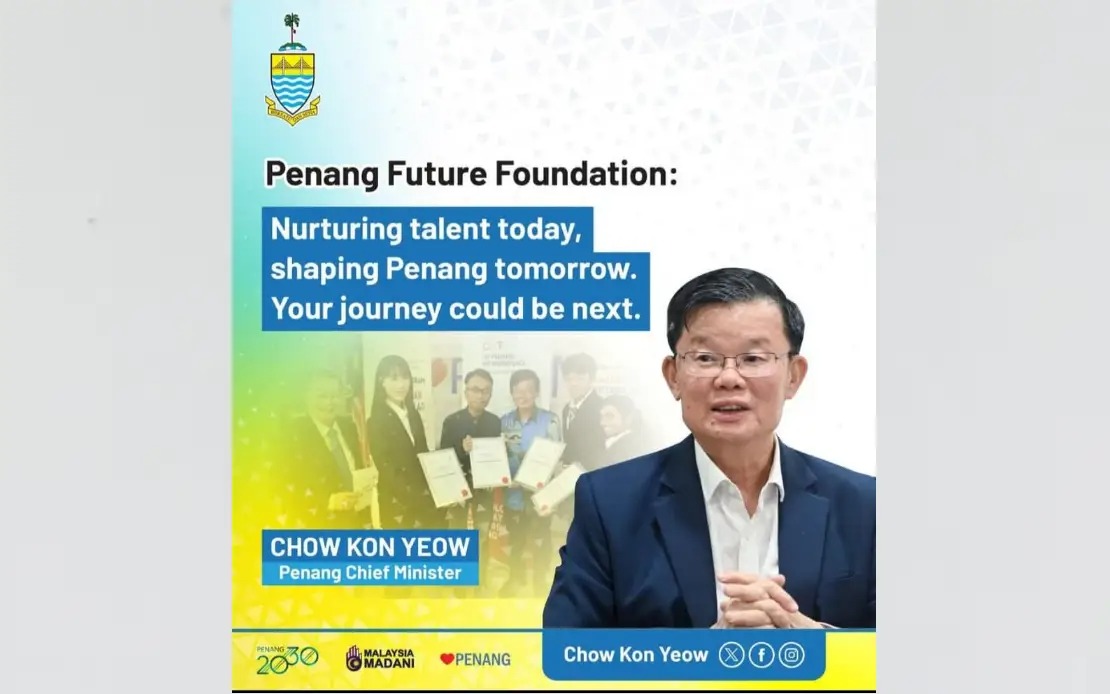
The Penang Future Foundation has emerged as a significant force in talent retention and development within Malaysia's education landscape, having channelled approximately RM47.7 million towards 863 scholarships since its establishment by the Penang state government in 2015. Now entering its 11th year of operation, the initiative reflects a strategic commitment to building the skilled workforce required for the state's continued economic competitiveness and regional positioning as an investment hub.
Chief Minister Chow Kon Yeow highlighted the foundation's pivotal role in addressing a critical challenge facing Malaysia: retaining talented individuals within the state ecosystem while attracting fresh talent from across the country. The initiative operates through a mixed-funding model that combines both government resources and private sector contributions, creating a collaborative approach to scholarship provision that mirrors growing recognition among Malaysian policymakers that human capital development requires partnership between state and business.
The foundation's reach extends beyond Penang's geographical boundaries, deliberately welcoming applicants from all corners of Malaysia to participate in its scholarship programmes. This inclusive stance underscores a broader understanding that talent development serves not just individual advancement but regional economic resilience. By casting the net widely, the foundation positions Penang as an attractive destination for young professionals who might otherwise relocate to other states or overseas, thereby strengthening the state's demographic and economic position.
Specialisation in high-demand fields has characterised the foundation's strategic direction. In the most recent cycle, 58 students received awards specifically targeting Science, Technology, Engineering, Mathematics (STEM), Accountancy, and Finance—sectors experiencing persistent skills shortages across Southeast Asia and where Malaysia faces particular competition from neighbouring economies. This targeted approach demonstrates awareness of labour market dynamics and signals alignment with industry requirements, ensuring that scholarship investments translate into employment outcomes and economic productivity.
The foundation operates two distinct scholarship tiers designed to accommodate a broader spectrum of academic achievement. The PFF Penang Scholar programme targets students maintaining a cumulative grade point average of 3.67 and above, catering to high-achieving applicants with exceptional academic records. Complementing this, the PFF Mutiara Scholar award serves students with CGPAs between 3.00 and 3.66, acknowledging that talented individuals with strong but not exceptional academic performance may face financing barriers to higher education. This two-tier structure reflects pragmatic recognition that scholarship access should extend beyond the highest academic echelon to encompass capable students from diverse socioeconomic backgrounds.
According to Chief Minister Chow, the foundation's expansion reflects Penang's ambitious vision for sustained economic growth over the next five decades. The state's strategic positioning as a manufacturing and technology hub, combined with its relatively developed infrastructure and cosmopolitan environment, creates conditions where talent attraction and retention directly influence competitiveness. In an era when knowledge-based industries increasingly determine regional prosperity, the availability of skilled professionals becomes a primary determinant of whether states can attract high-value investments and maintain economic momentum.
The timing of scholarship announcements carries strategic significance within Malaysia's education calendar and employment pipeline. By opening applications for PFF Scholarship 2026 from July 15 to August 5, the foundation aligns its recruitment cycle with the academic progression of current students, allowing those completing secondary education or undergraduate degrees to plan their continued studies with certainty regarding financial support. This coordination with education timelines maximises the likelihood of successful applications and reduces uncertainty that might otherwise prompt talented students to seek opportunities elsewhere.
Prospective applicants will navigate the application process through the foundation's dedicated website at www.penangfuturefoundation.my, where periodic announcements and detailed information about eligibility requirements, application procedures, and field-specific considerations will be published. This digital-first approach to scholarship administration reflects contemporary practices in talent recruitment and administrative efficiency, reducing barriers to information access that might discourage applications from students in less urban areas or those with limited resources to travel for consultation.
For Malaysian students considering their educational trajectory and financing options, the Penang Future Foundation represents a meaningful opportunity to access higher education while maintaining flexibility regarding career development. The foundation's emphasis on STEM and professional fields aligns with Malaysia's broader economic transition towards higher-value industries, and successful applicants gain not merely financial support but also association with a state-level initiative that could enhance their professional networks and career prospects within Penang's business community.
The foundation's evolution reflects broader conversations within Malaysian policymaking about educational equity, talent development, and regional economic strategy. By channelling substantial resources towards scholarship provision rather than alternative uses of state funds, Penang's government has effectively stated that investment in human capital development yields returns exceeding infrastructure or subsidy programmes. For other Malaysian states and federal policymakers, the foundation's growth and sustained focus on targeted scholarships in high-demand fields presents a relevant case study in implementing talent retention strategies that address both immediate skills shortages and long-term economic positioning.
As Southeast Asia intensifies competition for talent and investment, initiatives like the Penang Future Foundation take on heightened significance. They signal state-level commitment to creating pathways for capable individuals to contribute productively to economic development while building the skilled workforce required for competitive advantage in increasingly sophisticated global markets. For students contemplating their futures and considering various scholarship options, the foundation's track record of distributing nearly RM48 million over a decade demonstrates reliable institutional commitment and substantial resources allocated specifically to merit-based educational advancement.