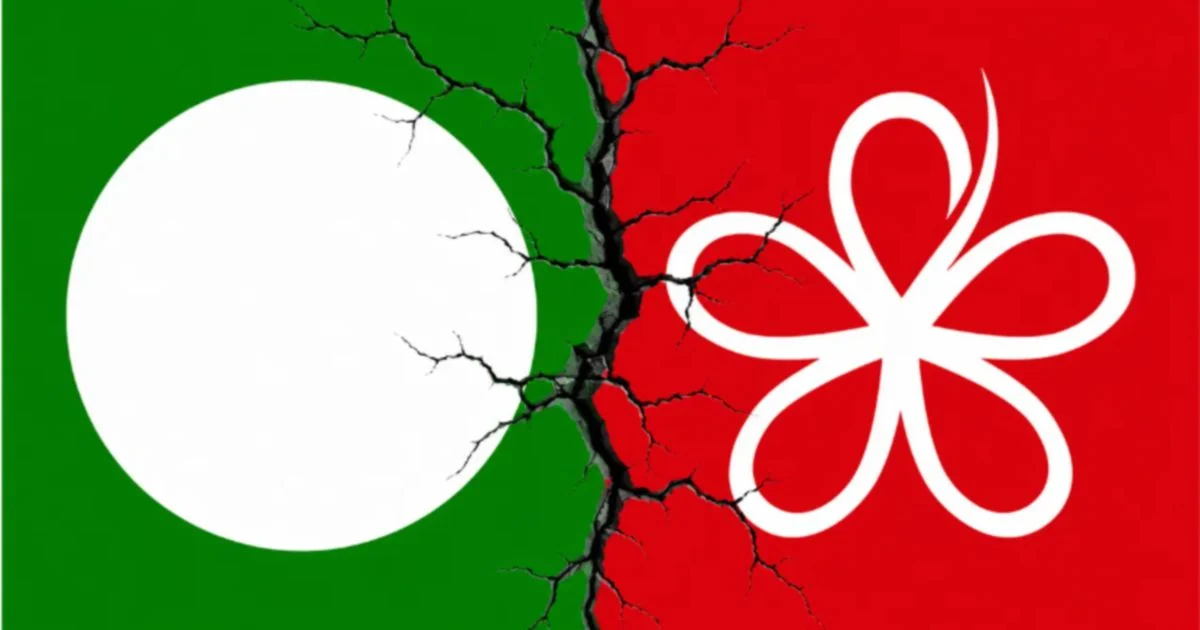
The relationship between PAS and Bersatu, two pillars of the Perikatan Nasional coalition, has deteriorated to the point where political observers are raising serious questions about the alliance's viability at the ballot box. Divisions within Malaysia's main opposition bloc could prove costly when voters go to the polls for the 16th General Election, with both parties risking significant electoral losses should the partnership continue to unravel.
PAS, as the dominant Islamic party in the coalition, and Bersatu, which brings former Prime Minister Muhyiddin Yassin's influence, have built Perikatan Nasional as an alternative political force to challenge the ruling Pakatan Harapan government. Yet mounting disagreements on party strategy, candidate selection, and ideological direction now threaten to fracture the carefully constructed alliance. The tension is not merely a matter of internal party squabbling; it reflects deeper strategic differences about the direction Malaysia's opposition should take in its quest for power.
Electoral mathematics matter significantly in Malaysia's first-past-the-post system. Perikatan Nasional's strength has historically depended on presenting a unified front capable of capturing a critical mass of parliamentary seats. A visibly divided coalition sends conflicting messages to voters about its readiness to govern and competence to lead. When coalition partners appear at odds, ordinary Malaysians become uncertain whether their votes will translate into effective representation and stable government formation after election day.
The consequences extend beyond simple vote-splitting between PAS and Bersatu candidates. Voters who might otherwise lean towards Perikatan Nasional could experience hesitation about backing an unstable partnership. In competitive constituencies where the coalition lacks overwhelming strength, such wavering support can determine whether opposition or government-backed candidates ultimately claim the seat. Across sufficient constituencies nationwide, this accumulated effect could reshape the entire election outcome.
Both parties stand to suffer independently from the rift. PAS, which has cultivated a strong grassroots organisation particularly in the Malay-Muslim heartland, depends partly on coalition positioning to expand beyond its traditional strongholds. Without stable partnership arrangements, the party finds itself unable to mount coordinated campaigns across state boundaries or negotiate strategic seat-sharing agreements. Bersatu, meanwhile, relies on coalition legitimacy to overcome perceptions that it represents merely a vehicle for Muhyiddin's political comeback rather than a party with independent ideological grounding.
The fracturing of Perikatan Nasional comes at a time when Pakatan Harapan appears to have steadied its internal coordination. After internal turbulence during the initial transition from the Mahathir era, the ruling coalition has achieved greater programmatic unity and voter confidence. An opposition bloc appearing divided by contrast provides the government with a significant tactical advantage in framing the electoral narrative around stability versus chaos.
Regional dynamics also play a role in this deterioration. Different PAS and Bersatu powerbrokers dominate particular state apparatuses, creating parallel authority structures that inevitably clash over resource allocation and policy implementation. These territorial rivalries transform national coalition disputes into localised competitions for influence, making reconciliation more difficult since multiple state-level actors have vested interests in perpetuating their side of the argument.
The ideological gap between the two parties, while not insurmountable, has widened in recent months. PAS's emphasis on Islamic governance principles and religious constituency concerns sometimes conflicts with Bersatu's more technocratic, developmentalist approach to policymaking. These differences in party cultures and voter messaging create operational friction when both must present a coherent unified platform to the electorate. Attempts to paper over such differences typically unravel under the pressures of actual campaigning.
For voters in peninsular Malaysia particularly, the PAS-Bersatu rift raises practical questions about governance. Many constituencies require both parties' cooperation under Perikatan Nasional's framework to form local and state governments. If national-level tensions translate into state-level non-cooperation, voters face the prospect of unstable administrations or complicated coalition negotiations that consume time and resources better directed at public service delivery.
The timing of this discord, occurring well before the formal election call, suggests the parties have yet to develop conflict resolution mechanisms strong enough to withstand organisational pressure. Typically, coalition partners compartmentalise disagreements to focus on the shared goal of winning votes. The fact that Perikatan Nasional disputes are increasingly visible to the public indicates control mechanisms have weakened considerably.
Observers of Malaysian electoral history note that coalitions projecting internal discord rarely gain the trust necessary to unseat incumbents. Voters tend to prefer familiar, functioning governments over untested alternatives that appear prone to internal instability. The burden therefore falls on Perikatan Nasional to demonstrate that despite current tensions, it possesses the cohesion and competence required to govern effectively. Without addressing the PAS-Bersatu rift convincingly, the coalition risks entering GE16 in a position of weakness relative to the ruling Pakatan Harapan alliance.

%22%2F%3E%3C%2Fpattern%3E%3C%2Fdefs%3E%3Crect%20width%3D%22100%25%22%20height%3D%22100%25%22%20fill%3D%22url(%23ph2hy9vg)%22%2F%3E%3Crect%20width%3D%22100%25%22%20height%3D%22100%25%22%20fill%3D%22url(%23ph2hy9vp)%22%2F%3E%3Ctext%20x%3D%2250%25%22%20y%3D%2250%25%22%20text-anchor%3D%22middle%22%20dominant-baseline%3D%22central%22%20fill%3D%22rgba(255%2C255%2C255%2C0.95)%22%20font-family%3D%22Georgia%2C%20'Times%20New%20Roman'%2C%20serif%22%20font-weight%3D%22700%22%20font-size%3D%22272%22%20letter-spacing%3D%22-0.02em%22%3EAnwar%3C%2Ftext%3E%3C%2Fsvg%3E)