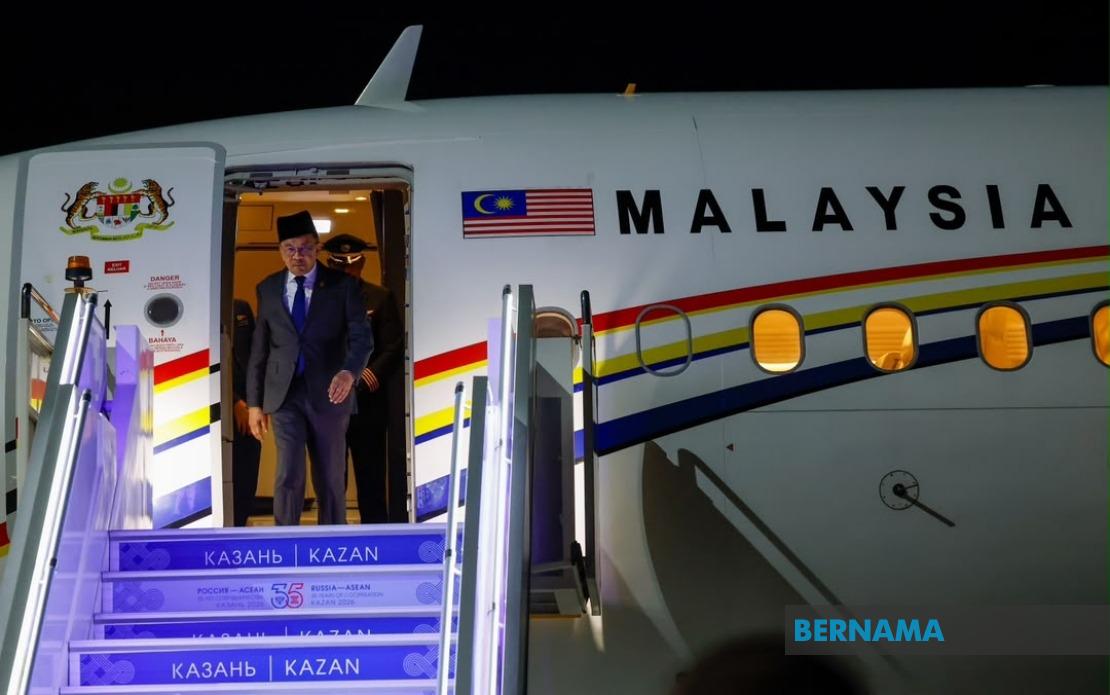
Prime Minister Datuk Seri Anwar Ibrahim touched down in Kazan on Sunday evening to participate in a significant regional engagement that underscores Malaysia's commitment to maintaining robust ties with a major Eurasian power amid shifting global dynamics. The premier's arrival at Kazan International Airport, accompanied by senior cabinet ministers and diplomatic officials, signals the importance Kuala Lumpur places on the forthcoming ASEAN-Russia Commemorative Summit scheduled for June 17-18.
The two-day gathering in the capital of Russia's Republic of Tatarstan carries particular symbolic weight, as participating nations will commemorate three and a half decades of institutional dialogue that began in 1991 in Kuala Lumpur. This milestone provides an opportune moment for both sides to assess the trajectory of their engagement and articulate a forward-looking agenda for the remainder of this decade. The summit's timing also reflects broader Southeast Asian interests in maintaining constructive relationships with non-aligned powers, particularly as regional economies navigate complex trade and investment landscapes.
Anwar's delegation comprises an economically focused representation, with Minister of Investment, Trade and Industry Datuk Seri Johari Abdul Ghani and Minister of Economy Akmal Nasrullah Mohd Nasir aboard the aircraft. This composition emphasizes Malaysia's intention to advance commercial dimensions of the partnership during bilateral discussions. The inclusion of these economic portfolios suggests concrete agenda items centred on facilitating business ties and exploring sectoral opportunities that could benefit both nations' growth trajectories.
Upon arrival, the Prime Minister was formally received by Malaysia's Ambassador to Russia Datuk Cheong Loon Lai, while the Russian reception committee included Ilya Nachvin, Minister of Digital Development of Tatarstan, alongside Kazan Mayor Ilsur Metshin and state protocol representatives. This high-level welcoming protocol reflects Moscow's regard for the ASEAN bloc and Malaysia's particular standing within the regional grouping. Such ceremonial courtesy typically precedes substantive engagement on matters of strategic interest to both capitals.
The four outcome documents expected to emerge from the summit reveal the breadth of ambition characterizing ASEAN-Russia cooperation. Beyond the ceremonial Kazan Declaration acknowledging three and a half decades of relations, participating nations anticipate finalizing instruments addressing energy cooperation, cultural exchange, and a comprehensive action plan spanning 2026 to 2030. These instruments will establish operational frameworks guiding practical collaboration across multiple domains, ensuring the partnership transcends traditional diplomatic formality to generate tangible benefits for citizens and business communities.
Cooperation trajectories encompass sectors critical to regional prosperity and resilience. Trade and investment facilitation remains foundational, though contemporary negotiations extend into energy security—a topic of heightened salience given global supply chain disruptions and Southeast Asia's energy diversification imperatives. Food security cooperation addresses production and distribution vulnerabilities exposed during recent international crises, while digital economy engagement reflects both regions' technological advancement aspirations. Science and technology partnerships, alongside education and tourism frameworks, underpin the people-to-people dimensions essential for sustained diplomatic relationships.
During his Kazan stay, Anwar anticipates meetings with Russian President Vladimir Putin and the head of Tatarstan's republic government, conversations that will likely encompass bilateral matters and regional issues demanding coordinated approaches. These high-level engagements provide forums for discussing peace advocacy, economic resilience pathways, and mutual interests spanning multiple continents. The Prime Minister's emphasis on dialogue and peaceful resolution aligns with Malaysia's traditional foreign policy orientation and ASEAN's commitment to regional stability through diplomatic channels.
This represents Anwar's third Russian visit since assuming office in November 2022, demonstrating sustained prioritization of Moscow ties despite Malaysia's diverse diplomatic portfolio. His September 2024 attendance at the Eastern Economic Forum in Vladivostok and May 2025 official Moscow visit establish a pattern of engagement encompassing both economic forums and high-level bilateral consultations. These successive visits have progressively widened discussion horizons, moving from initial relationship establishment through increasingly specialized collaboration in agriculture, aerospace capabilities, and renewable energy sectors.
The summit's convening in Kazan, rather than Moscow or a Southeast Asian capital, reflects Russia's emphasis on its Far Eastern and Eurasian development priorities. Tatarstan, as a major economic and technological hub within the Russian federation, hosts forums addressing modernization and digital advancement—areas where ASEAN nations possess significant interests. This venue selection therefore facilitates not merely diplomatic ceremonies but substantive exchanges on contemporary development challenges facing both regions, from automation implications to agricultural innovation.
Malaysia's participation demonstrates its strategic commitment to preserving ASEAN Centrality while cultivating pragmatic partnerships with major powers across different geopolitical alignments. In an increasingly multipolar international environment characterized by competing spheres of influence and fragmented cooperation frameworks, maintaining equidistance and active engagement with diverse partners remains central to Malaysia's diplomatic doctrine. The Kazan summit provides an arena for advancing this balancing approach while extracting concrete benefits across economic, security, and cultural dimensions.
The documents Malaysia helps shepherd through adoption will establish substantive cooperation benchmarks measurable against actual implementation metrics, distinguishing these engagements from symbolic declarations. The 2026-2030 action plan particularly will guide resource allocation and priority-setting across both governmental and private sectors, potentially unlocking commercial opportunities for Malaysian enterprises in Russian markets and vice versa. These frameworks also position ASEAN collectively as a consequential partner worthy of differentiated engagement, not merely a geographical region peripheral to great power competition.

%22%2F%3E%3C%2Fpattern%3E%3C%2Fdefs%3E%3Crect%20width%3D%22100%25%22%20height%3D%22100%25%22%20fill%3D%22url(%23ph2hy9vg)%22%2F%3E%3Crect%20width%3D%22100%25%22%20height%3D%22100%25%22%20fill%3D%22url(%23ph2hy9vp)%22%2F%3E%3Ctext%20x%3D%2250%25%22%20y%3D%2250%25%22%20text-anchor%3D%22middle%22%20dominant-baseline%3D%22central%22%20fill%3D%22rgba(255%2C255%2C255%2C0.95)%22%20font-family%3D%22Georgia%2C%20'Times%20New%20Roman'%2C%20serif%22%20font-weight%3D%22700%22%20font-size%3D%22272%22%20letter-spacing%3D%22-0.02em%22%3EAnwar%3C%2Ftext%3E%3C%2Fsvg%3E)