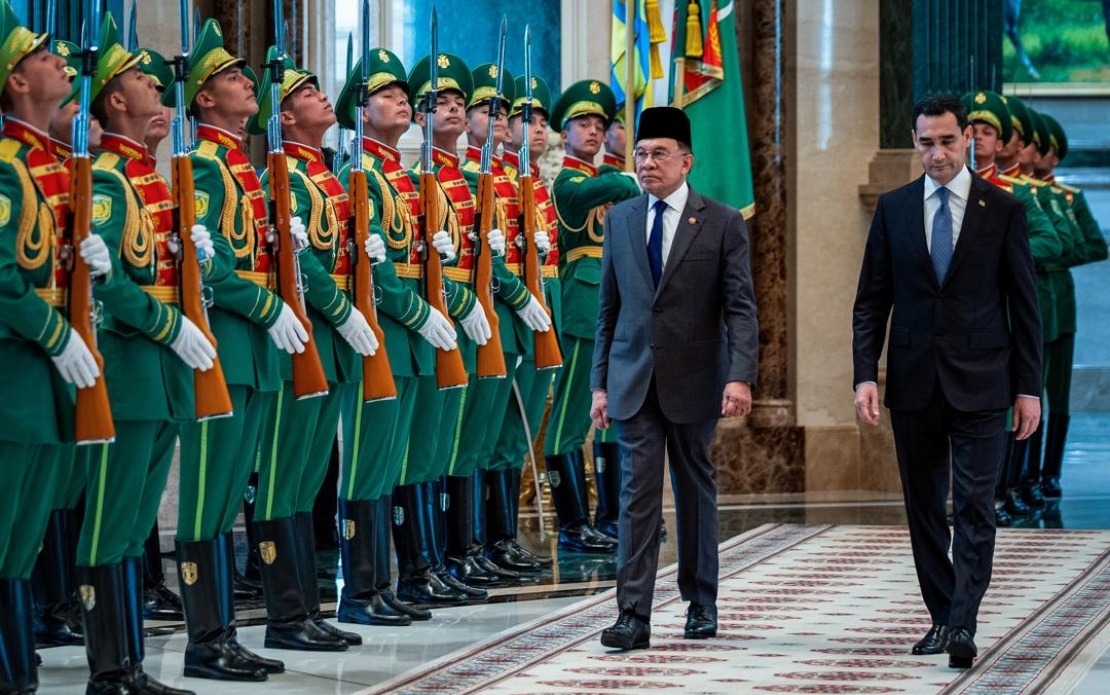
Prime Minister Datuk Seri Anwar Ibrahim was accorded full ceremonial honours during his arrival at the Turkmenistan Presidential Palace in Ashgabat on June 19, underscoring the significance Malaysia places on strengthening ties with Central Asia. The state reception marked a diplomatic milestone, representing the first official visit by the Prime Minister to Turkmenistan since he assumed office in November 2022. The formal welcome ceremony, complete with a guard of honour and the simultaneous playing of both nations' anthems, reflected the mutual respect between Kuala Lumpur and Ashgabat and signalled the importance of bilateral engagement at the highest levels.
Turkmenistan President Serdar Berdimuhamedov personally received the Malaysian Premier upon arrival, emphasizing the host nation's commitment to strengthening bilateral relations. The ceremonial reception was followed by formal introductions between Anwar and senior members of the Turkmenistan Cabinet, along with other high-ranking government officials. The Malaysian delegation accompanying the Prime Minister was then presented to President Berdimuhamedov, establishing the groundwork for substantive engagement between the two governments. This sequence of formal protocols demonstrated the structured approach both nations were taking to deepen their diplomatic and economic partnerships.
Following the initial ceremonial proceedings, Anwar and Berdimuhamedov embarked on a private four-eyed meeting before transitioning to a broader bilateral discussion. These conversations were designed to address issues of mutual concern and explore avenues for enhanced cooperation across various sectors. The dual-format engagement—beginning with an intimate leadership exchange before expanding to include broader delegations—allowed the two leaders to establish personal rapport while creating space for more technical discussions involving their respective government teams. Such diplomatic architecture often proves essential in establishing the foundations for longer-term strategic partnerships.
The two-day official visit, which commenced on June 18, represented a significant development in Malaysia's engagement with Central Asia, a region that has assumed growing importance in Malaysian foreign policy. As Malaysia's 10th Prime Minister, Anwar has prioritised expanding Malaysia's diplomatic footprint beyond traditional Southeast Asian and regional partnerships, recognising the economic and geopolitical opportunities presented by Central Asian states. Turkmenistan's strategic location along ancient trade routes and its substantial natural gas reserves position it as a valuable partner for Malaysia's energy security and broader economic diversification objectives.
For Malaysian readers and policymakers, this diplomatic visit underscores the government's commitment to broadening the nation's international engagement beyond established partnerships. Central Asia, largely distant from Malaysia's immediate region, has become increasingly relevant as Malaysia seeks to strengthen ties with emerging economic powers and secure long-term energy supplies. Turkmenistan, in particular, represents opportunities for Malaysian companies in energy, infrastructure, and technology sectors, while also serving as a gateway to the broader Central Asian market comprising Kazakhstan, Uzbekistan, and other nations.
President Berdimuhamedov's decision to extend a formal invitation and personally receive the Malaysian Prime Minister reflects Turkmenistan's interest in deepening relations with Southeast Asian nations. This outreach aligns with a broader regional trend wherein Central Asian governments are actively seeking to diversify their international partnerships and reduce dependency on traditional Russian and Chinese spheres of influence. Malaysia's position as a respected Southeast Asian democracy and Islamic-majority nation makes it an attractive partner for Turkmenistan's own strategic realignment objectives.
The bilateral discussions during Anwar's visit likely encompassed trade and investment frameworks, energy cooperation, cultural exchange programmes, and broader geopolitical coordination. Malaysia's experience in managing a multi-ethnic, multi-religious society and its position as a bridge between Islamic and broader international communities offer valuable insights for Turkmenistan as it navigates its own developmental challenges. Conversely, Turkmenistan's energy resources and emerging market characteristics present concrete commercial opportunities for Malaysian enterprises seeking international expansion.
The timing of this inaugural official visit by Anwar carries additional significance within the context of Malaysia's pivot towards greater global engagement. Under his leadership, the government has signalled a renewed emphasis on building strategic partnerships across multiple regions rather than concentrating diplomatic efforts on traditional allies. This approach reflects recognition that Malaysia's future prosperity depends partly on its ability to forge meaningful relationships with economically dynamic and resource-rich nations across Asia and beyond.
Looking forward, the outcomes of the bilateral discussions and the agreements likely negotiated during this visit will shape the trajectory of Malaysia-Turkmenistan relations for years to come. Whether measured through trade increases, investment flows, or deeper diplomatic coordination, this visit establishes the foundation upon which future cooperation will be constructed. For Southeast Asia more broadly, Malaysia's proactive engagement with Central Asia demonstrates the region's growing integration into wider Asian networks of commerce, culture, and diplomacy, extending the reach of Southeast Asian influence and interests across diverse geopolitical landscapes.


%22%2F%3E%3C%2Fpattern%3E%3C%2Fdefs%3E%3Crect%20width%3D%22100%25%22%20height%3D%22100%25%22%20fill%3D%22url(%23ph2hy9vg)%22%2F%3E%3Crect%20width%3D%22100%25%22%20height%3D%22100%25%22%20fill%3D%22url(%23ph2hy9vp)%22%2F%3E%3Ctext%20x%3D%2250%25%22%20y%3D%2250%25%22%20text-anchor%3D%22middle%22%20dominant-baseline%3D%22central%22%20fill%3D%22rgba(255%2C255%2C255%2C0.95)%22%20font-family%3D%22Georgia%2C%20'Times%20New%20Roman'%2C%20serif%22%20font-weight%3D%22700%22%20font-size%3D%22272%22%20letter-spacing%3D%22-0.02em%22%3EAnwar%3C%2Ftext%3E%3C%2Fsvg%3E)