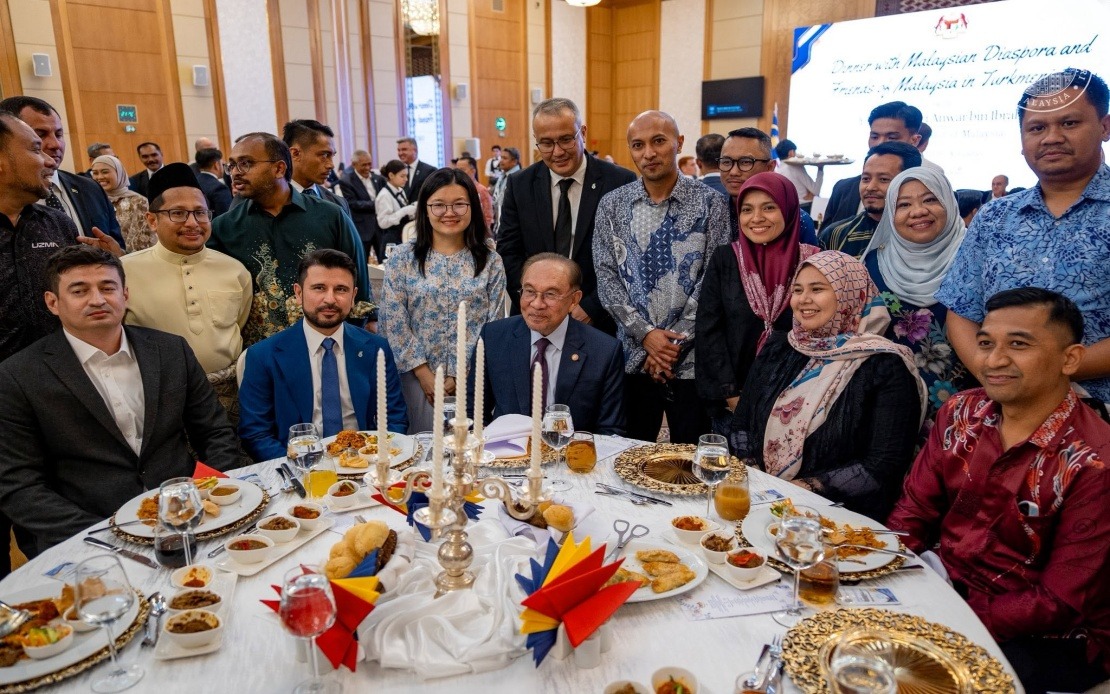
Prime Minister Datuk Seri Anwar Ibrahim seized the opportunity during his visit to Ashgabat, Turkmenistan, to convene with Malaysians residing in the Central Asian nation, reinforcing the MADANI Government's dedication to nurturing enduring relationships with citizens abroad. The gathering underscored a strategic dimension of Malaysia's diplomatic engagement beyond conventional bilateral arrangements, reflecting the administration's recognition that diaspora communities represent vital channels for cultural exchange and economic advancement at the grassroots level.
Anwar characterised the encounter as particularly meaningful given the geographical distance separating Ashgabat from Malaysia's shores. Despite the thousands of kilometres between the Central Asian capital and Kuala Lumpur, he observed that the assembled diaspora members exhibited the same patriotic spirit and sense of belonging that would be found among compatriots gathered domestically. The Prime Minister's Facebook post captured the emotional resonance of the meeting, suggesting that proximity to the homeland is not the decisive factor in sustaining national identity and commitment to Malaysia's progress.
Central to Anwar's message was an appeal for the diaspora to remain actively engaged with developments unfolding within Malaysia. Rather than viewing expatriation as a severance of ties, he encouraged Malaysians abroad to follow the nation's trajectory, participate in knowledge-sharing networks, and contribute to discussions about the country's future direction. This emphasis reflects a broader governmental philosophy that positions overseas Malaysians not merely as individuals who have chosen alternative residency but as extensions of Malaysia's diplomatic and soft-power apparatus.
The Prime Minister articulated a particular vision of the diaspora's role in advancing national interests. He described these communities as unofficial ambassadors who, through their professional conduct, business acumen, and cultural ambassadorship, actively construct and reinforce Malaysia's international reputation. By excelling in their respective fields and maintaining visible connections to their country of origin, diaspora members contribute to an intangible yet crucial asset: the nation's standing and perceived prestige within global networks.
Anwar's first official visit to Turkmenistan, undertaken at the invitation of President Serdar Berdimuhamedov, transcended the conventional parameters of state-to-state diplomatic engagement. While trade, investment, and economic cooperation traditionally anchor bilateral visits, the Prime Minister emphasised that this mission encompassed broader strategic objectives. The engagement aimed at cultivating deeper friendship, fostering mutual understanding, and establishing collaborative frameworks in previously unexplored domains that could yield reciprocal advantages for both nations.
The timing of Anwar's journey carries particular significance within the context of Malaysia-Turkmenistan relations. President Berdimuhamedov's December 2024 visit to Malaysia constituted a landmark occasion, representing high-level engagement that warranted reciprocation through a reciprocal state visit. Such exchanges establish diplomatic momentum and signal both nations' commitment to transcending superficial interactions in favour of substantive, long-term partnerships. The sequential nature of these visits demonstrates a deliberate effort to institutionalise bilateral cooperation.
Geographically and geopolitically, Turkmenistan occupies an intriguing position within Central Asia's evolving dynamics. As a nation straddling energy resources, regional trade corridors, and emerging economic opportunities, it presents considerable potential for Malaysian engagement across multiple sectors. For Malaysia, traditionally anchored within Southeast Asian frameworks, the Central Asian region represents relatively uncharted territory offering opportunities for diversification of diplomatic and economic relationships beyond established regional partnerships.
The diaspora engagement component of Anwar's visit reveals a sophisticated understanding of modern statecraft. Governments increasingly recognise that nationals residing abroad constitute valuable networks for intelligence-gathering, market assessment, and soft-power projection. Malaysian communities in Central Asia, though numerically modest compared to those in Western nations or the Middle East, occupy strategic positions within business, education, and professional sectors. Their experiences and perspectives provide governments with ground-level insights into local conditions, emerging opportunities, and potential challenges.
For Malaysian readers, particularly those contemplating or maintaining expatriate status, Anwar's messaging carries implications regarding state expectations and support mechanisms. The government's articulation of diaspora value suggests a willingness to engage with overseas populations not as lost nationals but as continuing stakeholders in Malaysia's national project. This framing potentially influences diaspora willingness to invest in Malaysia, transfer knowledge, and facilitate inbound investment and partnerships.
The broader context of Malaysia-Central Asia relations warrants consideration. While Southeast Asia dominates Malaysian foreign policy discourse, strategic diversification toward Central Asia aligns with regional trends toward multi-directional engagement. As China's Belt and Road Initiative extends infrastructure and connectivity across Eurasia, Malaysia's cultivation of Central Asian relationships positions the nation to participate in emerging economic corridors and benefit from intensified trans-continental commerce.
Anwar's emphasis on the diaspora's role as reputation-builders reflects contemporary recognition that national soft power extends beyond government institutions into the daily professional and social activities of citizens abroad. Each Malaysian working successfully in Ashgabat, contributing to their community, and maintaining visible cultural connections becomes, in effect, an ambassador for the nation. This distributed ambassadorial function operates continuously, requiring no formal appointment or resources, yet delivering measurable returns through enhanced perceptions of Malaysia's dynamism and capability.
Moving forward, the significance of this engagement lies not merely in the immediate encounter but in establishing frameworks for sustained interaction between the Malaysian government and diaspora communities. As Malaysia navigates increasingly complex international environments and seeks to expand influence and partnerships beyond traditional spheres, leveraging diaspora networks represents a cost-effective strategy for advancing multiple national objectives simultaneously. The Ashgabat meeting thus exemplifies an emerging diplomatic approach that recognises Malaysians abroad as valuable partners in the nation's continued growth and international standing.

%22%2F%3E%3C%2Fpattern%3E%3C%2Fdefs%3E%3Crect%20width%3D%22100%25%22%20height%3D%22100%25%22%20fill%3D%22url(%23ph2hy9vg)%22%2F%3E%3Crect%20width%3D%22100%25%22%20height%3D%22100%25%22%20fill%3D%22url(%23ph2hy9vp)%22%2F%3E%3Ctext%20x%3D%2250%25%22%20y%3D%2250%25%22%20text-anchor%3D%22middle%22%20dominant-baseline%3D%22central%22%20fill%3D%22rgba(255%2C255%2C255%2C0.95)%22%20font-family%3D%22Georgia%2C%20'Times%20New%20Roman'%2C%20serif%22%20font-weight%3D%22700%22%20font-size%3D%22272%22%20letter-spacing%3D%22-0.02em%22%3EAnwar%3C%2Ftext%3E%3C%2Fsvg%3E)