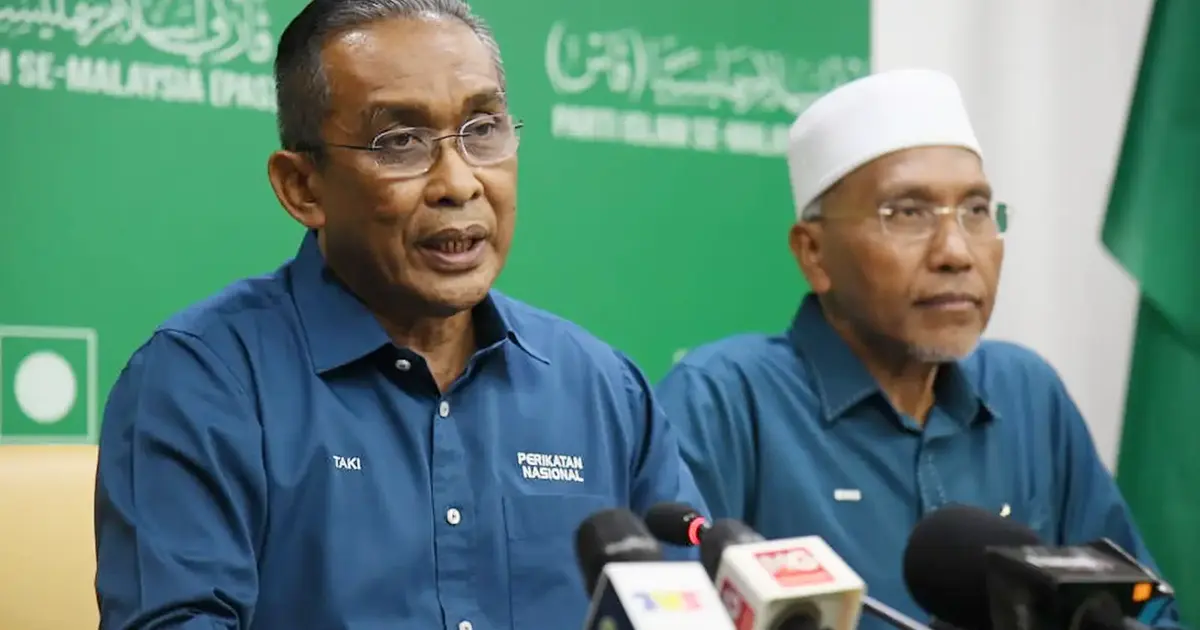
The Perikatan Nasional coalition has moved to enforce stricter administrative protocols governing its internal operations, with Secretary-General Takiyuddin Hassan issuing a directive that all meetings and events must receive explicit approval from the coalition's chairman before proceeding. The announcement came in response to unconfirmed reports that Bersatu president Muhyiddin Yassin had initiated plans to convene a PN Supreme Council gathering, raising fresh questions about coordination within the multi-party alliance and the distribution of authority among its senior leadership.
Takiyuddin's statement represents a significant clarification of internal governance rules within the coalition, which has served as a critical political force in Malaysian politics since its formation ahead of the 2023 general election. The emphasis on obtaining the chairman's formal consent before organizing formal meetings suggests potential disagreements over decision-making protocols within the umbrella organization, where competing interests from different constituent parties must be reconciled. This procedural tightening may indicate efforts to consolidate central authority and prevent independent action by individual party leaders operating within the broader coalition framework.
The timing of Takiyuddin's declaration carries particular significance given Muhyiddin's position as Bersatu president, one of the most influential component parties within PN. Muhyiddin, a former Prime Minister, commands considerable political capital and organizational strength through Bersatu's grassroots network. Any perception of circumventing established protocols through unilateral meeting convocation could be seen as either an assertion of autonomous party prerogatives or, conversely, as an attempted power consolidation that the secretary-general felt compelled to address through formal pronouncement.
The governance structure of PN itself reflects the complex nature of Malaysian coalition politics, where multiple parties with distinct organizational hierarchies and policy priorities must function as a unified political entity while maintaining their individual identities and interests. The PN Supreme Council serves as the coalition's highest decision-making body, typically comprising representatives from its constituent parties. Controlling the convocation of such meetings effectively grants the chairman—currently held by the party holding the coalition's de facto leadership position—substantial influence over the coalition's strategic direction and public positioning.
For Malaysian observers, these internal PN dynamics carry broader implications for national political stability. The coalition represents a significant parliamentary bloc, and any fracturing of its internal cohesion could reshape the existing power balance in Parliament and beyond. Both the ruling coalition and opposition groups maintain close watch over PN's organizational health, as shifts within the alliance could theoretically alter government composition or parliamentary mathematics that underpin current governance arrangements. The apparent need to clarify and reinforce meeting protocols suggests underlying tensions that may warrant monitoring.
Takiyuddin's position as secretary-general places him in a delicate administrative role, responsible for maintaining organizational discipline across parties with sometimes competing strategic objectives. His intervention on the procedural matter underscores the challenge of managing consensus within a coalition where no single party possesses overwhelming dominance, requiring constant negotiation and consensus-building among the leadership. The secretary-general's office traditionally serves as the neutral administrative arbiter, making Takiyuddin's public statement particularly noteworthy as a signal of institutional concerns rather than merely partisan positioning.
Muhyiddin's reported intention to convene the Supreme Council may have reflected legitimate party interests in advancing specific coalition business or addressing matters requiring collective deliberation. However, Takiyuddin's response indicates that the secretary-general's office views uncoordinated meeting initiatives as potentially disruptive to established chain-of-command procedures. This dynamic mirrors broader patterns in Malaysian political coalitions, where parties must balance their autonomous operations with coalition discipline requirements that ensure coordinated public messaging and unified strategic positioning.
The enforcement of approval requirements for coalition meetings also carries implications for transparency and internal democracy within PN. Centralized control over meeting convocation can facilitate unified decision-making but may simultaneously restrict opportunities for broader consultation or discussion of contentious issues within the coalition framework. Members of constituent parties might perceive such controls as either necessary safeguards against fragmentary tendencies or as constraining mechanisms that subordinate individual party voices to coalition leadership preferences.
Looking at Southeast Asian political trends, Malaysia's PN structure represents a contemporary approach to multi-party coalition management in electoral democracies. While some regional coalitions emphasize decentralized decision-making and broad consultation protocols, others concentrate authority through rigorous procedural controls. Takiyuddin's statement reveals PN's institutional preference for centralized approval mechanisms, which may reflect lessons learned from previous coalition experiences or deliberate architectural choices aimed at preventing internal paralysis through competing initiatives.
The practical enforcement of such protocols remains uncertain, particularly regarding consequences for parties that organize meetings without prior clearance. Without explicit disciplinary mechanisms outlined in Takiyuddin's statement, the directive may function more as an administrative preference than an enforceable organizational rule. Nevertheless, its public articulation signals the secretary-general's commitment to procedural coherence and the coalition's broader institutional development as a political entity with defined governance structures and hierarchical decision-making processes that transcend individual party operations.

%22%2F%3E%3C%2Fpattern%3E%3C%2Fdefs%3E%3Crect%20width%3D%22100%25%22%20height%3D%22100%25%22%20fill%3D%22url(%23ph2hy9vg)%22%2F%3E%3Crect%20width%3D%22100%25%22%20height%3D%22100%25%22%20fill%3D%22url(%23ph2hy9vp)%22%2F%3E%3Ctext%20x%3D%2250%25%22%20y%3D%2250%25%22%20text-anchor%3D%22middle%22%20dominant-baseline%3D%22central%22%20fill%3D%22rgba(255%2C255%2C255%2C0.95)%22%20font-family%3D%22Georgia%2C%20'Times%20New%20Roman'%2C%20serif%22%20font-weight%3D%22700%22%20font-size%3D%22272%22%20letter-spacing%3D%22-0.02em%22%3EAnwar%3C%2Ftext%3E%3C%2Fsvg%3E)