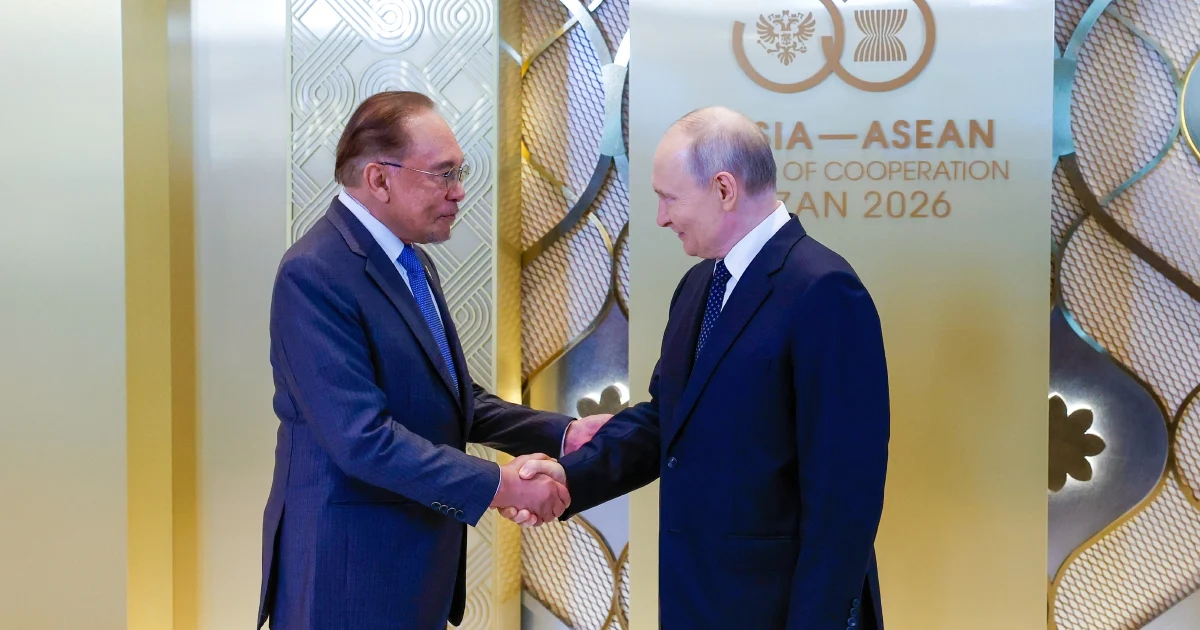
Prime Minister Datuk Seri Anwar Ibrahim revealed in Bintulu today that Malaysia has secured a long-term energy supply commitment from Russian President Vladimir Putin, marking a significant development in the country's quest for stable fuel sources. The assurance underscores Kuala Lumpur's strategic pivot towards fostering deeper ties with major global energy producers beyond traditional suppliers, positioning the nation to navigate increasingly complex international energy markets with greater resilience.
Anwar's announcement reflects a deliberate policy shift aimed at fortifying Malaysia's energy security architecture through deliberate diversification. Rather than relying on a narrow base of established suppliers, the Prime Minister is actively cultivating relationships with diversified sources of hydrocarbons and other energy resources. This approach acknowledges the geopolitical volatility that can disrupt conventional supply chains and the necessity for Malaysia—a nation heavily dependent on imported fuels—to build redundancy into its energy procurement strategy.
The timing of this development carries particular significance for the Malaysian energy landscape. As the country navigates post-pandemic economic recovery and infrastructure expansion, demand for reliable, affordable energy continues to climb. Industries ranging from manufacturing to petrochemicals to data centres require stable power supplies and feedstock security. Putin's commitment therefore addresses a fundamental constraint on Malaysia's economic growth trajectory and industrial competitiveness.
Russia's willingness to extend such assurances to Malaysia also signals Moscow's broader interest in deepening engagement across Southeast Asia at a time when Western nations maintain various diplomatic and economic restrictions. For Malaysia, this represents an opportunity to leverage geopolitical competition to secure more favourable energy terms. The nation's strategic location astride major shipping routes and its established presence in regional forums gives Kuala Lumpur meaningful negotiating power in bilateral energy discussions.
Anwar's emphasis on Malaysia's role in the global energy sector during his Bintulu address—a major oil and gas production centre—carries multilayered implications. The Prime Minister is simultaneously acknowledging Malaysia's existing domestic hydrocarbon resources while signalling that the country recognises the necessity of supplementing domestic production with imports. This realistic assessment contrasts with approaches that might overestimate local supply capacity or resist prudent diversification.
For Southeast Asia more broadly, Malaysia's expanding energy partnerships with major producers potentially reshape regional dynamics. As member economies pursue bilateral energy agreements outside traditional institutional frameworks, the region's collective energy security becomes more fragmented but potentially more resilient. However, this bilateral approach may also reduce opportunities for coordinated regional strategies that could yield greater bargaining power for the bloc as a whole.
The specific value of Russian energy partnerships warrants examination within Malaysia's broader energy mix. Liquefied natural gas, crude oil, and coal represent different supply options with varying strategic implications. Russia's primary energy export strength lies in natural gas and oil, sectors where Malaysia maintains existing exploration and refining capacity but increasingly requires imported supplies. These complementarities suggest the bilateral arrangement addresses genuine structural needs rather than serving purely political objectives.
Malaysia's energy security challenges have intensified as global energy transition discussions increasingly pressure hydrocarbon-dependent economies. The country faces mounting international pressure to accelerate renewable energy adoption while simultaneously managing the economic realities of continued fossil fuel dependency across significant portions of the economy. Anwar's strategy of securing long-term conventional energy supplies buys Malaysia time to manage this transition at a manageable pace while avoiding economically disruptive energy price shocks.
The geopolitical context surrounding this announcement merits consideration. Malaysia has historically maintained a non-aligned foreign policy posture, cultivating relationships across major powers rather than committing exclusively to particular blocs. Anwar's approach to energy partnerships reflects this broader diplomatic philosophy, seeking to extract maximum benefit from competing global powers while avoiding the appearance of strategic subordination to any single entity.
Domestically, the Putin assurance addresses concerns among Malaysian policymakers about energy affordability and supply disruption. Citizens and businesses alike prioritise stable energy costs, and a government that secures long-term supply arrangements at predictable terms enhances its credibility on economic management. This becomes particularly important given prevailing inflation concerns and their impact on household purchasing power across Malaysia.
Looking forward, the sustainability of Russia-Malaysia energy relationships will depend on managing geopolitical risks, enforcement mechanisms, and pricing terms. Any arrangement must weather potential international pressure and ensure that Malaysian strategic autonomy remains intact. The challenge for Anwar's administration involves maximising the benefits of such partnerships while maintaining sufficient flexibility to adjust course if circumstances change.
This energy security initiative ultimately reflects the complex calculus that middle-power nations like Malaysia must perform in contemporary international relations. Anwar's framework seeks to balance immediate energy requirements against long-term strategic positioning, domestic economic needs against international relationships, and pragmatic partnership against principled positioning. The success of this approach will substantially influence Malaysia's economic trajectory and regional influence in the coming years.
%22%2F%3E%3C%2Fpattern%3E%3C%2Fdefs%3E%3Crect%20width%3D%22100%25%22%20height%3D%22100%25%22%20fill%3D%22url(%23ph5vnqfg)%22%2F%3E%3Crect%20width%3D%22100%25%22%20height%3D%22100%25%22%20fill%3D%22url(%23ph5vnqfp)%22%2F%3E%3Ctext%20x%3D%2250%25%22%20y%3D%2250%25%22%20text-anchor%3D%22middle%22%20dominant-baseline%3D%22central%22%20fill%3D%22rgba(255%2C255%2C255%2C0.95)%22%20font-family%3D%22Georgia%2C%20'Times%20New%20Roman'%2C%20serif%22%20font-weight%3D%22700%22%20font-size%3D%22272%22%20letter-spacing%3D%22-0.02em%22%3EMITRA%3C%2Ftext%3E%3C%2Fsvg%3E)