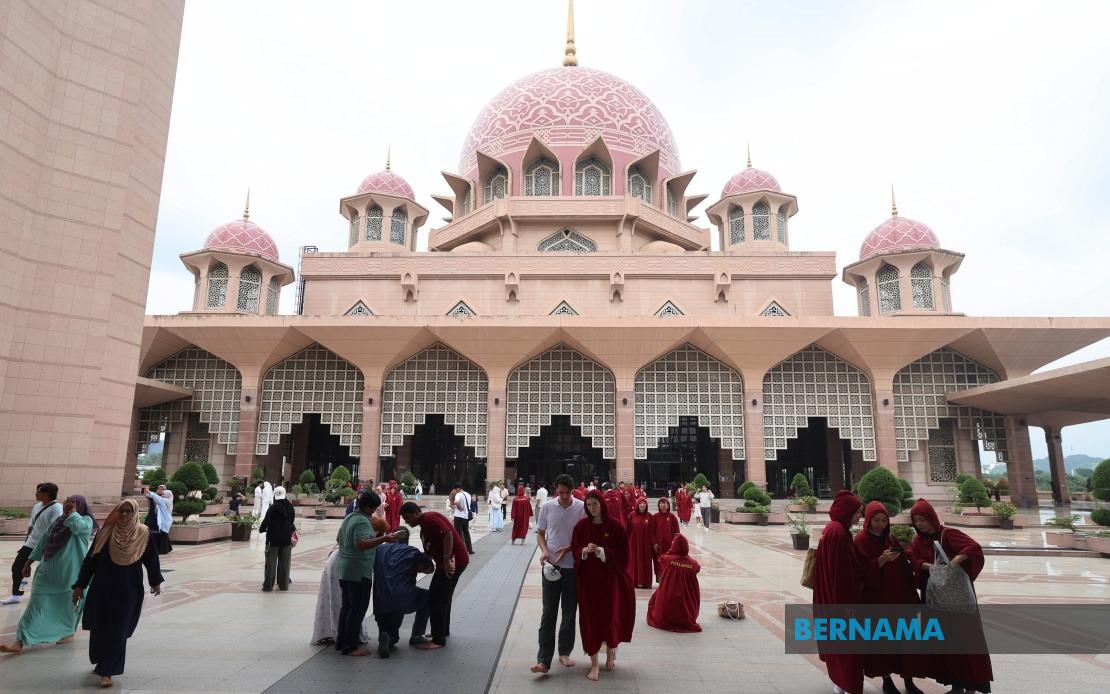
The Putra Mosque in Putrajaya is preparing to host one of the year's most significant Islamic observances, drawing together approximately 5,000 participants from across Malaysia and beyond for the National Maal Hijrah 1448H/2026M celebration. The event represents a major national occasion commemorating the Prophet Muhammad's Hijrah, the pivotal migration that signalled the commencement of Islamic civilisation's formal development. With Sultan Nazrin Shah of Perak scheduled to officiate proceedings, the gathering underscores the religious and cultural importance attached to this annual commemoration within Malaysia's official calendar.
The attendance roster reflects the event's significance within Malaysia's political and religious hierarchy. Both Deputy Prime Ministers, Datuk Seri Ahmad Zahid Hamidi and Datuk Seri Fadillah Yusof, alongside numerous Cabinet ministers, foreign diplomatic representatives, and senior government officials, are expected to participate in the day's proceedings. This convergence of political and religious leadership demonstrates how deeply Maal Hijrah observance is woven into Malaysia's governance structure and national identity, particularly given the country's status as a Muslim-majority nation with Islam enshrined as the official religion.
A cornerstone of the celebration involves the conferment of the National and International Tokoh Maal Hijrah Awards, a distinction that recognises exceptional individuals whose contributions extend beyond their professional achievements. Recipients are selected based on stringent criteria encompassing profound expertise within their chosen disciplines, demonstrated moral character of the highest calibre, and measurable contributions toward strengthening Islam's position and influence both domestically and on the world stage. These awards serve not merely as accolades but as affirmations of individuals whose life trajectories embody the transformative values that the Hijrah symbolises.
The Department of Islamic Development Malaysia (JAKIM) deliberately structured this year's observance around the concept of spiritual renewal and positive transformation. By emphasising how the Prophet's Hijrah catalysed civilisational advancement, JAKIM has framed the contemporary celebration as an invitation for modern Muslims to harness similar principles of change within their own lives and communities. This thematic focus bridges historical Islamic narratives with present-day challenges facing Malaysian and global Muslim populations, creating relevance for diverse audience segments attending the ceremony.
Innovative programming has enhanced the celebratory experience this year through the introduction of the Tausiyyah @ Maal Hijrah initiative. Held at the Putra Mosque in the day preceding the main ceremony, this supplementary programme engages attendees in profound contemplation of Quranic teachings through recitations by accomplished qari alongside scholarly exposition of textual meanings. The programme explicitly encourages participants to move beyond passive listening toward active intellectual and spiritual engagement, extracting practical wisdom applicable to contemporary personal and professional circumstances. This pedagogical approach transforms the observance from ceremonial formality into a meaningful learning experience.
The Tausiyyah programme's dual emphasis on Quranic recitation and interpretive reflection acknowledges that Malaysian Muslims, like their global counterparts, seek deeper spiritual understanding rather than surface-level religious observance. By creating space for tadabbur—the careful contemplation of divine verses—JAKIM responds to a broader contemporary movement within Islamic communities toward reflective, knowledge-based faith practices. For Malaysian Muslims navigating complex modern societies, such programmes provide intellectual scaffolding for integrating religious principles into daily decision-making.
Following the main ceremony, the National and International Tokoh Maal Hijrah Lecture 1448H/2026 will convene at the Putrajaya Islamic Complex Auditorium, transforming award recipients into knowledge-sharers and mentors. This continuation reflects a pedagogical philosophy wherein honouring excellence simultaneously obligates recognised individuals to disseminate their accumulated wisdom and experiences to broader audiences. The lecture series thus extends the celebration beyond singular commemorative moments into sustained intellectual discourse benefiting those seeking guidance within Islamic frameworks.
For Malaysia's Muslim population and Southeast Asia's broader Islamic communities, this national celebration carries symbolic weight extending beyond religious observance into questions of civilisational identity and future direction. The Hijrah represents not merely historical migration but a paradigm of intentional transformation undertaken with divine purpose. By elevating contemporary figures through the Tokoh awards, Malaysia positions itself as a custodian of Islamic values while simultaneously asserting that Islamic civilisation advances through meritocracy, knowledge, and moral excellence rather than hereditary privilege or political convenience.
The international component of the gathering, including foreign guests and representatives, positions Malaysia as a centre of Islamic thought and dialogue within Southeast Asia. This projection matters increasingly as regional nations navigate geopolitical complexities and seek to assert soft power through religious and cultural influence. Malaysia's high-profile Maal Hijrah observances demonstrate continuity in Islamic institutional life while adapting to contemporary expectations for meaningful engagement and educational substance.
For Malaysian readers observing this event, the significance extends to questions about how national identity incorporates religious observance and whether state-sponsored religious programmes genuinely serve spiritual needs or primarily serve ceremonial functions. The inclusion of international delegations and sophisticated award recognition systems suggests serious investment in substantive Islamic advancement rather than perfunctory celebration. Simultaneously, the prominence of political leadership at religious events reflects the ongoing intersection of governance and faith in Malaysian society—a characteristic distinctive to Malaysia's constitutional and social architecture within Southeast Asia.
The multi-day programming structure, incorporating preliminary Tausiyyah sessions, the main ceremony with official speeches and award presentations, and follow-up lectures, reveals careful curation designed to maximise meaningful engagement. This layered approach acknowledges that contemporary Malaysians, regardless of their religious commitment levels, expect educational value and intellectual substance alongside ceremonial participation. The result positions the Maal Hijrah observance as relevant not only to practising Muslims but to all Malaysians interested in understanding their nation's religious and cultural foundations.

%22%2F%3E%3C%2Fpattern%3E%3C%2Fdefs%3E%3Crect%20width%3D%22100%25%22%20height%3D%22100%25%22%20fill%3D%22url(%23ph2hy9vg)%22%2F%3E%3Crect%20width%3D%22100%25%22%20height%3D%22100%25%22%20fill%3D%22url(%23ph2hy9vp)%22%2F%3E%3Ctext%20x%3D%2250%25%22%20y%3D%2250%25%22%20text-anchor%3D%22middle%22%20dominant-baseline%3D%22central%22%20fill%3D%22rgba(255%2C255%2C255%2C0.95)%22%20font-family%3D%22Georgia%2C%20'Times%20New%20Roman'%2C%20serif%22%20font-weight%3D%22700%22%20font-size%3D%22272%22%20letter-spacing%3D%22-0.02em%22%3EAnwar%3C%2Ftext%3E%3C%2Fsvg%3E)