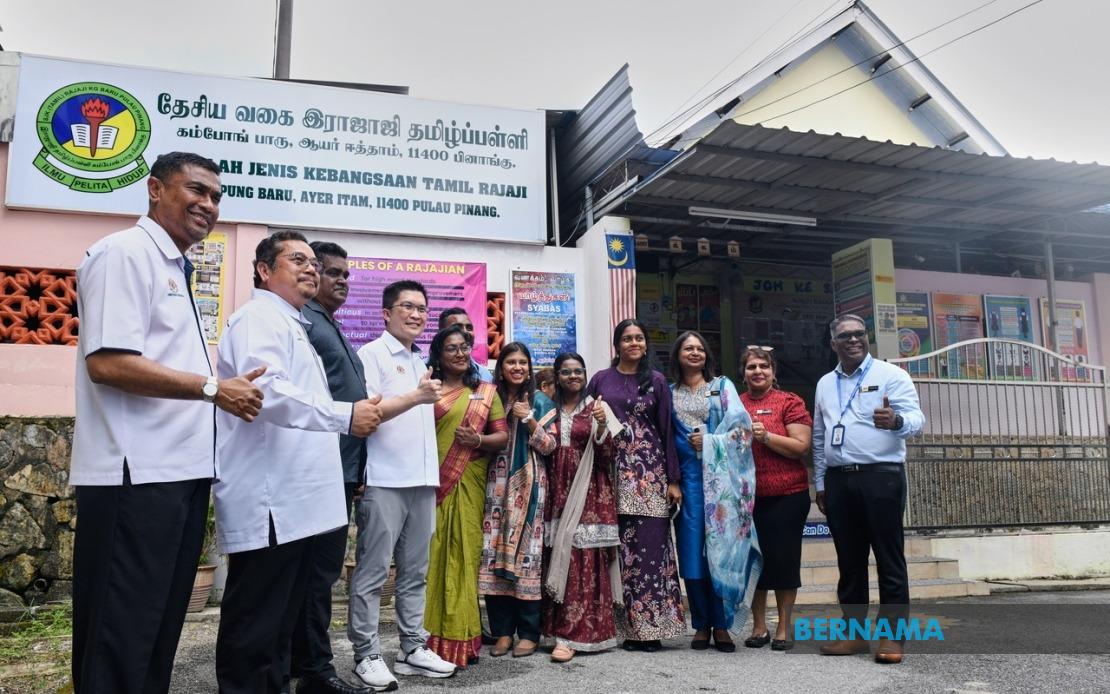
The Education Ministry has given its formal backing to a major infrastructure upgrade for SJKT Rajaji in George Town, approving the construction of an RM8 million facility that will relieve decades of operational strain on one of Penang's longest-standing Tamil-language educational institutions. Deputy Education Minister Wong Kah Woh announced the development, confirming that the school—which has served the community for 76 years—will transition to a purpose-built campus in the Farlim district of Bandar Baru Ayer Itam, approximately 500 metres from its current location.
The current SJKT Rajaji operates under significant spatial constraints, a predicament that has become increasingly untenable as it struggles to accommodate roughly 100 pupils within facilities designed for a different era. Wong explained that the relocation represents a watershed moment for the institution, offering the prospect of a fresh operational environment where educational activities can unfold without the physical limitations that have long characterised the school's operations. The compressed conditions have impacted everything from classroom instruction to extracurricular programming, making the need for expansion not merely a convenience but an educational necessity.
The Penang state government took the initial step toward resolving this challenge in 2022 by earmarking a 2.3-acre plot of land in Farlim specifically for the school's relocation. The school's board of governors subsequently filed an application with the Education Ministry last year, initiating a formal approval process that involved coordinating with various local authorities to address regulatory and administrative requirements. Following the resolution of these issues, the ministry granted its formal approval, paving the way for the project to advance into its construction phase.
Construction activities are anticipated to span 18 months, positioning the school to commence operations at its new campus no later than the 2029 academic session. This timeline, while requiring patience from stakeholders, reflects realistic expectations for a project of this scale and complexity. The scheduled opening would provide adequate time for both physical construction and the detailed logistical planning necessary to facilitate a smooth transition, including the relocation of equipment, materials, and administrative operations.
A particularly noteworthy aspect of the project is its financing structure. Wong underscored that the entire RM8 million investment will be underwritten by a private developer through its corporate social responsibility programme, eliminating any burden on state finances. This public-private partnership model demonstrates how business enterprises can meaningfully contribute to educational infrastructure development, particularly for communities that have historically received insufficient investment in their schooling facilities.
State Housing and Environment Committee chairman Datuk Seri S. Sundarajoo, who also leads the Penang Tamil Schools Special Committee, contextualised the SJKT Rajaji project within a broader revitalisation effort affecting Tamil-medium education across the state. Penang currently operates 28 Tamil national-type schools, several of which are simultaneously undergoing their own development initiatives. The state is pursuing a multi-faceted approach that encompasses securing permanent campus sites for schools currently operating on temporary premises and implementing phased infrastructure improvements.
The momentum appears substantial. Sundarajoo indicated that groundbreaking ceremonies for a minimum of three SJKT projects are scheduled to occur within the current calendar year, signalling an acceleration in development activities. Beyond these imminent undertakings, several additional schools including SJKT Sungai Bakap and SJKT Juru have had their development programmes revived after periods of dormancy, suggesting a coordinated strategy to upgrade facilities systematically across the state's Tamil school network.
For Malaysian readers, particularly those in Penang and other states with significant Tamil-speaking populations, the SJKT Rajaji project carries significance beyond the immediate school community. It illustrates how targeted infrastructure investment can address longstanding inequities in educational provision. Tamil schools have historically operated with constrained resources compared to their Malay-medium counterparts, and tangible projects like this one represent concrete progress toward parity in the physical learning environment.
Sundarajoo framed the broader initiative as evidence of Penang's commitment to enhancing Tamil school facilities without imposing additional financial strain on state coffers—a particular concern given competing budgetary demands across multiple sectors. By leveraging corporate partnerships and securing dedicated land allocations, the state government is demonstrating a model of educational development that relies on strategic coordination rather than budgetary expansion.
The relocation also carries implications for urban planning and community development. The 2.3-acre site in Farlim positions the school within an evolving residential district, potentially reshaping educational accessibility for Tamil-speaking families in the area. As Bandar Baru Ayer Itam continues to develop, having a purpose-built educational facility integrated into community planning can contribute to the area's social infrastructure and residential attractiveness.
For the immediate school community at SJKT Rajaji, the approval represents validation of years of advocacy by parents, educators, and administrators who recognised that the institution's existing premises had become a constraint on educational quality. The new facility will enable the school to expand its pupil intake, diversify its programme offerings, and provide staff with working conditions commensurate with modern educational standards. The 76-year legacy of the school, built within inadequate spaces, will transition into a new chapter beginning in 2029.
The project also reflects a broader understanding within Malaysian policymaking circles that educational equity requires investment in infrastructure across all language streams. While Malay and English-medium schools have received substantial capital development in recent years, dedicated projects for Tamil schools—particularly in urban areas like Penang—remain comparatively scarce. The SJKT Rajaji approval thus sets a precedent that may influence resource allocation discussions in other states with Tamil school populations facing similar spatial challenges.


%22%2F%3E%3C%2Fpattern%3E%3C%2Fdefs%3E%3Crect%20width%3D%22100%25%22%20height%3D%22100%25%22%20fill%3D%22url(%23ph2hy9vg)%22%2F%3E%3Crect%20width%3D%22100%25%22%20height%3D%22100%25%22%20fill%3D%22url(%23ph2hy9vp)%22%2F%3E%3Ctext%20x%3D%2250%25%22%20y%3D%2250%25%22%20text-anchor%3D%22middle%22%20dominant-baseline%3D%22central%22%20fill%3D%22rgba(255%2C255%2C255%2C0.95)%22%20font-family%3D%22Georgia%2C%20'Times%20New%20Roman'%2C%20serif%22%20font-weight%3D%22700%22%20font-size%3D%22272%22%20letter-spacing%3D%22-0.02em%22%3EAnwar%3C%2Ftext%3E%3C%2Fsvg%3E)