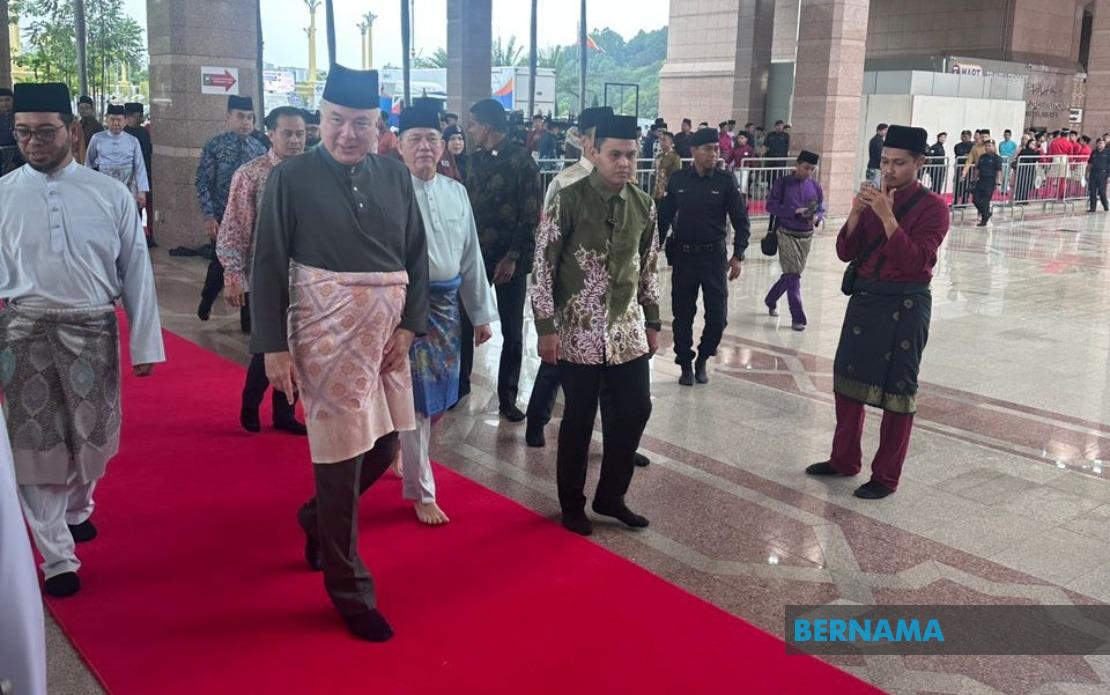
At the National Level Maal Hijrah 1448 Celebration in Putrajaya on June 17, Deputy Yang di-Pertuan Agong Sultan Nazrin Shah delivered a pointed critique of leadership conduct in Malaysia, arguing that impulsive decision-making rooted in personal sentiment represents a grave threat to national wellbeing. The Sultan's remarks, made before roughly 5,000 attendees at the Putra Mosque, highlighted a concern that resonates deeply within Malaysian governance circles: the tendency of officials to prioritize immediate emotional responses over measured, informed judgement. He underscored that when leaders abandon careful deliberation in favour of reckless action, the ultimate price falls not on decision-makers but on ordinary citizens who must absorb the consequences of poor governance.
The Sultan emphasized that contemporary leadership demands a fundamentally different approach—one grounded in calm assessment, intellectual openness, and genuine caution. Leaders must resist the pull of expedience, recognising that short-term political gains achieved through hasty choices invariably generate long-term damage that bleeds resources and erodes public trust. This message carries particular relevance in the Malaysian context, where policy reversals and sudden administrative shifts have occasionally disrupted economic planning and public confidence. The Sultan's emphasis on well-informed judgement suggests a framework where expertise, data analysis, and consultation take precedence over gut feeling or political pressure—a standard that applies equally to senior ministers and mid-level administrators tasked with implementing national programmes.
Drawing from Islamic history, Sultan Nazrin referenced the strategic wisdom embedded in the Hijrah itself, pointing specifically to Prophet Muhammad PBUH's decision to appoint Abdullah bin Uraiqit as guide during the migration from Mecca to Medina. Though not yet Muslim, Uraiqit possessed the specialised knowledge and proven reliability required for the journey's success. This historical example reinforces a crucial principle: Islamic governance recognises merit, expertise, and integrity without regard to religious affiliation, provided such individuals do not undermine Muslim interests. For Malaysian policymakers, the lesson translates into a call for meritocratic appointment practices and the incorporation of diverse expertise into decision-making bodies—an approach that strengthens institutions by drawing talent from across society rather than narrowing selection based on political considerations.
Beyond leadership conduct, Sultan Nazrin articulated a broader concern about the erosion of sacrifice as a guiding value within Malaysian Muslim communities and the nation more broadly. He observed that the willingness to subordinate personal comfort and private interest to collective good has become increasingly rhetorical rather than lived practice. True sacrifice, the Sultan argued, transcends mere acknowledgment of loss; it demands courage, perseverance, and genuine sincerity in service of objectives larger than oneself. This framing challenges contemporary cultural trends toward individualism and short-term gratification, suggesting that national resilience depends fundamentally on citizens' preparedness to endure hardship for communal benefit. In the context of Malaysia's development challenges—from addressing regional inequality to managing climate transitions—this invocation of sacrificial commitment carries substantial weight.
The Sultan cautioned that the Muslim ummah, both in Malaysia and globally, risks losing this vital spiritual and civic resource at precisely the moment when international pressures intensify. He warned that without deliberate cultivation of sacrificial values within educational institutions, religious bodies, and civil society, the community risks becoming adrift in what he termed "increasingly challenging storms and waves." This language suggests both external geopolitical turbulence and internal moral drift, with the implication that material progress absent strong ethical foundations becomes fragile and ultimately hollow. For Malaysian audiences particularly, this resonates with ongoing debates about maintaining cultural and religious identity whilst navigating rapid modernisation and globalisation.
Unity emerged as the third pillar of Sultan Nazrin's address, with the Sultan drawing inspiration from the Medina Charter as a historical model for interethnic and interreligious cooperation. The Charter, established after the Hijrah, successfully bound together diverse populations through principles of tolerance and equitable governance—a particularly pertinent reference given Malaysia's own multicultural composition and occasional communal tensions. Sultan Nazrin posited that effective nation-building depends fundamentally on the population's willingness to respect difference whilst cooperating toward shared objectives, all sustained by leadership that demonstrates both justice and wisdom. This formulation implicitly critiques zero-sum approaches to governance and intergroup relations, suggesting instead that sustainable progress emerges through collaborative frameworks that honour pluralism.
The Sultan further contextualised national unity within the framework of Islamic civilisational advancement, arguing that cooperation combined with just and wise administration represents the authentic foundation for prosperity. Malaysia's experience bears out this principle: the country's rapid economic development coincided with periods of relative interethnic harmony and competent institutional management, whilst moments of communal friction have frequently corresponded with governance lapses or perceptions of unfairness. The Sultan's invocation of this connection serves as implicit reminder that national strength cannot rest exclusively on economic metrics or military capacity; it requires the ongoing commitment of diverse populations functioning within systems perceived as legitimate and equitable.
Central to Sultan Nazrin's framing was a reinterpretation of Maal Hijrah's significance beyond its calendar function or historical nostalgia. Rather, he positioned the commemoration as an occasion for introspection and collective recalibration—a moment when Malaysians, particularly Muslim Malaysians, should assess whether their conduct and values align with principles of thoughtful governance, sacrificial commitment, and pluralistic unity. This therapeutic dimension transforms a religious observance into an active process of national self-examination, encouraging citizens and leaders alike to confront how contemporary practice diverges from stated ideals. The Sultan's suggestion that heedlessness increasingly threatens public consciousness, with populations becoming overwhelmed by worldly preoccupations, gestures toward concerns about attention fragmentation and values erosion in digital age societies.
The attendance of Deputy Prime Minister Datuk Seri Fadillah Yusof and Minister in the Prime Minister's Department (Religious Affairs) Dr Zulkifli Hasan underscored the government's engagement with the Sultan's message, though the extent to which administrative structures will operationalise these principles remains to be observed. Sultan Nazrin's remarks function simultaneously as moral exhortation and gentle institutional critique—challenging Malaysia's leadership apparatus to examine whether current decision-making processes embody the wisdom and foresight he advocates. For Malaysian readers and observers, the speech represents an important articulation of values-based governance from a respected constitutional figure, offering a framework for evaluating both individual leadership performance and systemic institutional health. The coming months will test whether his warnings about impulsive governance and his calls for sacrificial commitment resonate beyond ceremonial contexts into actual policy deliberation and administrative practice.


%22%2F%3E%3C%2Fpattern%3E%3C%2Fdefs%3E%3Crect%20width%3D%22100%25%22%20height%3D%22100%25%22%20fill%3D%22url(%23ph2hy9vg)%22%2F%3E%3Crect%20width%3D%22100%25%22%20height%3D%22100%25%22%20fill%3D%22url(%23ph2hy9vp)%22%2F%3E%3Ctext%20x%3D%2250%25%22%20y%3D%2250%25%22%20text-anchor%3D%22middle%22%20dominant-baseline%3D%22central%22%20fill%3D%22rgba(255%2C255%2C255%2C0.95)%22%20font-family%3D%22Georgia%2C%20'Times%20New%20Roman'%2C%20serif%22%20font-weight%3D%22700%22%20font-size%3D%22272%22%20letter-spacing%3D%22-0.02em%22%3EAnwar%3C%2Ftext%3E%3C%2Fsvg%3E)