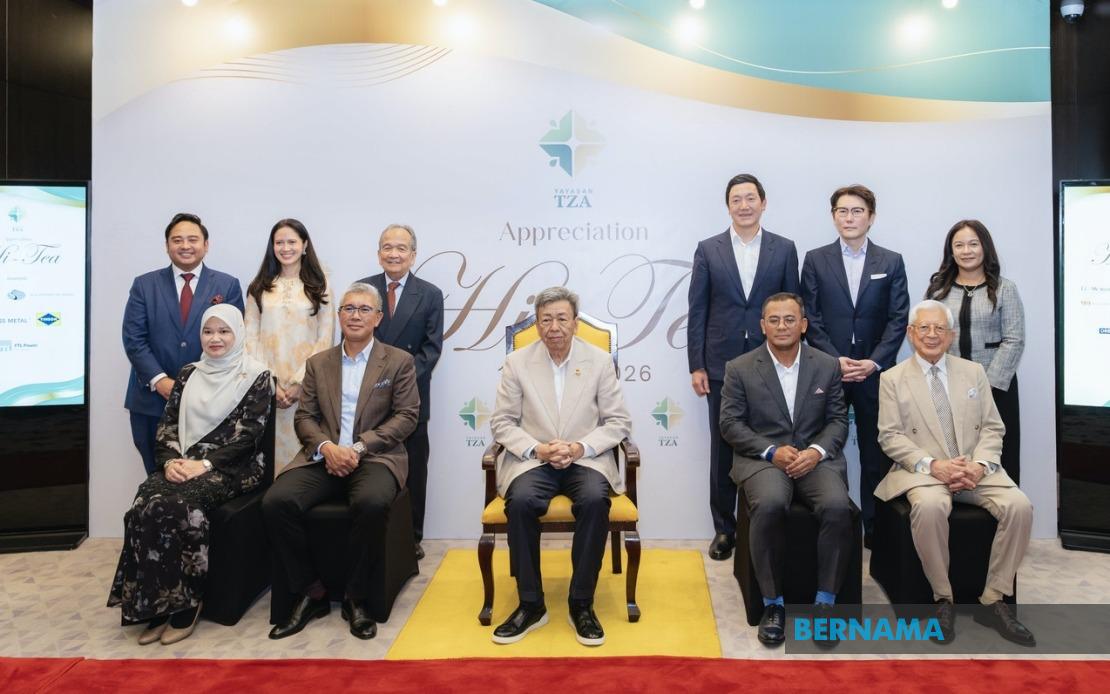
The Sultan of Selangor, Sultan Sharafuddin Idris Shah, attended a recognition ceremony on June 18 for Yayasan TZA (YTZA), the charitable foundation, marking another milestone in the organisation's evolving social impact agenda. Arriving at the venue shortly before 4 pm, His Royal Highness was warmly received by YTZA chairman Tan Sri Arshad Raja Tun Uda and YTZA advisor Tengku Datuk Seri Zafrul Abdul Aziz, with Selangor Menteri Besar Datuk Seri Amirudin Shari and Education Minister Fadhlina Sidek also in attendance. The gathering underscored the foundation's positioning within Malaysia's broader educational and community development landscape, drawing senior political and institutional figures.
Tengku Zafrul articulated the foundation's dual-track philosophy during his remarks, emphasising that YTZA's interventions transcend immediate relief to catalyse sustainable systemic change. The foundation operates across multiple domains—academic enrichment, environmental sustainability, grassroots community engagement and cultural programmes—all unified by a commitment to inclusivity and long-term capacity building. This holistic approach reflects growing recognition among Malaysian philanthropic bodies that one-dimensional aid responses prove insufficient for addressing entrenched socioeconomic disparities.
Central to YTZA's contemporary strategy is the ACE SPM initiative, a targeted academic support scheme designed specifically for Form Five students preparing for the Sijil Pelajaran Malaysia examination. The programme recognises a persistent educational equity gap whereby students from B40 (bottom 40% income) households often lack access to supplementary tuition and preparation resources available to their more affluent peers, creating a structural disadvantage that compounds across educational trajectories. By 2025, ACE SPM had directly served 467 students across ten Selangor-based schools, whilst digital components of the programme reached an additional 4,000 learners, demonstrating the scalability potential when online platforms augment traditional classroom interventions.
The scale of YTZA's digital reach carries particular significance for Malaysian educational equity conversations. As Southeast Asia's digital adoption accelerates, foundations increasingly leverage technology to democratise access to quality learning materials and expert guidance. The figure of 4,000 students reached through digital channels suggests that YTZA has successfully operationalised hybrid delivery models, allowing resource-constrained organisations to multiply impact beyond geographic and temporal constraints. This approach holds relevance for policymakers contemplating how to extend educational support networks into rural and underserved urban corridors where trained tutors remain scarce.
During the ceremony, His Royal Highness witnessed presentation of two substantial financial commitments underscoring private sector participation in YTZA's expansion ambitions. Kuok Brothers Sdn Bhd pledged RM1 million whilst YTL Power International Berhad contributed RM300,000, institutional donations that signal corporate confidence in the foundation's implementation capacity and strategic direction. These contributions reflect a broader pattern whereby Malaysian conglomerates increasingly channel corporate social responsibility investments through established foundations rather than managing discrete programmes independently—a shift that professionalises fund deployment whilst reducing administrative fragmentation.
Tengku Zafrul explicitly acknowledged the constellation of stakeholders enabling YTZA's operations: corporate sponsors, individual donors, strategic institutional partners, volunteer facilitators and various supporters. This explicit recognition underscores a governance philosophy emphasising collaborative architecture rather than top-down charity administration. For Malaysian civil society observers, such language signals maturation in how foundations conceptualise their role—not as benevolent providers dispensing aid to passive beneficiaries, but as coordinators mobilising diverse resources and expertise toward collectively defined outcomes.
The foundation simultaneously unveiled Larian KITA@Klang, a community fun run scheduled for October 10 that will coincide with the Sultan of Selangor's Silver Jubilee celebrations throughout 2025. This represents the fourth iteration of YTZA's Larian KITA series, community-oriented running events that deliberately celebrate inclusivity whilst showcasing local cultural and gastronomic identity. The integration of athletic activity, community participation and cultural celebration within a charitable framework exemplifies contemporary philanthropic trends whereby organisations increasingly recognise that social impact emerges not solely through transactional benefit-delivery but through building connective social capital and shared civic identity.
The October timing strategically positions Larian KITA@Klang within the broader commemorative calendar surrounding the Sultan's Silver Jubilee, leveraging a moment of heightened civic attention and royal visibility to amplify community mobilisation. Klang, as the venue, carries symbolic weight—as Selangor's royal seat, it represents institutional continuity with the sultanate whilst simultaneously functioning as a diverse, multiethnic urban centre where inclusive community engagement carries particular relevance. The choice of Klang thus embeds the fun run within specific geographic and political narratives.
Fundamentally, YTZA's programming architecture reflects evolving understanding across Malaysian civil society regarding sustainability in charitable work. Rather than concentrating solely on immediate remedial interventions, the foundation strategically addresses capacity constraints limiting B40 student academic performance through structured preparation programmes, recognises technology's democratising potential in knowledge distribution, and consciously constructs spaces for shared community identity and civic participation. These elements collectively position YTZA within a cohort of Southeast Asian foundations attempting to transcend traditional charity paradigms.
For Malaysian policymakers and educators observing foundation-based educational initiatives, YTZA's demonstrated reach and expansion trajectory offers instructive lessons regarding what becomes possible when private resources combine with professional programme design and institutional legitimacy. The foundation's 2025 expansion targets suggest organisational confidence in demand for these services—a reasonable inference given persistent educational inequities despite Malaysia's respectable enrolment statistics. The question animating future policy conversation concerns whether government resources might eventually complement and scale foundation-pioneered models, or whether philanthropic provision will remain a structural supplement to public educational investment rather than catalyst for systemic reform.

%22%2F%3E%3C%2Fpattern%3E%3C%2Fdefs%3E%3Crect%20width%3D%22100%25%22%20height%3D%22100%25%22%20fill%3D%22url(%23ph2hy9vg)%22%2F%3E%3Crect%20width%3D%22100%25%22%20height%3D%22100%25%22%20fill%3D%22url(%23ph2hy9vp)%22%2F%3E%3Ctext%20x%3D%2250%25%22%20y%3D%2250%25%22%20text-anchor%3D%22middle%22%20dominant-baseline%3D%22central%22%20fill%3D%22rgba(255%2C255%2C255%2C0.95)%22%20font-family%3D%22Georgia%2C%20'Times%20New%20Roman'%2C%20serif%22%20font-weight%3D%22700%22%20font-size%3D%22272%22%20letter-spacing%3D%22-0.02em%22%3EAnwar%3C%2Ftext%3E%3C%2Fsvg%3E)