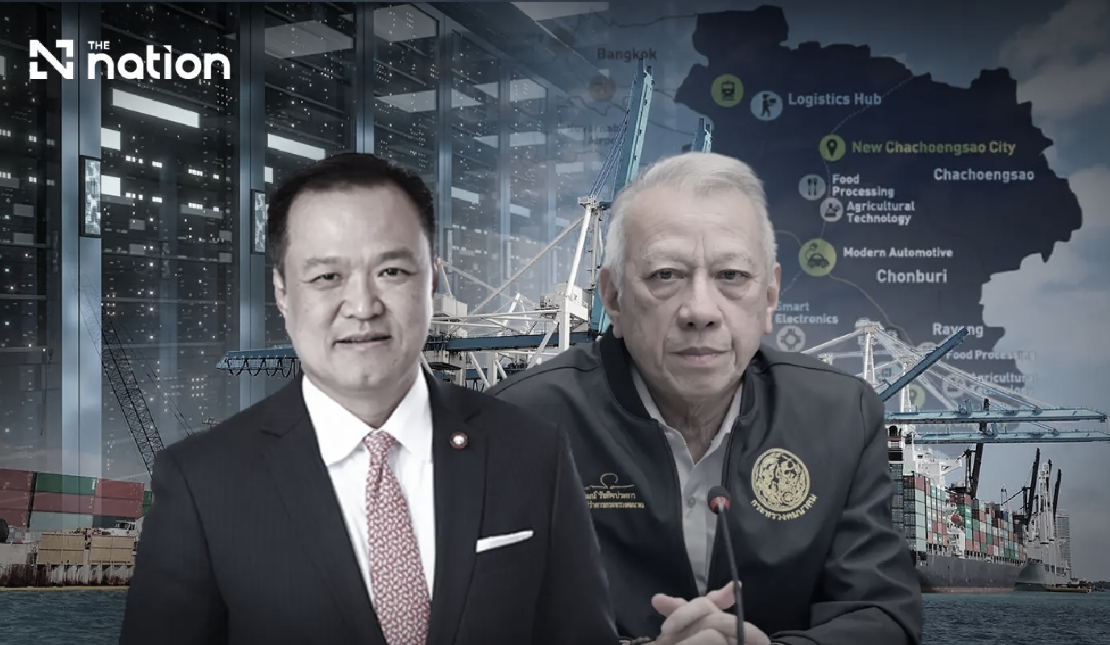
Thailand's Prime Minister Anutin Charnvirakul has reasserted personal command over the Eastern Economic Corridor, one of the kingdom's most ambitious development initiatives, signalling a fundamental recalibration of how the government intends to market its flagship investment proposition to international capital. The decision, which took effect on June 15 following Cabinet acknowledgment two days later, strips Deputy Prime Minister and Transport Minister Phiphat Ratchakitprakarn of his supervisory role over the EEC Office and removes him as chairman of the Eastern Economic Corridor Policy Committee. Government House sources characterised the move not as evidence of political tension but rather as a deliberate repositioning exercise, with Anutin now personally leading what officials describe as the "selling Thailand projects" campaign to overseas investors.
The significance of this administrative shift extends beyond mere bureaucratic reshuffling. The Eastern Economic Corridor, spanning Thailand's eastern provinces with their coastal advantages and proximity to Cambodia and Laos, has long been envisioned as a catalyst for industrial development and regional integration. By taking direct oversight, Anutin signals that he intends to reshape the corridor's strategic identity and investment narrative. Rather than continuing to rely on traditional heavy manufacturing as the primary draw, the government now wants to reposition the EEC around sectors that respond to contemporary global preoccupations and offer more sustainable competitive advantages for the region.
The new investment focus pivots substantially toward global food security, a sector that carries particular resonance in an era marked by supply chain vulnerabilities and growing anxiety about agricultural sustainability worldwide. Thailand's eastern provinces possess formidable existing capabilities in livestock production, fisheries, fruit cultivation, and horticultural specialisation. Government strategists evidently believe that framing the EEC as a global food security hub taps into a genuine international concern that transcends typical industrial recruitment cycles. As nations worldwide grapple with food supply uncertainties exacerbated by geopolitical tensions and climate variability, the proposition of investing in a sophisticated agricultural and agro-processing ecosystem offers tangible appeal to multinational food corporations and investment funds focused on essential commodity chains.
Equally transformative is the government's embrace of data centre development as a core pillar of EEC growth strategy. Data centres represent a fundamentally different investment class from traditional manufacturing, requiring enormous and stable supplies of electricity and water alongside sophisticated telecommunications infrastructure and climate control systems. The pivot reflects recognition that the eastern region faces genuine constraints in supporting further heavy industrial expansion—electricity and water procurement already impose substantial cost burdens that limit the corridor's competitiveness in labour-intensive manufacturing sectors. By contrast, data centre operators seeking geographically distributed facilities across Southeast Asia may view Thailand's eastern zone as an attractive alternative to more congested or expensive jurisdictions, provided the government can guarantee reliable utility supplies and regulatory stability.
The government is already moving to facilitate this transition through institutional mechanisms. The Energy Ministry is preparing a new electricity user category, designated Type 9, specifically designed for data centre operators. Facilities in this category would pay premium tariffs reflecting their exceptionally high power consumption, a pricing structure that acknowledges both the sector's unique demands and the scarcity value of available capacity. This graduated tariff approach allows the government to manage electricity allocation while channelling revenues toward infrastructure upgrade rather than subsidising consumption. Such technical preparation demonstrates that the EEC repositioning reflects genuine strategic planning rather than rhetorical posturing.
Regarding the political dimensions of this shift, Government House sources have gone to considerable lengths to deny that the reassignment reflects any deterioration in relationships within the ruling coalition or between Anutin and Phiphat personally. According to the official account, Phiphat himself initiated the conversation, informing the Prime Minister that friction between the EEC Office and the Board of Investment had created an uncomfortable working environment. Rather than continue operating amid institutional tension, Phiphat reportedly proposed that Anutin consolidate EEC oversight under his own portfolio—a characterisation that preserves Phiphat's dignity while explaining the administrative change as collaborative problem-solving rather than demotion.
Phiphat's own public response lent credibility to this narrative. He stated candidly that he had received no advance warning of the Cabinet orders, learning of them only when they were formally read during the meeting for acknowledgement. He pointedly deferred journalists' questions about the rationale to the Prime Minister himself, while emphatic denying that the change represented any diminishment of his role or any rift within Bhumjaithai, the coalition party both men represent. This measured tone, combined with his apparent acceptance of the decision, suggests either genuine agreement with the reshuffle or sufficient political discipline to avoid escalating tensions publicly.
Given Thailand's recent history of coalition instability and intra-party manoeuvring, the determination of both officials to frame this as apolitical carries particular weight. The government has simultaneously moved to distance the EEC reshuffling from two other contentious policy areas where Phiphat held positions. First, regarding the long-delayed three-airport high-speed rail project linking Don Mueang, Suvarnabhumi and U-Tapao airports, officials state that Anutin himself ordered that no amendments be made to the private-sector contract. Phiphat had previously advocated firmly against altering the payment model away from a pre-construction completion arrangement toward a "build-and-pay" structure. By asserting that the Prime Minister independently decided against contract modification, the government removes the EEC reshuffle from any appearance of disagreement over the rail project's controversial terms.
Second, officials have indicated that Anutin questioned Phiphat regarding a proposed Disneyland project within the EEC, with the Prime Minister expressing scepticism about timelines and return-on-investment analysis. This detail suggests that Anutin intends to impose greater rigour on the EEC's development pipeline, potentially winnowing aspirational projects lacking concrete feasibility studies. Such scrutiny aligns with the recalibration toward sectors like food security and data centres that presumably benefit from more established investment models and clearer demand signals.
For Malaysian readers and Southeast Asian observers, this Thai initiative carries several implications. Thailand's repositioning of the EEC around food security speaks to a regional pattern wherein countries increasingly view agricultural and agro-industrial capacity as strategically significant infrastructure deserving the same policy attention traditionally reserved for manufacturing or energy sectors. As regional supply chains become more contested and food security concerns intensify, the competitive positioning of agricultural ecosystems across Southeast Asia will likely intensify. Malaysia's own agricultural and agro-processing sectors may face heightened competition for regional investment if Thailand successfully markets the EEC as a comprehensive food security hub.
Simultaneously, Thailand's data centre ambitions highlight an emerging competition for infrastructure investment across Southeast Asia. Singapore has long dominated the region's data centre sector, but Thailand's combination of lower land costs, government support, and strategic location could attract operators seeking geographic diversification. Malaysia, along with Vietnam and Indonesia, faces similar competitive pressures. The imposition of premium electricity tariffs for data centre operators in Thailand suggests a policy framework that balances attracting investment with ensuring that essential utilities remain accessible for broader development.
The broader significance of Anutin's EEC reassertion lies in the signal it sends about Thailand's development priorities in the medium term. By personally taking charge of the corridor and reframing it around contemporary global concerns, the Prime Minister positions himself as architect of Thailand's response to evolving investment landscapes and geopolitical uncertainties. For regional competitors and investors alike, this suggests that Thailand intends to move decisively beyond aging industrial paradigms toward sectors offering greater resilience and international appeal in an era of heightened supply chain vulnerability and digital infrastructure demands.

%22%2F%3E%3C%2Fpattern%3E%3C%2Fdefs%3E%3Crect%20width%3D%22100%25%22%20height%3D%22100%25%22%20fill%3D%22url(%23ph2hy9vg)%22%2F%3E%3Crect%20width%3D%22100%25%22%20height%3D%22100%25%22%20fill%3D%22url(%23ph2hy9vp)%22%2F%3E%3Ctext%20x%3D%2250%25%22%20y%3D%2250%25%22%20text-anchor%3D%22middle%22%20dominant-baseline%3D%22central%22%20fill%3D%22rgba(255%2C255%2C255%2C0.95)%22%20font-family%3D%22Georgia%2C%20'Times%20New%20Roman'%2C%20serif%22%20font-weight%3D%22700%22%20font-size%3D%22272%22%20letter-spacing%3D%22-0.02em%22%3EAnwar%3C%2Ftext%3E%3C%2Fsvg%3E)