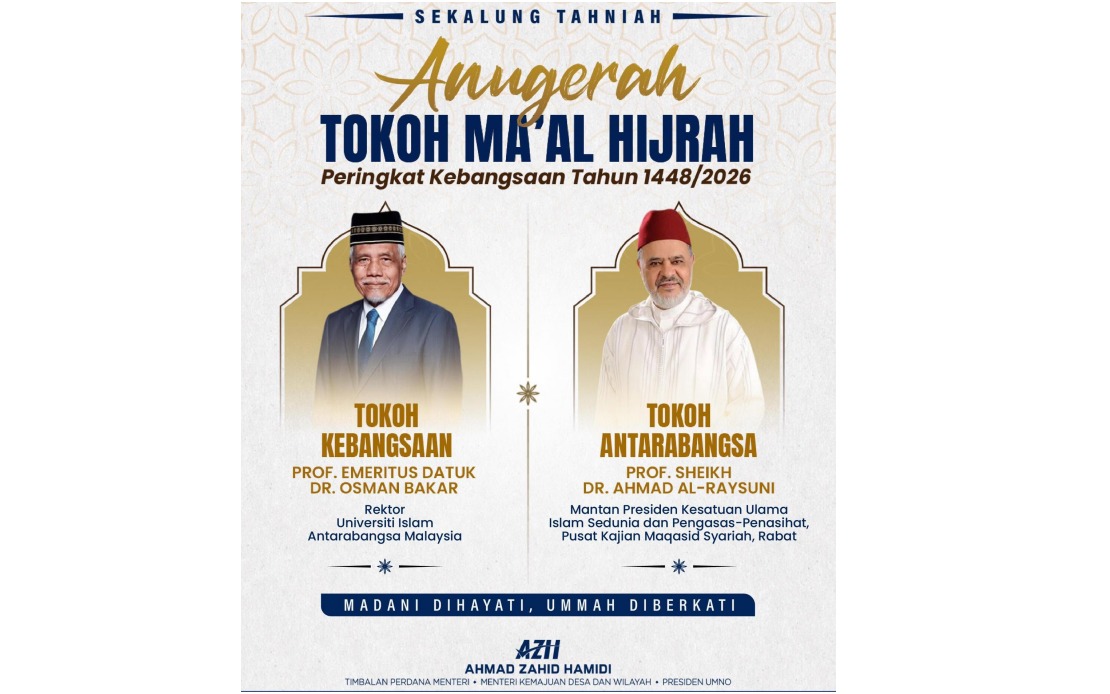
The Tokoh Maal Hijrah awards ceremony at Masjid Putra in Putrajaya has sparked calls from Malaysia's highest-ranking officials for the nation's Muslim community to embrace the exemplary conduct of the honoured recipients. Deputy Prime Minister Datuk Seri Dr Ahmad Zahid Hamidi marked the occasion by urging Muslims across the country to use the recognition bestowed upon this year's awardees as a catalyst for personal and collective advancement, particularly in the pursuit of knowledge and meaningful engagement within their communities.
Professor Emeritus Datuk Dr Osman Bakar claimed the National Tokoh Maal Hijrah Award at the June 17 ceremony, while Professor Sheikh Dr Ahmad Al-Raysuni, an accomplished Islamic jurisprudence specialist from Morocco, received the International variant of the honour. Sultan Nazrin Shah, the Sultan of Perak, conferred the awards alongside accompanying cash prizes, ceremonial trophies and certificates of recognition. The selections underscore how both scholars have fundamentally shaped discourse within Muslim intellectual circles and contributed substantially to the advancement of Islamic thought and practice.
Ahmad Zahid's message carried particular weight given his position within Malaysia's government hierarchy. He characterised the awards as validation of the recipients' lifetime dedication to strengthening Muslim communities, elevating the intellectual standing of Islamic scholarship, and disseminating Islamic principles that embody compassion, insight and tangible societal benefit. His comments reflected an understanding that recognition ceremonies such as these serve broader purposes beyond honouring individuals—they function as public affirmations of values the government wishes to promote among its citizens.
The Deputy Prime Minister specifically encouraged Muslims to persist in their quest for knowledge across all disciplines, a reminder that Islamic tradition has long valorised learning. Simultaneously, he called for continued commitment to serving one's community and advancing the broader interests of the ummah—the global Muslim community—alongside contributions to Malaysia's national development and the preservation of Islamic civilisation. This framing positioned individual achievement and communal responsibility as complementary rather than competing aspirations.
Deputy Prime Minister Datuk Seri Fadillah Yusof issued his own endorsement of the awards, suggesting their significance extended beyond religious circles to encompass all Malaysians regardless of faith. He contended that the recognition ceremonies functioned as reminders of the importance of sustained service and contribution to the nation's welfare. Fadillah's broader interpretation reflected an attempt to situate the awards within a framework of national unity and collective responsibility rather than sectarian identity alone.
Fadillah delved into the historical and spiritual dimensions of Maal Hijrah itself, moving beyond the recognition of individual achievement to examine the underlying principles that animated the Prophet Muhammad's migration from Mecca to Medina. He presented this foundational Islamic event not merely as a historical milestone but as an enduring source of moral instruction, emphasising how it continues to impart lessons about sacrifice, solidarity, fortitude and dedication to meaningful transformation. This interpretive approach attempted to connect contemporary award ceremonies with classical Islamic narrative and values.
The Deputy Prime Minister further articulated a vision of societal development grounded in moral and spiritual foundations rather than material metrics alone. He advocated for a society characterised by progress and prosperity that simultaneously maintains ethical and values-based moorings, suggesting that economic and technological advancement divorced from principled leadership risks hollow and unsustainable outcomes. This argument carries particular resonance in Malaysia, where policymakers frequently grapple with balancing rapid development with social cohesion and cultural preservation.
Fadillah's closing exhortation urged collective action toward strengthening communal bonds, deepening religious commitment and expanding charitable endeavours for the benefit of the broader Muslim community and Malaysia's prosperity. This language of collaborative endeavour and mutual obligation reflected an official emphasis on unity and shared purpose, particularly relevant given Malaysia's multi-ethnic and multi-religious composition where communal harmony remains a constant concern for government leadership.
The Tokoh Maal Hijrah awards programme itself occupies significant space within Malaysia's annual calendar of recognitions and celebrations. Held at the national level during formal Maal Hijrah observances, the awards carry prestige and official endorsement that elevates the recipients' standing and amplifies their influence within Malaysian Islamic discourse. The inclusion of an international category acknowledges the global character of Islamic scholarship and Malaysia's aspiration to participate meaningfully in international Muslim intellectual networks.
For Malaysian readers, the prominence of these official pronouncements underscores how government leadership continues to emphasise knowledge, ethical service and community participation as cardinal virtues within the nation's Muslim-majority context. The emphasis on learning and intellectual advancement aligns with Malaysia's broader development agenda, which increasingly depends on knowledge-intensive industries and skilled workforces. By explicitly linking these contemporary needs with Islamic values and traditions, officials attempt to frame Malaysia's modernisation trajectory as consistent with rather than antagonistic to religious identity and practice.
The international dimension represented by Ahmad Al-Raysuni's recognition signals Malaysia's broader engagement with global Islamic institutions and scholarship networks. This outward orientation reflects Malaysia's self-conception as a regional and international player within Muslim-majority geopolitics, capable of honouring and learning from scholars across geographical boundaries. Such recognition also potentially enhances Malaysia's soft power credentials within the wider Muslim world by demonstrating openness to diverse Islamic intellectual traditions while maintaining local institutional frameworks.
The ceremonial aspects of award presentations—involving the Sultan of Perak's personal participation, formal venues and widespread official acknowledgment—demonstrate how Malaysia's institutions continue to frame recognition of achievement within established protocols and hierarchies. This approach lends solemnity and weight to the occasion whilst simultaneously reinforcing institutional frameworks and constitutional traditions that structure Malaysian governance and social life. For observers across Southeast Asia, such ceremonies offer insight into how Malaysia integrates religious recognition with constitutional monarchy and democratic institutions.


%22%2F%3E%3C%2Fpattern%3E%3C%2Fdefs%3E%3Crect%20width%3D%22100%25%22%20height%3D%22100%25%22%20fill%3D%22url(%23ph2hy9vg)%22%2F%3E%3Crect%20width%3D%22100%25%22%20height%3D%22100%25%22%20fill%3D%22url(%23ph2hy9vp)%22%2F%3E%3Ctext%20x%3D%2250%25%22%20y%3D%2250%25%22%20text-anchor%3D%22middle%22%20dominant-baseline%3D%22central%22%20fill%3D%22rgba(255%2C255%2C255%2C0.95)%22%20font-family%3D%22Georgia%2C%20'Times%20New%20Roman'%2C%20serif%22%20font-weight%3D%22700%22%20font-size%3D%22272%22%20letter-spacing%3D%22-0.02em%22%3EAnwar%3C%2Ftext%3E%3C%2Fsvg%3E)