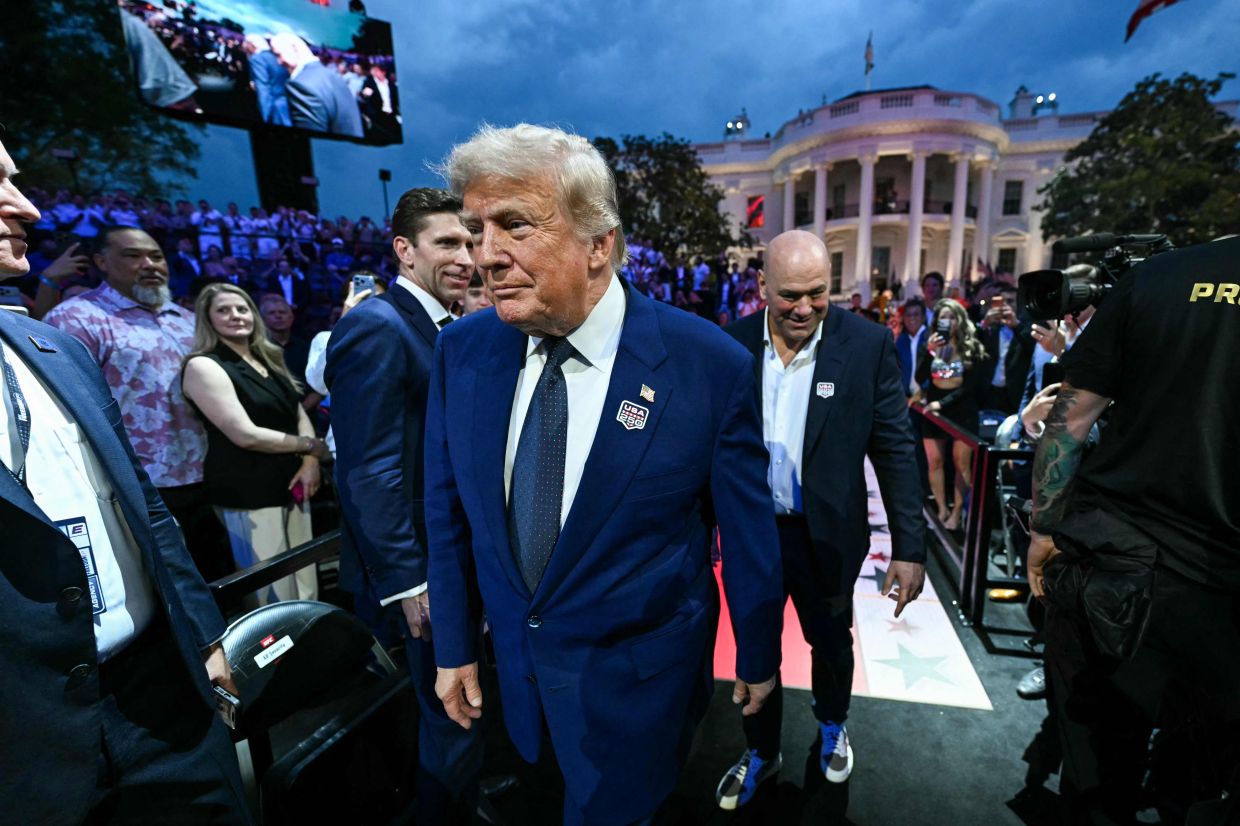
The South Lawn of the White House hosted an unconventional spectacle on Sunday evening when Donald Trump brought the Ultimate Fighting Championship to the presidential grounds to commemorate his 80th birthday. The decision to stage the TKO Group Holdings Inc.-operated sporting event at the nation's seat of power represents a striking departure from traditional uses of the venue and signals the administration's embrace of mixed martial arts as a cultural touchstone aligned with its political base. The event precedes Trump's departure to France for meetings with Group of Seven leaders, underscoring how the celebration was woven into his broader diplomatic and celebratory schedule.
The fights commenced just before 8:30 pm local time, with Trump and UFC President Dana White making a symbolic walk through the White House corridors leading to the arena. A nearly 100-foot-tall structure christened the "Claw" dominated the South Lawn, dwarfing the White House itself and capable of accommodating up to 4,300 spectators within the traditional octagonal cage setup. The arena's sheer scale represented an architectural intervention unprecedented in recent presidential history, with Trump suggesting in a June 2 TikTok video that the structure might become a permanent fixture, though the administration has since clarified in court filings that dismantling will begin at 10 am Monday.
Weather initially threatened the proceedings, with lightning and thunder in Washington forcing a slight delay. Once underway, the event drew a distinctive assemblage of political, corporate, and entertainment figures. Meta Platforms Inc. CEO Mark Zuckerberg, Paramount Skydance Corp. CEO David Ellison, Treasury Secretary Scott Bessent, and Trump family members occupied prominent positions. Joe Rogan, the podcast host whose audience skews toward young men who formed a crucial demographic in Trump's 2024 election victory, provided real-time commentary throughout the matches, bridging entertainment and political messaging.
The event's structure extended far beyond the White House grounds themselves. Military servicemembers filled seats on the South Lawn while the broadcast featured watch parties from military bases globally, including facilities in Okinawa, Japan, creating a geopolitical dimension to what was ostensibly a sporting celebration. Medal of Honor recipients and first responders escorted fighters into the arena, formally consecrating the proceedings with national iconography. As many as 120,000 additional spectators gathered at the nearby Ellipse, where free lottery-distributed tickets provided broader access to the spectacle.
The event anchored Trump's broader vision for commemorating America's 250th anniversary, which encompasses a commemorative gold coin bearing the president's likeness, an extensive fair on the National Mall, and an IndyCar race scheduled for August through Washington's downtown streets. This framing positions the UFC event as a flagship component of patriotic celebration, though it simultaneously raises questions about the intermingling of political symbolism with commercial entertainment and partisan constituency-building.
UFC's young, predominantly male fan base constituted a demographic bulwark for Trump's 2024 election victory, and the administration has reciprocated with institutional recognition. The State Department and Federal Bureau of Investigation have each signed partnership agreements with the UFC, representing an unprecedented alignment between federal security apparatus and combat sports. The event itself cost UFC over US$60 million to stage, with more than seven federal agencies mobilising what court filings characterised as "significant resources and manpower" in support.
Despite White House assurances that UFC would bear all costs, the scale of federal participation and the deployment of security and logistical resources inevitably involved substantial public expenditure. A lawsuit filed by the Public Integrity Project contested the event on constitutional grounds, characterising it as a "volcano of corruption" and alleging improper use of federal resources. Public sentiment reflected ambivalence; a YouGov poll released June 5 found 51% of Americans surveyed disapproved of the White House hosting the fights, with only 27% expressing approval, suggesting the event divided the broader electorate despite its appeal to Trump's core supporters.
Corporate sponsorship wove together the event's commercial and political dimensions. Crypto.com and Dodge's Ram truck brand secured prominent sponsorship positions, positioning themselves alongside presidential symbolism and federal infrastructure. Most tellingly, the Trump-family venture World Liberty Financial provided an additional US$250,000 bonus pool for the top two fighters, directly linking family business interests with the event's prestige and scope.
The event's ceremonial dimensions extended to Washington's most historically significant venues. The news conference preceding the fights took place at the Lincoln Memorial, where fighters engaged in traditional trash-talking and bravado, creating an incongruous juxtaposition of presidential reverence and combat sport theatricality. Fighter Michael Chandler articulated the weight of competing in such surroundings, noting that audiences would witness the "best version" of himself "on the White House lawn for America's 250th birthday," illustrating how individual competitors internalised the nationalist framing imposed upon the event.
Locker rooms occupied spaces normally reserved for official state functions, including the Indian Treaty Room, further subordinating traditional ceremonial geography to the sporting apparatus. The South Lawn, typically hosting the Easter Egg Roll and Congressional Picnic—genteel, family-oriented events—underwent dramatic transformation. Former President Joe Biden's temporary ice rink paled in comparison to the current architectural intervention, which Trump compared to the Eiffel Tower for its prominence and scale.
The event's broader significance for Southeast Asia and the region reflects American political polarisation's growing international visibility. The UFC's expansion into presidential symbolism signals evolving approaches to celebrity and entertainment governance, with implications for how other democracies might legitimise or contest similar intersections of commerce, sport, and state power. For Malaysian and regional observers, the event illustrates contemporary American political culture's increasing theatricality and the strategic importance of entertainment demographics in electoral politics.
Trump's departure to France immediately following the birthday celebration, carrying a UFC championship belt according to the company, literalised the blending of personal celebration and diplomatic engagement. The juxtaposition of hosting international combat sports at the White House before heading to Group of Seven summits creates a curious symbolic arc, suggesting how American cultural exports and entertainment industries remain central to presidential identity and international relations during Trump's second term.
%22%2F%3E%3C%2Fpattern%3E%3C%2Fdefs%3E%3Crect%20width%3D%22100%25%22%20height%3D%22100%25%22%20fill%3D%22url(%23ph2hy9vg)%22%2F%3E%3Crect%20width%3D%22100%25%22%20height%3D%22100%25%22%20fill%3D%22url(%23ph2hy9vp)%22%2F%3E%3Ctext%20x%3D%2250%25%22%20y%3D%2250%25%22%20text-anchor%3D%22middle%22%20dominant-baseline%3D%22central%22%20fill%3D%22rgba(255%2C255%2C255%2C0.95)%22%20font-family%3D%22Georgia%2C%20'Times%20New%20Roman'%2C%20serif%22%20font-weight%3D%22700%22%20font-size%3D%22272%22%20letter-spacing%3D%22-0.02em%22%3EAnwar%3C%2Ftext%3E%3C%2Fsvg%3E)