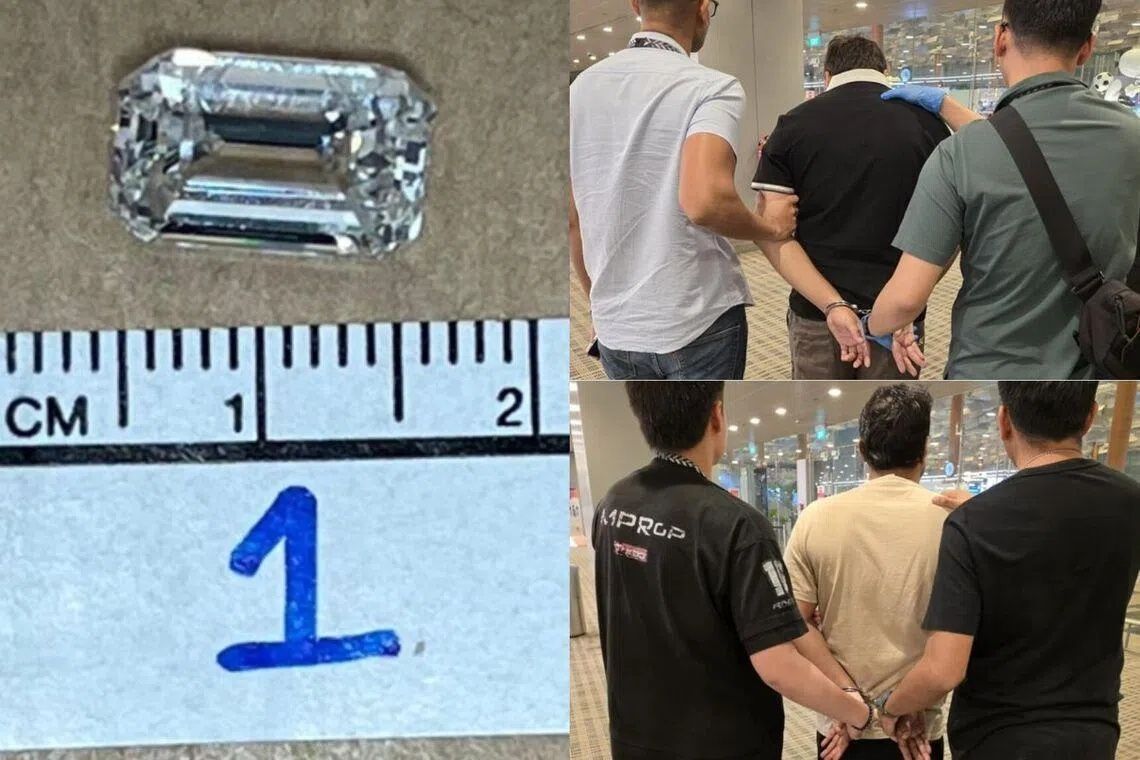
Police in Singapore have arrested two men aged 30 and 42 following the theft of a high-value diamond from a jewellery store in the Chinatown district. The brazen heist occurred on June 19 at a shop located on Kreta Ayer Road, when staff discovered that a genuine diamond worth more than S$235,000 had been replaced with a counterfeit substitute. The quick detection of the theft enabled authorities to launch an immediate investigation that would culminate in arrests within hours.
The police responded to an emergency call from the jewellery store at 3.40pm on June 19, when the shop assistant realised something was amiss during a routine stock verification. What had appeared to be a straightforward customer inquiry about purchasing a premium diamond had instead masked a carefully orchestrated sleight-of-hand operation. The suspects had engaged staff in conversation about the gemstone, examined it closely under the pretence of genuine interest, and then executed the swap with practised precision before departing empty-handed.
The investigation that followed demonstrated the effectiveness of modern law enforcement techniques in urban environments. Officers from the Central Police Division and Police Operations Command Centre worked systematically through available evidence, combining traditional ground enquiries with sophisticated digital surveillance tools. Extensive review of closed-circuit television footage from the jewellery store and surrounding areas, supplemented by police camera networks deployed throughout the Chinatown precinct, allowed investigators to identify the two suspects with sufficient clarity for apprehension.
The pair's attempted escape proved futile when officers intercepted them at Changi Airport Terminal 3 on the same day as the theft. The swift apprehension suggested that the suspects had planned to flee Singapore immediately following their alleged crime, anticipating detection and moving quickly to exit the country before authorities could act. However, the rapid response and coordinated intelligence work prevented their departure and enabled the recovery of the stolen diamond, which was seized as evidence.
Investigations revealed that the modus operandi employed by the two men involved establishing a facade of genuine commercial interest. They presented themselves as potential buyers, examining the diamond with apparent seriousness while building rapport with sales staff. During this period of engagement, when attention was focused on the transaction and the merchandise itself, they substituted the authentic gemstone with a carefully prepared counterfeit. The fake diamond was sufficiently convincing to pass initial cursory inspection, which explains why the theft went undetected until the shop assistant conducted a more thorough check.
The nationalities of the arrested men have not been disclosed by authorities, though their immediate attempt to depart from Singapore's primary airport suggests they may not be local residents. This detail carries significance for regional law enforcement cooperation, as gemstone theft rings sometimes operate across multiple jurisdictions, with individuals targeting high-value items before coordinating rapid exits through international airports. The incident underscores vulnerabilities in luxury retail that transcend national boundaries and require coordinated security approaches.
Both men will be charged on June 20 with theft in dwelling with common intention, a charge that reflects the premeditated nature of the offence and the collaboration between the two perpetrators. The applicable penalties under Singapore law are substantial: if convicted, each faces imprisonment of up to seven years and fines, a sentence structure designed to deter organised retail theft and protect the country's jewellery sector from organised criminal activity. The severity of potential punishment reflects the high value of the stolen property and the deliberate planning evident in the execution.
The Singapore Police Force issued a statement emphasising their commitment to combating such crimes, declaring "zero tolerance for such acts of crime and will spare no effort to apprehend offenders and deal with them in accordance with the law." This messaging serves both as reassurance to the business community and as a deterrent to potential offenders. The statement also included a direct advisory to shop owners and managers within the luxury retail sector, specifically those dealing in diamonds, watches, jewellery and other high-value items.
Authorities warned retailers to remain vigilant against similar tactics and to implement heightened security protocols around sleight-of-hand theft techniques. The advisory emphasises staff training to recognise suspicious behaviour patterns, such as customers showing excessive interest in examining items without genuine purchase intent, or those displaying nervous body language inconsistent with ordinary commercial transactions. Enhanced staff awareness represents a cost-effective complement to technological security measures like surveillance systems.
For Malaysian readers and regional business operators, this incident offers practical lessons in retail security. While Singapore maintains exceptionally low crime rates overall, the fact that an organised theft ring was able to operate against a professional jewellery store demonstrates that no establishment is entirely immune. Retailers across Southeast Asia, including Malaysia's own jewellery sector in Kuala Lumpur's commercial districts and shopping centres, should consider reviewing their protocols for authenticating high-value merchandise and monitoring customer behaviour. The incident also highlights how effective coordination between airport security and police investigations can intercept fleeing suspects before they clear national borders, a model applicable across the region's increasingly integrated transportation networks.
This case serves as a reminder that luxury retail theft often involves careful planning and coordination rather than opportunistic shoplifting. The deployment of technology, ground intelligence, and rapid response protocols enabled Singapore authorities to secure both the recovery of stolen property and the apprehension of suspects on the same day. As jewellery and gemstone businesses expand across Southeast Asia, such coordinated approaches to security and law enforcement cooperation will become increasingly important for protecting both retailers and consumers.


%22%2F%3E%3C%2Fpattern%3E%3C%2Fdefs%3E%3Crect%20width%3D%22100%25%22%20height%3D%22100%25%22%20fill%3D%22url(%23ph2hy9vg)%22%2F%3E%3Crect%20width%3D%22100%25%22%20height%3D%22100%25%22%20fill%3D%22url(%23ph2hy9vp)%22%2F%3E%3Ctext%20x%3D%2250%25%22%20y%3D%2250%25%22%20text-anchor%3D%22middle%22%20dominant-baseline%3D%22central%22%20fill%3D%22rgba(255%2C255%2C255%2C0.95)%22%20font-family%3D%22Georgia%2C%20'Times%20New%20Roman'%2C%20serif%22%20font-weight%3D%22700%22%20font-size%3D%22272%22%20letter-spacing%3D%22-0.02em%22%3EAnwar%3C%2Ftext%3E%3C%2Fsvg%3E)