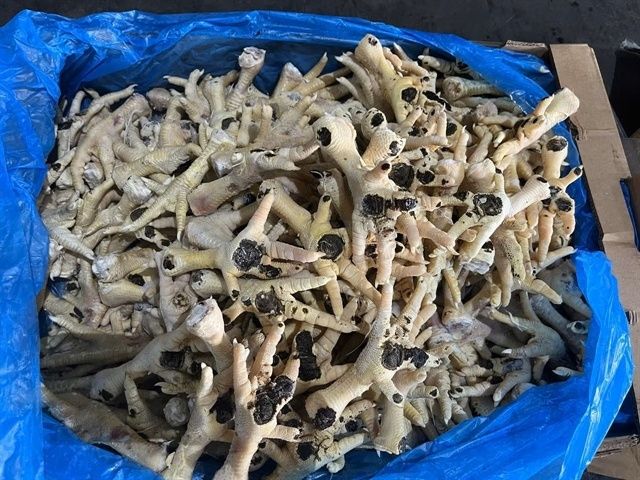
Hanoi police have filed smuggling charges against two businesswomen following an investigation that uncovered a sophisticated operation importing hundreds of containers of frozen chicken feet from countries with active poultry diseases and distributing them illegally throughout Vietnam's domestic market. The operation, which spanned from 2023 to 2026, represents a significant breach of Vietnam's food safety protocols and biosecurity measures designed to protect consumers from contaminated poultry products.
The two accused are Nguyen Thi To Loan, aged 47, who directly managed ABF Food Import-Export JSC based in Ninh Binh Province, and Trang Tuyet Ngoc, aged 45, serving as head of the assistant department at An Binh Group. Police confirmed on Friday that both suspects have confessed to all charges, clearing a major hurdle in prosecuting what appears to be a carefully orchestrated smuggling network that deceived customs authorities and circumvented Vietnamese food safety legislation.
At the heart of the scheme lay a straightforward deception: ABF imported 339 containers of frozen chicken feet between 2023 and 2026, declaring them on customs documentation as goods intended solely for processing and subsequent re-export. Vietnamese law explicitly prohibits the domestic sale of poultry products originating from countries experiencing poultry disease outbreaks; such shipments may enter Vietnamese territory only for legitimate processing and re-export purposes. This regulatory framework exists to shield domestic consumers and prevent the spread of avian diseases that could devastate local poultry industries.
Instead of adhering to these legal requirements, Nguyen Thi To Loan directed Trang Tuyet Ngoc to distribute the entire shipment across Vietnam's domestic food service sector. Investigators determined that more than 10,000 metric tonnes of frozen chicken feet were sold to restaurants, hotels, and catering businesses throughout Hanoi, Cao Bang, Ninh Binh, Quang Ninh, and numerous other provinces. The geographic breadth of the distribution underscores how extensively contaminated products penetrated Vietnam's food supply chain, potentially exposing tens of thousands of consumers to health risks.
The financial scale of the operation is substantial. Authorities valued the imported goods at approximately 347 billion Vietnamese Dong, equivalent to roughly US$13 million. Notably, the perpetrators paid no import duties whatsoever on these shipments, meaning the state also suffered significant revenue losses alongside the threat to public health. The absence of duty payments suggests either complicity among customs officials or sophisticated bribery mechanisms that enabled the goods to pass through checkpoints undetected.
When police conducted raids on cold-storage facilities connected to the operation, they discovered the true extent of the scheme's ongoing scope. Across multiple warehouses, authorities uncovered more than 2,000 metric tonnes of frozen chicken feet still in storage. At the An Viet 2 freezer facility located in Hanoi's Quang Minh Industrial Zone, police found over 1,000 metric tonnes, including approximately 260 metric tonnes that had already expired and displayed visible signs of deterioration including mold growth and putrefaction. Most alarmingly, these decomposed products appeared to be staged for further distribution, suggesting the operation continued its illegal activities even as law enforcement closed in.
A subsequent raid at the THL cold-storage warehouse in Lang Son Province in northern Vietnam yielded an additional 1,030-plus metric tonnes of frozen chicken feet. The volume of material still in storage indicates that despite years of operations, the network retained significant inventory, suggesting either more extensive distribution networks yet to be uncovered or an operation that had accumulated stock faster than it could distribute. This inventory discovery proved crucial in establishing the scale and deliberateness of the smuggling enterprise.
Vietnam's law enforcement has formally charged both suspects under Article 188 of the 2015 Penal Code, which addresses smuggling offences. This charge carries serious implications, as smuggling cases involving compromised food products typically face heightened penalties given the public health dimensions. For Malaysian readers and businesses across Southeast Asia, this case illustrates the continuing vulnerability of regional food supply chains to organized criminal networks that exploit regulatory gaps and corrupt officials.
The investigation remains active, with Hanoi police actively determining the roles of other individuals and organizations potentially implicated in the broader network. This suggestion implies that the two charged women may have been operatives within a larger structure, possibly involving importers, customs brokers, cold-storage operators, and distribution networks. Such investigations typically expand significantly as authorities trace financial flows and identify all parties who profited from the illegal operation.
The case carries substantial implications for food safety across Southeast Asia. Vietnam is a major poultry product exporter to regional markets, and confirmation that smuggled and potentially disease-bearing products were illegally distributed within Vietnam raises questions about whether any contaminated material crossed into neighboring countries including Thailand, Cambodia, Laos, and potentially beyond. Southeast Asian regulatory authorities may need to conduct retrospective testing on poultry products imported from Vietnam during this period.
For Vietnamese consumers, the discovery underscores persistent vulnerabilities in domestic food safety oversight despite regulatory frameworks theoretically designed to prevent such incidents. The operation's longevity—spanning three years—suggests systematic failures in customs enforcement, cold-chain monitoring, and restaurant supply chain verification. Authorities will likely face pressure to implement more rigorous traceability systems and surprise inspections of food service suppliers.
The case also highlights how organized food fraud networks operate by exploiting regulatory complexity. By falsely declaring products as exports, the smugglers leveraged the distinction between domestic and export regulations to circumvent safety protocols. This methodology—regulatory arbitrage through misclassification—remains a consistent challenge for developing economies where customs infrastructure may lack sophistication or experience with evolving smuggling techniques.

%22%2F%3E%3C%2Fpattern%3E%3C%2Fdefs%3E%3Crect%20width%3D%22100%25%22%20height%3D%22100%25%22%20fill%3D%22url(%23ph2hy9vg)%22%2F%3E%3Crect%20width%3D%22100%25%22%20height%3D%22100%25%22%20fill%3D%22url(%23ph2hy9vp)%22%2F%3E%3Ctext%20x%3D%2250%25%22%20y%3D%2250%25%22%20text-anchor%3D%22middle%22%20dominant-baseline%3D%22central%22%20fill%3D%22rgba(255%2C255%2C255%2C0.95)%22%20font-family%3D%22Georgia%2C%20'Times%20New%20Roman'%2C%20serif%22%20font-weight%3D%22700%22%20font-size%3D%22272%22%20letter-spacing%3D%22-0.02em%22%3EAnwar%3C%2Ftext%3E%3C%2Fsvg%3E)