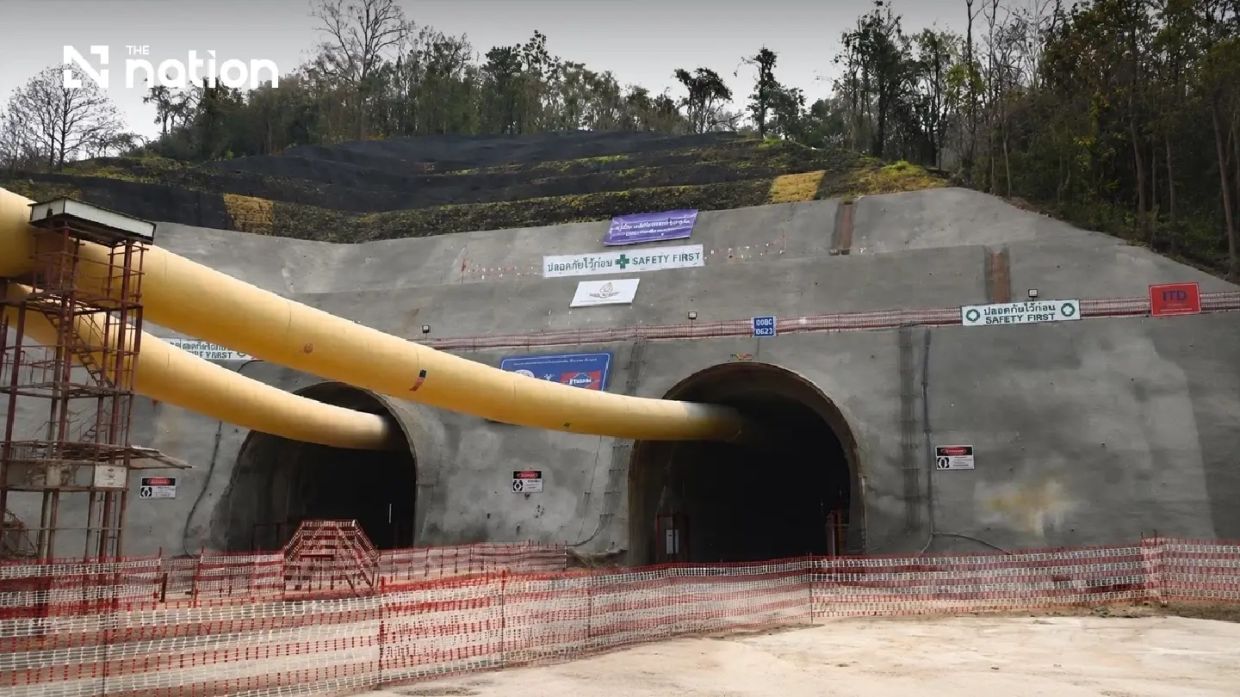
Thailand's ambitious railway expansion programme suffered a serious setback on Saturday evening when a structural collapse at the Doi Luang tunnel construction site in Chiang Rai's Chiang Saen district claimed two lives and left seven workers injured. The accident, which occurred around 8.35pm during ongoing construction of the State Railway of Thailand's Den Chai-Chiang Rai-Chiang Khong railway line, has prompted immediate safety reviews and a comprehensive investigation into the circumstances that led to the incident.
Initial accounts provided by Deputy Transport Minister Siripong Angkasakulkiat indicated that the collapse stemmed from rocks dislodging from the tunnel wall as workers were undertaking waterproofing installation work. Earlier reports had suggested the failure occurred within the shotcrete work area, though officials cautioned that the full picture remained under examination. The preliminary toll recorded two fatalities, three seriously wounded, and four with minor injuries. All affected workers were transported to hospital for treatment, with the site subsequently cordoned off to prevent further risk.
The Doi Luang tunnel represents a critical component of the railway infrastructure connecting northern Thailand's economic hubs. Stretching 3.4 kilometres in length, the tunnel has already been bored through and is undergoing the finishing and systems installation phase. This stage involves intricate technical work including waterproofing, ventilation systems, electrical installations, and safety infrastructure that requires precise execution and robust temporary structures to support workers at height within the confined underground environment.
The tunnel forms part of Contract 3 of the broader Chiang Rai-Chiang Khong railway section, a 19.385 billion baht undertaking administered by the State Railway of Thailand. This contract encompasses an expansive 87-kilometre stretch of both grade-level and elevated tracks, three new railway stations, three additional halt facilities, signalling and telecommunications infrastructure, and associated supporting works. The scale and complexity of this component underscores the logistical challenges involved in executing such a major transport development in Thailand's northern region.
Responsibility for executing Contract 3 rests with the CKST-DC3 Joint Venture, a consortium formed by three major construction entities: CH. Karnchang Public Company Limited, Sino-Thai Engineering & Construction Public Company Limited, and Chiangmai Construction Co., Ltd. This tri-party arrangement reflects the substantial expertise and resources required to manage such an ambitious infrastructure project. The joint venture structure is common in Thai megaprojects, distributing risk and combining the specialised capabilities of experienced contractors.
Deputy Minister Siripong emphasised that response protocols had been activated immediately following the incident. The project's safety management unit assumed operational control of the affected area, implementing containment measures and initiating continuous monitoring of conditions. This hierarchical response structure is designed to prevent secondary incidents while preserving the integrity of the investigation site for forensic analysis. The emphasis on maintaining control and preventing further deterioration reflects standard practice in industrial accident response across Southeast Asia.
The State Railway of Thailand's Special Projects and Construction Department mobilised to conduct an urgent on-site inspection, initiating the formal investigative process. Officials stressed that the underlying causes remained under examination, pending detailed technical analysis and witness interviews. Such investigations typically involve structural engineers, safety consultants, and independent third parties to establish whether failures stemmed from design inadequacies, material defects, workmanship issues, or procedural lapses. The findings will likely shape future safety protocols across similar rail construction projects in Thailand and the region.
This incident raises broader questions about occupational safety management on Thailand's expanding railway infrastructure. The Den Chai-Chiang Rai-Chiang Khong railway represents part of Thailand's strategy to improve transport connectivity with neighbouring Laos and Myanmar, supporting trade and regional integration goals. However, such ambitious timelines occasionally create pressure that can compromise safety cultures on construction sites. Malaysian construction firms operating in Thailand and across Southeast Asia will closely monitor the investigation's conclusions, as safety standards established in one jurisdiction often influence regional expectations and contractual requirements.
For Malaysian stakeholders with interests in Thai infrastructure projects or regional construction supply chains, this incident underscores the critical importance of robust safety management systems on underground construction work. Malaysian contractors operating in challenging geological and environmental conditions face comparable risks, making the lessons from this incident directly applicable. The involvement of multiple consortium partners also reflects collaboration models increasingly common in ASEAN's megaprojects, where cost and risk-sharing arrangements distribute liability but require meticulously coordinated safety oversight.
The broader Den Chai-Chiang Rai-Chiang Khong railway initiative remains a cornerstone of Thailand's northern development strategy, particularly given its connections to planned regional rail corridors linking Southeast Asian nations. The project's importance means investigation findings will likely result in strengthened protocols rather than project abandonment. However, the loss of life inevitably prompts reflection on whether construction timelines adequately accommodate the complexity and hazards inherent in underground work through challenging terrain.
As investigation proceeds, Thai transport authorities will coordinate with the contractor consortium to determine whether the accident stemmed from temporary works design, installation methodology, or operational procedures. Incident reports and corrective measures will inform industry standards across Thailand and potentially influence safety requirements for similar projects throughout ASEAN. For regional construction professionals, this Chiang Rai incident represents a sobering reminder that even established contractors with significant combined experience require vigilant safety oversight when executing the most technically demanding and hazardous infrastructure tasks.
%22%2F%3E%3C%2Fpattern%3E%3C%2Fdefs%3E%3Crect%20width%3D%22100%25%22%20height%3D%22100%25%22%20fill%3D%22url(%23ph3iugkg)%22%2F%3E%3Crect%20width%3D%22100%25%22%20height%3D%22100%25%22%20fill%3D%22url(%23ph3iugkp)%22%2F%3E%3Ctext%20x%3D%2250%25%22%20y%3D%2250%25%22%20text-anchor%3D%22middle%22%20dominant-baseline%3D%22central%22%20fill%3D%22rgba(255%2C255%2C255%2C0.95)%22%20font-family%3D%22Georgia%2C%20'Times%20New%20Roman'%2C%20serif%22%20font-weight%3D%22700%22%20font-size%3D%22151%22%20letter-spacing%3D%22-0.02em%22%3EBezzecchi%3C%2Ftext%3E%3C%2Fsvg%3E)