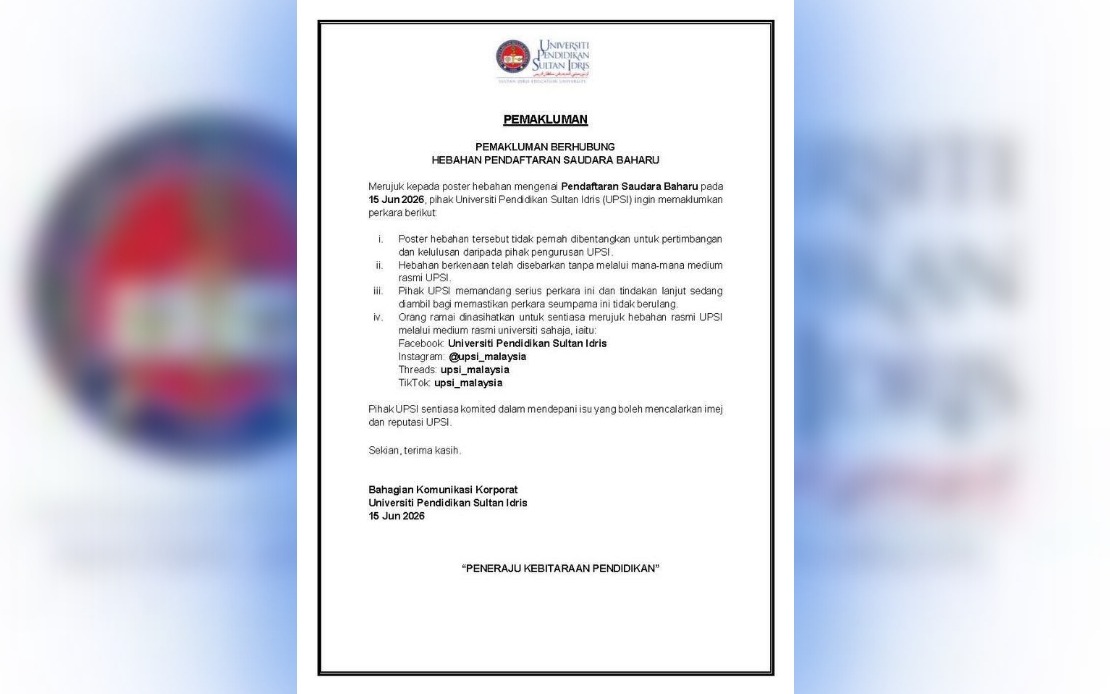
Universiti Pendidikan Sultan Idris (UPSI) has moved to clarify that it had no involvement in a poster promoting registration of 'saudara baharu' or newly converted Muslims that recently circulated across social media platforms. The institution issued a statement through its official social media accounts on June 17 to address mounting public confusion about the poster's origins and authenticity following its rapid spread online.
The poster, which bore a June 15 date stamp, never reached UPSI's administrative offices for formal consideration or approval, according to the university's official statement. This critical distinction underscores a growing concern about how misinformation and unauthorised content can be attributed to legitimate institutions in the digital age. The university explicitly confirmed that the poster was disseminated through channels unaffiliated with UPSI's official communications infrastructure, raising questions about how the document came to be associated with the educational institution.
UPSI's response reflects a broader institutional challenge facing Malaysian universities and government bodies: the difficulty of controlling narratives and preventing misuse of institutional identity for purposes the organisation does not endorse. By categorically denying any involvement, UPSI attempted to establish clear boundaries between its official stance and content circulating under its perceived banner. The university stressed that members of the public should rely exclusively on information distributed through its recognised official channels to avoid falling victim to misleading or fraudulent communications.
The incident highlights the vulnerability of educational institutions to reputational damage through association with viral content. Even content that contradicts institutional values or policy can become entangled with an organisation's brand if it spreads widely and is believed by significant audiences. UPSI's proactive denial was designed to prevent the poster from becoming permanently linked with the university in public memory and search engine results. This defensive posture is increasingly common among Malaysian institutions seeking to protect their credibility in an environment where misinformation travels faster than corrections.
UPSI's formal statement indicated the university takes the matter with considerable seriousness and has committed to implementing measures to prevent similar incidents in future. The specificity of this commitment suggests the institution recognises that passive denial alone is insufficient; stakeholders expect concrete preventative action. Such measures might include enhanced digital security protocols, staff training on identifying and reporting fraudulent communications, or improved mechanisms for rapid public response when misrepresentation occurs.
The university's emphasis on its institutional reputation carries particular weight in Malaysia's educational landscape, where public trust in universities influences enrolment decisions, donor support, and community standing. Unauthorised posters associated with religious recruitment or registration activities could especially undermine confidence, particularly if stakeholders perceive the content as misrepresenting the university's values or operational standards. UPSI's swift action attempted to prevent any such erosion of institutional credibility.
This episode also illustrates how social media's algorithmic amplification can transform isolated or marginal content into phenomena that demand institutional response. A poster created or shared by unknown individuals can gain unexpected visibility and become attributed to larger organisations without any deliberate effort on the part of those institutions. Malaysian authorities and institutions are increasingly grappling with this asymmetry, where defending against false association requires significant resources and rapid response mechanisms.
The broader context of religious sensitivity in Malaysia adds another dimension to UPSI's concern. Content related to Islam, conversion, and religious registration touches on areas where public sentiment is particularly engaged and where institutional positioning matters significantly. A university's perceived stance on such matters can influence how diverse student communities perceive their welcome at the institution. UPSI's careful distancing from the poster represented an attempt to reassure all constituencies that the institution was not unilaterally promoting specific religious activities through official channels.
For Malaysian students and families evaluating educational institutions, incidents like this underscore the importance of verifying information through official university websites and published communication rather than relying on social media content claiming institutional endorsement. The proliferation of spoofed communications and deepfakes means that visual similarity to official materials is no longer sufficient evidence of authenticity. Educational consumers must develop media literacy skills to distinguish between genuine institutional communications and impostor content.
The incident also raises questions about digital security protocols at Malaysian universities. How unauthorised posters come to be associated with institutional identities—whether through compromised email accounts, infiltrated design systems, or clever manipulation of visual branding—represents a vulnerability that extends beyond UPSI. Strengthening institutional cybersecurity and implementing verification systems for outgoing communications has become as critical to reputation management as traditional public relations strategy. As Malaysian institutions increasingly operate in digital environments, protecting institutional identity in online spaces requires investment comparable to that dedicated to physical campus security.

%22%2F%3E%3C%2Fpattern%3E%3C%2Fdefs%3E%3Crect%20width%3D%22100%25%22%20height%3D%22100%25%22%20fill%3D%22url(%23ph2hy9vg)%22%2F%3E%3Crect%20width%3D%22100%25%22%20height%3D%22100%25%22%20fill%3D%22url(%23ph2hy9vp)%22%2F%3E%3Ctext%20x%3D%2250%25%22%20y%3D%2250%25%22%20text-anchor%3D%22middle%22%20dominant-baseline%3D%22central%22%20fill%3D%22rgba(255%2C255%2C255%2C0.95)%22%20font-family%3D%22Georgia%2C%20'Times%20New%20Roman'%2C%20serif%22%20font-weight%3D%22700%22%20font-size%3D%22272%22%20letter-spacing%3D%22-0.02em%22%3EAnwar%3C%2Ftext%3E%3C%2Fsvg%3E)