%22%2F%3E%3C%2Fpattern%3E%3C%2Fdefs%3E%3Crect%20width%3D%22100%25%22%20height%3D%22100%25%22%20fill%3D%22url(%23ph3jkoxg)%22%2F%3E%3Crect%20width%3D%22100%25%22%20height%3D%22100%25%22%20fill%3D%22url(%23ph3jkoxp)%22%2F%3E%3Ctext%20x%3D%2250%25%22%20y%3D%2250%25%22%20text-anchor%3D%22middle%22%20dominant-baseline%3D%22central%22%20fill%3D%22rgba(255%2C255%2C255%2C0.95)%22%20font-family%3D%22Georgia%2C%20'Times%20New%20Roman'%2C%20serif%22%20font-weight%3D%22700%22%20font-size%3D%22320%22%20letter-spacing%3D%22-0.02em%22%3EDAP%3C%2Ftext%3E%3C%2Fsvg%3E)
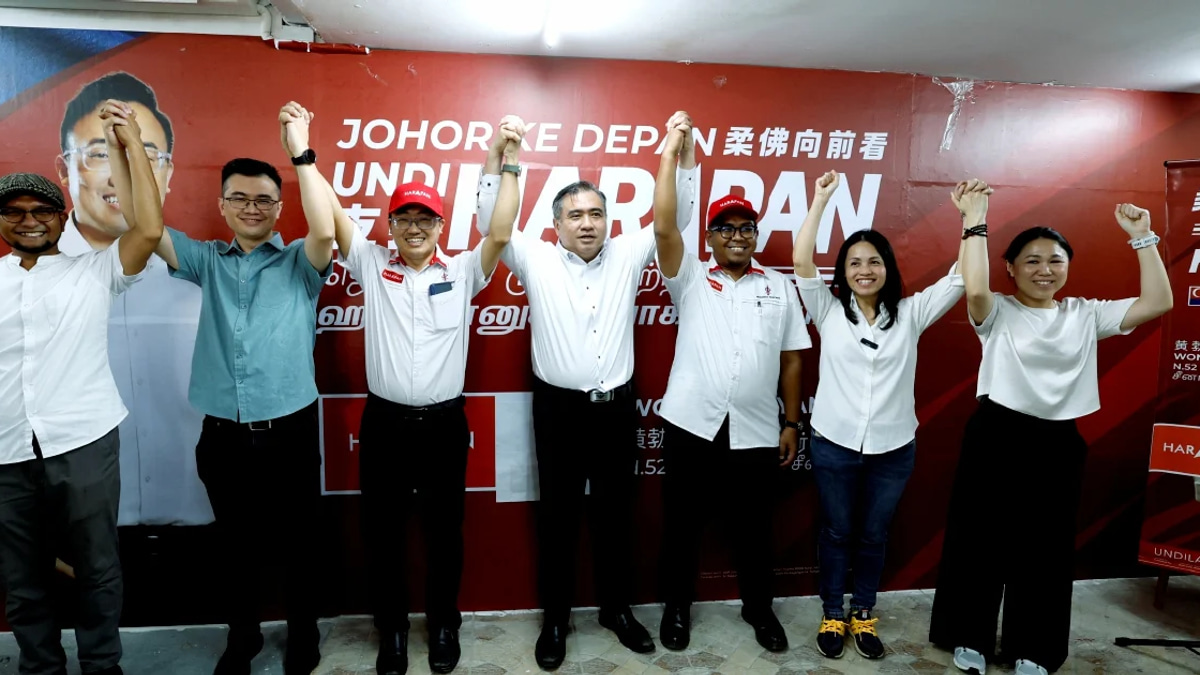
The Democratic Action Party revealed its four-candidate slate for the Johor state election on June 20, signalling an ambitious push across multiple constituencies in a strategic region that will play a decisive role in determining the peninsular state's political direction. Transport Minister and DAP secretary-general Anthony Loke Siew Fook made the announcement at a ceremony in Johor Bahru, underscoring the party's confidence in its electoral prospects despite facing a competitive landscape across the state.
The party's candidate selection reflects a deliberate expansion strategy, particularly through the nomination of Nor Zulaila Abd Ghani, a 38-year-old private secretary to the Deputy Finance Minister, who will contest the Tiram state seat. This marks a watershed moment for DAP, as the party has never previously fielded a candidate in Tiram, a mixed-composition constituency with a Malay-majority voter base. By venturing into this demographic territory, DAP is signalling its intention to broaden its electoral appeal beyond its traditional strongholds and test its ability to resonate with voters from different communal backgrounds.
Lee Wern Yiing, 30, chief of Johor DAP Socialist Youth (DAPSY), has been selected to contest Johor Jaya, bringing youth representation to the party's campaign effort. The appointment of a younger candidate reflects broader trends within DAP to refresh its image and appeal to voters under 40, a demographic that has shown increasing willingness to engage with multi-racial political messaging in recent election cycles. Wern Yiing's role within the youth wing suggests the party views this contest as an opportunity to mobilise its grassroots organisational capacity.
Two additional nominations round out the slate: Mohamad Shafwan Ani, a 33-year-old special assistant to the Kulai Member of Parliament, will contest Bukit Permai, while Wong Bor Yang, the 40-year-old incumbent assemblyman for Senai, seeks to retain his seat. Shafwan Ani's candidacy carries particular significance, as his nine-year presence in the Bukit Permai constituency provides on-the-ground familiarity that DAP evidently believes will translate into voter receptivity. Wong's renomination underscores the party's confidence in defending an incumbent position, suggesting internal polling or ground assessment indicates his position remains relatively secure despite the competitive electoral environment.
The strategic architecture underlying these nominations reflects Pakatan Harapan's broader calculations regarding the Kulai parliamentary constituency, which comprises three state assembly seats. Loke articulated this explicitly, noting that the coalition's objective is to secure all three seats within this zone. PKR has positioned itself to contest Bukit Batu, while DAP now contests both Tiram and Bukit Permai, with Senai remaining under DAP's incumbency. This division of labour suggests sophisticated coordination between PH's component parties to avoid internal competition and maximise the coalition's overall seat count in a constituency that likely holds importance for federal-level bargaining after polling concludes.
Loke's public expression of confidence regarding the Tiram candidacy deserves particular attention, as it reflects DAP leadership's assessment that the party possesses sufficient appeal or organisational strength to compete credibly in a Malay-majority seat. This confidence may derive from several factors: shifting voter sentiment across urban and peri-urban areas, dissatisfaction with incumbent parties, or perception of improved receptiveness to multi-racial political messaging among segments of the Malay electorate. If Nor Zulaila performs competitively or wins, it would represent a significant breakthrough for DAP's political positioning in Johor and would likely encourage the party to pursue similar strategies in other states where Malay-majority constituencies have previously been considered unfavourable territory.
The Electoral Commission has established July 11 as polling day, with nomination proceedings scheduled for June 27 and early voting occurring on July 7. This timeline grants candidates approximately one week between nomination day and polling to conduct intensive campaigning, compress their messaging, and mobilise their respective support networks. For the DAP contingent, this compressed schedule necessitates that ground organisation and campaign infrastructure be substantially operational by late June, suggesting that candidate selection announcements and campaign preparations have been proceeding in parallel with formal nomination procedures.
Johor DAP chairman Teo Nie Ching and her deputy Wong Shu Qi attended the announcement ceremony, providing visible party leadership support for the candidate slate. Their presence at the Johor Bahru event reinforces signals of party unity and confidence, though the participation of state-level leadership also reflects the reality that state elections represent critical tests of party strength and coalition viability at the sub-national level.
The four-candidate nomination carries implications extending beyond immediate electoral mathematics in Johor. DAP's willingness to contest a Malay-majority seat and its apparent confidence in doing so reflect evolving calculations regarding the party's electoral ceiling and demographic reach in Malaysia's post-2018 political environment. Should the Tiram bid succeed or demonstrate unexpectedly strong performance, it would provide evidence supporting the thesis that voter behaviour is progressively disaggregating along non-communal lines, with policy preference, anti-incumbency, and economic grievance outweighing traditional demographic voting patterns. Conversely, a decisive defeat would vindicate those who argue that communal considerations remain determinative in Malaysian electoral politics, particularly where Malay-majority constituencies are concerned.
For Malaysian observers tracking Pakatan Harapan's political trajectory and internal dynamics, these nominations also signal the coalition's ongoing test of seat-division arrangements between component parties. The apparent willingness of PKR and DAP to accept designated territories within Kulai, rather than competing against one another, demonstrates that coalition discipline remains functional, at least at the state electoral level. Whether such arrangements prove sustainable across multiple electoral cycles and whether they generate equitable outcomes for all coalition participants remains an open question, but the Johor state election will provide important empirical evidence regarding coalition cohesion.