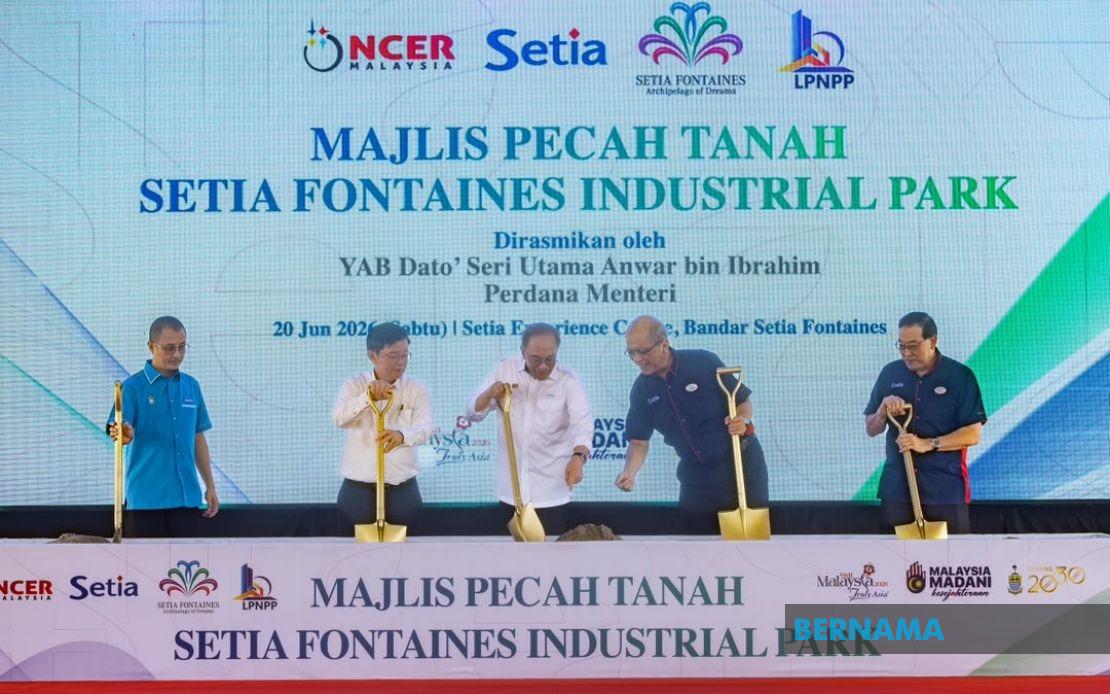
Prime Minister Datuk Seri Anwar Ibrahim has called for a fundamental shift in how Malaysia approaches major development initiatives, insisting that both government-linked investment vehicles and private enterprises must actively construct pathways for ordinary citizens to benefit from economic expansion. Speaking at the groundbreaking ceremony for the Setia Fontaines Industrial Park in Bandar Setia Fontaines, Anwar underscored that approvals granted to major institutional players such as Khazanah Nasional Berhad, Permodalan Nasional Berhad, the Employees Provident Fund, and private corporations should be conditional upon meaningful participation opportunities for those earning modest incomes.
The Prime Minister's remarks reflect deepening official concern that Malaysia's investment-led growth model risks entrenching socioeconomic stratification unless deliberately structured to distribute gains more broadly. Anwar cautioned that without deliberate intervention, the gap between different income tiers will continue to expand while prospects for poorer households become progressively more limited. This warning comes amid ongoing national conversations about whether rapid industrialisation and capital concentration are translating into genuine prosperity for working Malaysians or simply creating wealth for those already positioned to capitalise on new opportunities.
Anwar framed inclusive development as integral to social cohesion rather than merely as a charitable consideration. His emphasis suggests the government views widening inequality not merely as an economic efficiency problem but as a potential source of political instability and community fragmentation. The framing reflects international evidence that societies with pronounced income gaps experience heightened social friction and reduced trust in institutions—concerns that resonate particularly in a multi-ethnic democracy like Malaysia where economic disparities can acquire communal dimensions.
Central to Anwar's argument is his rejection of measuring economic success purely through headline growth metrics. He insisted that impressive GDP figures, foreign direct investment flows, and corporate profit announcements mean little if the benefits remain concentrated among existing elites. This perspective challenges the conventional technocratic approach to development that emphasises aggregate growth while remaining indifferent to distributional outcomes. By elevating inclusivity to a policy imperative rather than treating it as a secondary consideration, the Prime Minister is essentially redefining what constitutes successful economic governance.
The Setia Fontaines Industrial Park itself becomes a test case for this philosophy. Located in Bandar Setia Fontaines within Seberang Perai, the facility aims to balance development between the mainland and Penang Island, historically a locus of regional inequality. Anwar described the project as instrumental in ensuring Seberang Perai's economic trajectory aligns with the rapid transformation occurring on the island and in the state's southern districts. This spatial dimension reflects how uneven development can crystallise geographical divides within regions, potentially creating zones of prosperity adjacent to areas of stagnation.
Anwar identified the industrial park's potential to generate quality employment as Malaysia transitions from labour-intensive, back-end manufacturing toward sophisticated technology sectors. This sectoral shift matters profoundly for lower-income workers. Automation and technology upgrading typically displace workers in routine manufacturing while creating demand for higher-skilled personnel. Unless deliberately managed, such transitions can leave displaced workers stranded without viable pathways to comparable earnings. Anwar's emphasis on ensuring local workers access to newly created positions signals awareness that technological advancement without workforce preparation simply exports prosperity while leaving domestic communities behind.
The Prime Minister placed particular emphasis on strengthening collaboration between industry, vocational training providers, and universities—specifically mentioning Universiti Sains Malaysia—to develop locally-qualified talent pipelines. This institutional framework reflects recognition that market forces alone will not spontaneously generate the skills alignment necessary for inclusive growth. Employers seeking advanced technical workers will naturally recruit globally if domestic candidates lack requisite qualifications, hollowing out the multiplier effects that development projects should generate within local economies.
Anwar highlighted the relentless pace of technological change as a driving rationale for this collaborative approach. Technology sectors evolve dramatically within eighteen-month to two-year cycles, rendering static vocational curricula obsolete. Training institutions must maintain intimate ongoing relationships with industry to anticipate emerging skill requirements and adapt programmes accordingly. Without such integration, educational institutions risk producing graduates qualified for yesterday's requirements rather than tomorrow's opportunities—a particular risk in Malaysia given the nation's aspirations toward higher-value manufacturing and knowledge-intensive sectors.
The Prime Minister's remarks implicitly acknowledge a persistent gap between job creation and job-readiness in Malaysia. Businesses repeatedly report difficulty recruiting workers with appropriate technical competencies despite relatively high unemployment in certain demographics. This mismatch reflects inadequate alignment between educational outputs and labour market demands, particularly at middle-skill levels where vocational qualifications matter most for lower-income workers. By foregrounding this coordination challenge, Anwar signals that inclusive growth requires deliberate institutional engineering rather than passive reliance on market mechanisms.
For Malaysia and the broader Southeast Asian context, Anwar's emphasis carries particular salience. Nations across the region are pursuing manufacturing diversification and technology upgrading to escape middle-income traps. Yet without explicit attention to distributional consequences, such transitions can exacerbate inequality and trigger social turbulence. Thailand's recent youth-driven political movements, Philippine labour displacement anxieties, and Indonesia's persistent rural-urban divides all illustrate how unmanaged structural economic change can generate political instability. Anwar's insistence on inclusive development pathways may thus represent recognition that growth trajectories sustainable over decades require broad-based participation rather than concentrated benefits.
The challenge Anwar has articulated—ensuring that every approved development project simultaneously creates opportunities for middle- and lower-income communities—remains ambitious. Implementation will require sustained monitoring of development outcomes, willingness to redirect investment approvals if inclusivity metrics prove inadequate, and coordination across multiple government agencies and private actors with divergent immediate interests. Whether Malaysia's institutional architecture can reliably deliver this vision remains an open question that will substantially shape whether the nation's continued industrialisation produces widely-shared prosperity or reinforces existing hierarchies.