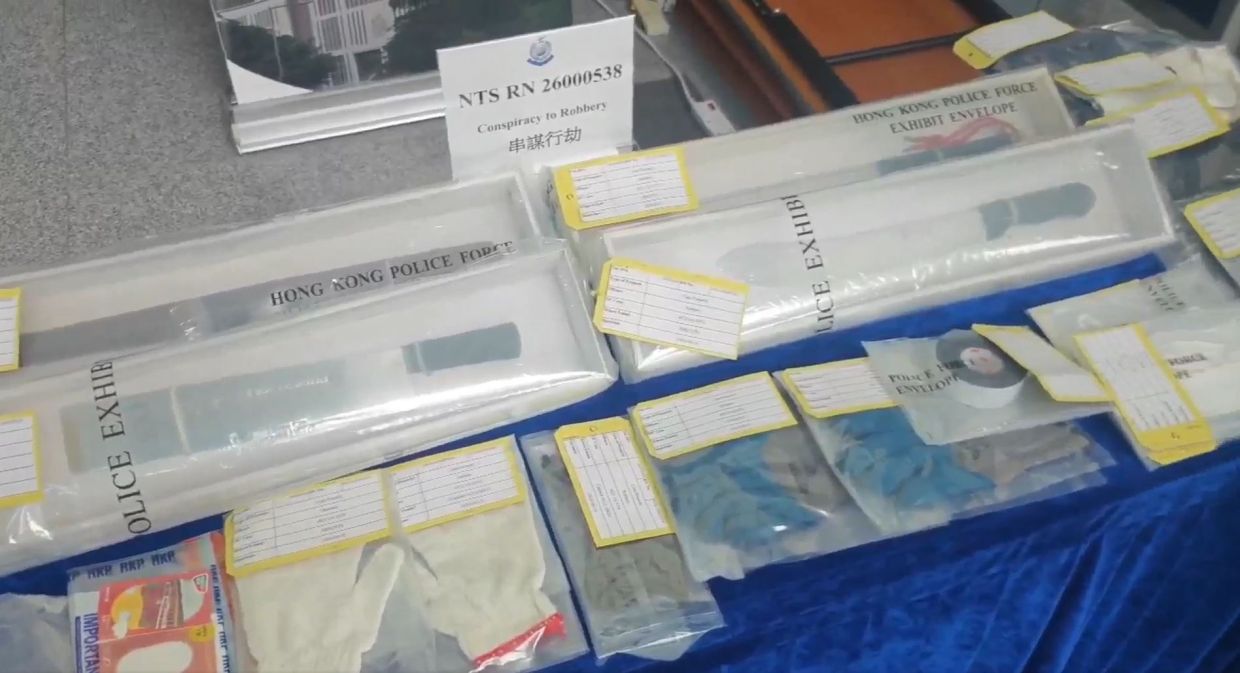
Hong Kong police have made seven arrests following a violent robbery at Hong Kong International Airport's car park, where a man transporting six gold bars valued at HK$7 million was stabbed and relieved of his cargo. The incident occurred on Thursday, June 18, and authorities moved swiftly to apprehend suspects, with the seven detainees—comprising four men and three women between 20 and 39 years old—taken into custody within 12 hours of the crime being reported on Saturday, June 20.
The arrested individuals face accusations of conspiracy to commit robbery and abetting criminal activity, though investigators believe the full network involved in orchestrating the heist extends beyond those currently in custody. Several suspects with alleged triad connections are among those arrested, signalling the potential involvement of organised crime syndicates in what appears to be a carefully coordinated operation rather than an opportunistic theft.
Authorities indicate that accomplices remain at large and have likely crossed into the Chinese mainland following the robbery. Recognising the cross-border dimensions of the case, Hong Kong police have formally requested assistance from mainland law enforcement agencies, underlining the increasingly transnational nature of serious crimes affecting the territory. This cooperation represents standard protocol for incidents involving suspected flight across the Hong Kong-mainland border.
The victim, arriving from Bali, Indonesia in the early hours of Thursday morning, was carrying the six gold bars in a backpack, having been tasked with delivering them to a mainland business contact. As he made his way through the airport car park 3 towards his parked vehicle, three assailants wearing masks intercepted him, initiating a violent assault. Armed with knives, the attackers inflicted stab wounds to the victim's left hand and foot, subduing him sufficiently to seize the backpack containing the valuable cargo before escaping in a seven-seater vehicle.
The rapid response by police yielded significant investigative progress. Within a short timeframe, detectives recovered the seven-seater vehicle used as a getaway vehicle and also retrieved the knives employed during the assault. These items were located in the Tsuen Wan district, providing crucial forensic evidence and establishing a geographic pattern that helped lead to the arrest of the initial suspects. The victim received medical treatment at Princess Margaret Hospital, where he was reported to be in stable condition following treatment for his injuries.
What distinguishes this case from random street crime is the apparent sophistication of the planning and execution. Police have indicated that the robbery exhibited characteristics inconsistent with chance opportunity, including the assailants' apparent knowledge of the victim's arrival flight and his specific parking location. This intelligence suggests the involvement of an insider—someone positioned within the airport operations, the victim's circle, or the logistics chain who could provide the criminals with detailed information necessary to intercept him at a vulnerable moment.
The targeting of someone arriving with substantial quantities of gold suggests the robbers had advance knowledge of both the cargo and its handler. Whether this inside information came from airport personnel, customs officials, airline staff, or someone closer to the victim remains under investigation. The distinction between organised crime and spontaneous theft is crucial for law enforcement strategy, as it indicates whether a broader criminal infrastructure requires dismantling or whether a smaller group can be prosecuted in isolation.
For Malaysian readers, this incident carries several implications regarding regional security concerns. As a major international hub, Hong Kong International Airport handles vast quantities of high-value goods, making it an attractive target for organised crime networks operating throughout Southeast Asia. The cross-border nature of this particular case—involving Indonesian origination, mainland Chinese recipients, and Hong Kong staging—mirrors trafficking patterns that affect Malaysian territories and airports. The involvement of individuals with triad connections emphasises how traditional organised crime syndicates continue to adapt their operations to exploit modern commercial logistics.
The incident also underscores vulnerabilities that extend beyond Hong Kong's borders. Southeast Asian airports, including those in Malaysia, share similar structural challenges: large car parks offering limited surveillance, international passengers unfamiliar with local protocols, and complex supply chains that create information asymmetries exploitable by criminals. The success with which the perpetrators identified and targeted this specific victim raises questions about the adequacy of security protocols protecting high-value shipments transiting through regional aviation hubs.
The rapid police response and recovery of evidence reflect Hong Kong's investigative capabilities, yet the successful escape of suspected accomplices to the mainland highlights limitations of cross-border enforcement. For Malaysia and other regional jurisdictions, the case illustrates the necessity of strengthening information-sharing mechanisms and coordinating with counterparts across national boundaries. Criminal networks operating in this region leverage the fragmented nature of enforcement jurisdictions, using border crossings as escape routes and protection mechanisms.
The involvement of triads in this robbery typifies how traditional organised crime structures continue to mobilise capital and personnel for lucrative criminal enterprises. These syndicates maintain networks spanning multiple jurisdictions and can mobilise substantial violence to accomplish their objectives. Their participation in gold theft suggests sophisticated money laundering capabilities to convert stolen bullion into usable currency, raising concerns about how stolen precious metals circulate through regional informal financial systems.
As investigations continue and authorities seek to apprehend remaining suspects, the case serves as a reminder of how major transportation hubs remain vulnerable to coordinated criminal action. The intersection of international travel, high-value cargo, and organised crime presents ongoing challenges for security professionals throughout Southeast Asia. The Hong Kong police's continued efforts to work with mainland counterparts may eventually yield additional arrests, potentially exposing the full scope of the criminal network involved in this sophisticated operation.