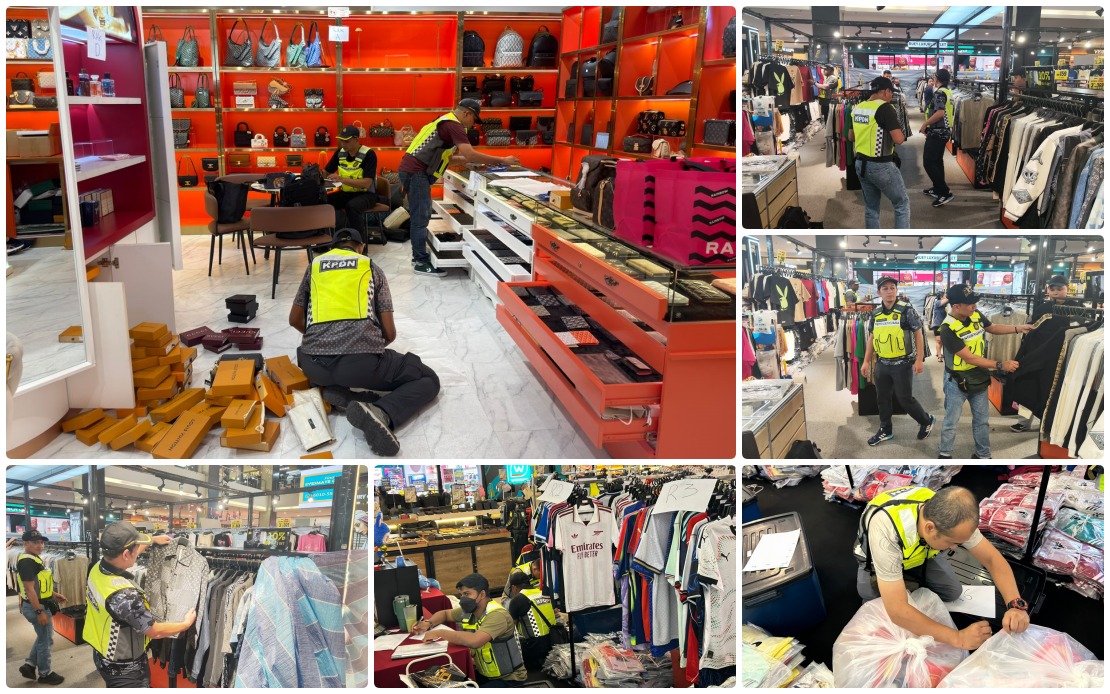
The Ministry of Domestic Trade and Cost of Living (KPDN) has intensified its crackdown on intellectual property violations by dismantling a suspected counterfeit operation spanning three locations in Johor Bahru. The June 15 raids yielded seized merchandise valued at RM600,000, representing a significant blow to an enterprise that appeared to operate with considerable scale and distribution reach across the state.
Datuk Azman Adam, the enforcement director-general of KPDN, revealed that the operation culminated a month-long intelligence-gathering phase. Investigators had been monitoring commercial activity at major supermarket outlets before identifying the suspects as likely suppliers to a broader network of retailers. This methodical approach suggests an organized distribution chain rather than isolated street-level hawking, indicating that counterfeiters have developed sophisticated channels to penetrate legitimate retail environments.
The confiscated inventory paints a picture of a comprehensive counterfeit enterprise. Authorities recovered clothing items, handbags, wallets, belts, and perfumes bearing unauthorised applications of well-known brand trademarks. The breadth of product categories suggests the operation catered to diverse consumer preferences while leveraging the equity of established global labels to deceive buyers. Accompanying business documentation recovered during the raids may prove instrumental in tracing supplier networks and identifying downstream recipients of the contraband merchandise.
Initial verification procedures, conducted with representatives from the trademark owners who filed complaints, established sufficient grounds to suspect violations of Section 102(1)(c) of the Trademark Act 2019. This provision specifically criminalises possessing counterfeit goods with intent to sell, placing culpability squarely on traders rather than innocent consumers. The legal framework distinguishes between individual liability and corporate responsibility, acknowledging that coordinated business operations typically involve multiple levels of decision-making.
Four individuals have been detained in connection with the enterprise, including the primary business owner and a caretaker responsible for premises management. Their roles suggest a hierarchical structure, with the owner likely directing strategic decisions while support staff managed day-to-day operations. The detention phase represents a critical investigation juncture during which authorities can interrogate suspects about supplier relationships, customer identities, and financial transactions that may illuminate the operation's full scope.
The Trademark Act 2019 prescribes progressively severe penalties calibrated to deter both first-time and repeat offenders. Individual perpetrators face maximum fines of RM10,000 per counterfeit item alongside potential imprisonment up to three years for initial convictions. Recidivism triggers substantially harsher sanctions: fines escalate to RM20,000 per item with imprisonment stretching to five years. Corporate entities confront even steeper financial consequences, facing RM15,000 per item initially and RM30,000 per item for subsequent violations, effectively making organised counterfeiting extraordinarily expensive regardless of conviction frequency.
These penalty structures reflect legislative intent to price counterfeiting out of viability as a commercial enterprise. With a RM600,000 seizure spanning numerous items, potential accumulated fines could reach into millions of ringgit if authorities successfully prosecute across the entire merchandise inventory. Such exposure should dissuade rational actors from venturing into intellectual property crime, though organised syndicates may view penalties as operating costs absorbed into profit margins.
Counterfeiting operations impose measurable economic damage beyond direct sales losses incurred by brand owners. Malaysian consumers purchasing counterfeit goods receive substandard products while believing themselves to hold authentic merchandise, eroding market trust and degrading purchasing decisions. Moreover, counterfeit trade generates unreported income outside the formal tax system, depriving government revenue while undercutting legitimate retailers who cannot compete with unethical pricing reflecting zero intellectual property compliance costs.
The supermarket insertion point identified by investigators reveals how counterfeit goods penetrate consumer consciousness through seemingly legitimate channels. Shoppers browsing supermarket shelves harbour reasonable confidence that merchandise meets regulatory and authenticity standards, yet organised counterfeiters exploit this assumption by placing fake products alongside genuine items. This channel represents a particularly insidious attack vector because it compromises consumer confidence in established retail venues rather than restricting counterfeits to street markets where vigilance levels remain higher.
KPDN's commitment to intensifying enforcement operations addresses a growing challenge in Southeast Asia where counterfeit trade flourishes amid porous supply chains and sophisticated distribution networks. Malaysia's strategic location as a regional commercial hub makes it simultaneously vulnerable to counterfeiting activities and positioned to protect legitimate trade flows. Aggressive enforcement at critical junctures like Johor Bahru serves as deterrent messaging to would-be counterfeiters while reassuring brand proprietors and legitimate traders of government commitment to intellectual property protection.
The Johor operation's success hinges partly on intelligence partnerships between brand representatives and government agencies. Companies invested in protecting trademark integrity provide crucial investigative groundwork, from monitoring retail channels to identifying suspected forgeries through subtle defects visible only to trained examiners. KPDN's willingness to mobilise resources based on private sector intelligence demonstrates institutional recognition that counterfeiting cannot be effectively combated through government action alone.
Looking forward, this enforcement action may trigger broader supply chain investigations if seized documentation yields actionable intelligence about upstream manufacturers and downstream distribution networks. Regional coordination through ASEAN mechanisms could amplify impact by disrupting cross-border counterfeit flows that currently exploit jurisdictional boundaries. As counterfeiters adopt increasingly sophisticated techniques to evade detection, Malaysian authorities must maintain corresponding vigilance and technological sophistication to protect consumers and legitimate commerce.

%22%2F%3E%3C%2Fpattern%3E%3C%2Fdefs%3E%3Crect%20width%3D%22100%25%22%20height%3D%22100%25%22%20fill%3D%22url(%23ph2hy9vg)%22%2F%3E%3Crect%20width%3D%22100%25%22%20height%3D%22100%25%22%20fill%3D%22url(%23ph2hy9vp)%22%2F%3E%3Ctext%20x%3D%2250%25%22%20y%3D%2250%25%22%20text-anchor%3D%22middle%22%20dominant-baseline%3D%22central%22%20fill%3D%22rgba(255%2C255%2C255%2C0.95)%22%20font-family%3D%22Georgia%2C%20'Times%20New%20Roman'%2C%20serif%22%20font-weight%3D%22700%22%20font-size%3D%22272%22%20letter-spacing%3D%22-0.02em%22%3EAnwar%3C%2Ftext%3E%3C%2Fsvg%3E)