The Philippine Department of Justice has launched a comprehensive investigation into possible criminal charges against public officials in connection with a shooting incident at the Senate building on May 13 and the subsequent escape of Senator Ronald dela Rosa from protective custody during the early morning hours of May 14. Justice Secretary Fredderick Vida confirmed that a dedicated panel of prosecutors is actively examining the circumstances surrounding both events to establish whether there is an underlying connection between them.
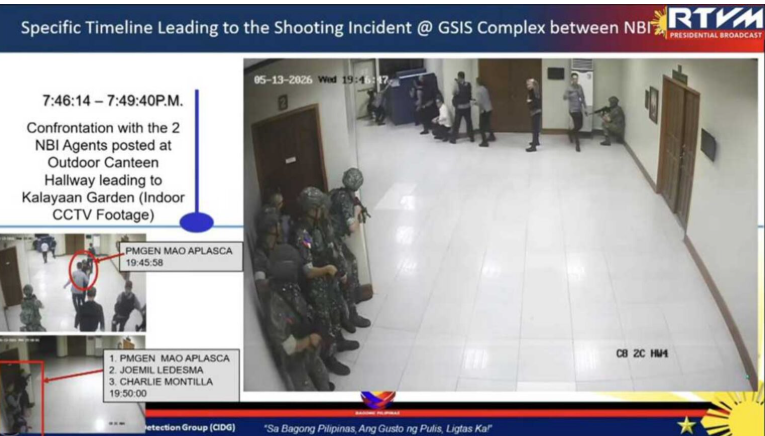
According to Vida's account of the preliminary investigation, prosecutors have gathered evidence from multiple sources including statements from personnel within the National Bureau of Investigation, interviews with media practitioners who were present, and analysis of closed-circuit television footage from the scene. This documentation has revealed that shots fired from a sniper position on the fifth floor of the Senate building were directed toward a vehicle belonging to the NBI that was stationed at the Government Service Insurance System premises at the time of the incident.
The coordinated timing of these two separate but potentially related events has raised significant concerns among investigators and the public about the nature of the incident and the involvement of persons in positions of authority. The fact that a senior law enforcement vehicle was apparently targeted during what appeared to be a carefully executed operation suggests a level of planning and coordination that goes beyond spontaneous criminal activity. Authorities are examining whether internal security protocols were compromised or whether individuals with access to sensitive information about protective arrangements may have been involved.
When pressed about whether individual suspects have already been identified, Vida declined to name specific persons but indicated that preliminary findings point toward involvement by individuals holding public office or government positions. This admission is noteworthy, as it suggests that the investigation has already moved beyond examining random assailants toward focusing on those with institutional access and authority. The involvement of public officials in such an incident would represent a serious breach of public trust and institutional integrity.
Vida emphasized that despite the active nature of the investigation, the Department of Justice remains in the early stages of formally charging any individuals. The prosecutor's office is taking a methodical approach to ensure that all evidence is properly documented and that any charges brought will withstand judicial scrutiny. This cautious posture reflects the sensitivity of investigating allegations that may implicate government personnel and the need to maintain credibility in what is already a high-profile case.
The Justice Secretary reiterated his commitment to conducting the inquiry with professionalism and objectivity, pledging that the investigation would proceed without fear or favor regardless of the political status or official positions of those who may be implicated. He stressed that the pursuit of justice must remain insulated from political pressure or considerations, particularly given the prominence of the individuals potentially involved and their connections to various power centers within the government and military establishment.
A critical principle that Vida articulated during his statement reflects the tension inherent in such investigations involving powerful figures. He acknowledged that while no individual should be exempt from legal accountability simply because of their position, equally important is the principle that persons should not be condemned in the court of public opinion or subjected to judicial proceedings before evidence has been thoroughly examined and properly evaluated. This balance is particularly delicate in Philippine political culture, where high-profile investigations can quickly become entangled with partisan considerations and public sentiment.
The May 13 Senate shooting and the May 14 escape of dela Rosa have generated intense speculation about motivations and potential conspirators. For Malaysian and Southeast Asian observers, the incident underscores vulnerabilities within high-security government facilities and raises questions about the effectiveness of protective custody arrangements for high-ranking officials. The case also highlights how incidents in one country's governance structure can expose broader institutional weaknesses that might have parallels elsewhere in the region.
The investigation's focus on establishing a connection between the shooting and the escape suggests that authorities are exploring whether these were coordinated events designed to achieve a specific objective. If such coordination is established, it would indicate a degree of sophistication and planning that distinguishes this from ordinary criminal incidents and points toward possible conspiratorial elements involving multiple actors with different roles in executing the overall operation.
For the Philippine political establishment and civil society, the investigation carries significant implications. The credibility of law enforcement and prosecutorial institutions depends on their ability to handle such cases fairly and transparently, even when doing so requires examining the conduct of powerful government officials. The Department of Justice's commitment to objectivity will be tested as the investigation progresses and as evidence potentially implicating specific individuals becomes clearer.
The case also raises broader questions about institutional safeguards and accountability mechanisms within Philippine government. The apparent targeting of an NBI vehicle and the circumstances surrounding a senator's escape from protective custody suggest that security protocols may require review and that gaps in oversight of sensitive government operations may need to be addressed. These are lessons with relevance across Southeast Asia, where similar institutions face comparable challenges in maintaining security and integrity.
As the investigation continues, the Philippine public and international observers will be watching to see whether the Department of Justice maintains its stated commitment to pursuing the matter objectively and whether evidence eventually presented to courts will withstand scrutiny. The outcome of this inquiry will have implications beyond the immediate case, potentially affecting public confidence in institutional capacity to hold powerful officials accountable and to maintain the rule of law even when doing so proves politically difficult.

%22%2F%3E%3C%2Fpattern%3E%3C%2Fdefs%3E%3Crect%20width%3D%22100%25%22%20height%3D%22100%25%22%20fill%3D%22url(%23ph2hy9vg)%22%2F%3E%3Crect%20width%3D%22100%25%22%20height%3D%22100%25%22%20fill%3D%22url(%23ph2hy9vp)%22%2F%3E%3Ctext%20x%3D%2250%25%22%20y%3D%2250%25%22%20text-anchor%3D%22middle%22%20dominant-baseline%3D%22central%22%20fill%3D%22rgba(255%2C255%2C255%2C0.95)%22%20font-family%3D%22Georgia%2C%20'Times%20New%20Roman'%2C%20serif%22%20font-weight%3D%22700%22%20font-size%3D%22272%22%20letter-spacing%3D%22-0.02em%22%3EAnwar%3C%2Ftext%3E%3C%2Fsvg%3E)